PixivSource: reading Pixiv novels through Legado book sources
最好的 Pixiv 第三方小说阅读器——开源阅读 + Pixiv 书源 / Legado with Pixiv BookSource, the Best Third-Party Novel Reader for Pixiv
At a glance
- What is it?
- PixivSource is not a reader app but a set of Legado book sources and subscription sources that turn Pixiv, Linpx and furry novel sites into a shelf based reader. It ships rule files, import links and a debug workflow, and it leaves the heavy lifting to the Legado fork.
- Who is it for?
- Adopt PixivSource if you already run a Legado based reader on Android and want Pixiv series, illustrations and offline caching in the same shelf as your other books. Skip it if you need a standalone app, a guaranteed direct connection to Pixiv, or a clearly stated licence.
- Can I use it commercially?
- Not without permission. GitHub finds no licence file in the repository, and without a licence all rights are reserved by default: you may read the code but not reuse it. Check the README, or ask the authors, before using it.
- Is it still maintained?
- Yes. The repository last received commits 5 days ago.
- What is it written in?
- Mainly JavaScript, according to GitHub's language statistics.
Answers come from the project's GitHub data, last synced on November 7, 2026, and from our analysis. They are not legal advice.
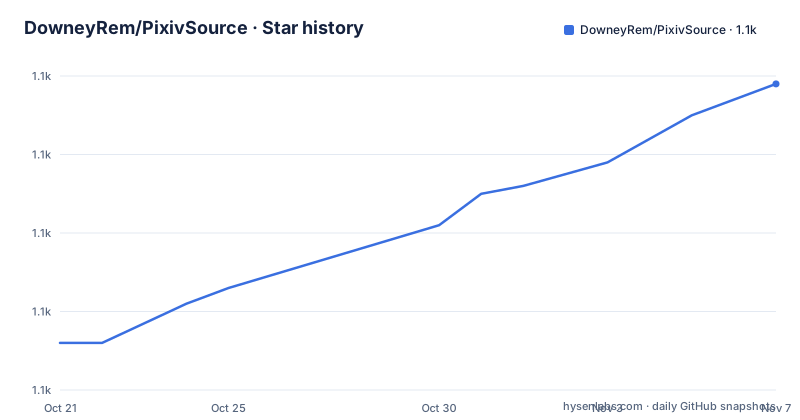
Star history
- DowneyRem/PixivSource1,119 ★ · +33
| Repository | 2026-10-21 | 2026-11-07 |
|---|---|---|
| DowneyRem/PixivSource | 1.1k | 1.1k |
33 Stars in the last 17 days, measured from the daily GitHub snapshot. Compare with other projects
Editorial analysis
PixivSource is a rule set, not a reader you install
The first thing to get straight is what this repository actually is. There is no APK here, no application module and no UI. The top level holds JSON files (books.json, btsrk.json, import.json, linpx.json, normal.json, pixiv.json, pixivToc.json), a scripts folder, a doc folder and a src folder holding JavaScript book sources. package.json describes the package as the Pixiv book source for Legado, and the scripts it declares build those sources rather than an application.
So the reader you actually use is a Legado based Android app, described in the project page as the open source reading browser that Legado is. PixivSource supplies the rules that make that browser understand a specific site: how to request a search, how to pull a chapter list out of a series page, how to strip a novel page down to readable text. The project page frames this as reading Pixiv content inside a general purpose reader, and the comparison table on that page lists features the official Pixiv application does not expose for free, such as a novel shelf, offline reading, reading history, author and tag blocking, and hidden like and follow notifications.
That positioning is the whole pitch. You are not replacing the Pixiv application. You are giving a generic reader a set of instructions about one site, then reusing the generic reader for everything else you read.
Three site rules, one JSON and one JS format
The feature table in the README breaks the project down by target site, and each row tells you three things: whether the source is available, whether it supports a direct connection, and which Pixiv specific behaviours it reproduces. The Pixiv row covers single works, series and illustrations, and lists search, discovery and adding by URL as implemented reading functions. The Linpx row and the furry novel row carry the same three reading functions and the same support for single works, series and illustrations.
The interesting column is the direct connection one. Linpx and the furry novel source are marked as supporting it. The Pixiv source is marked as not supporting it, while the documentation never explains what that means in practice, whether it is a proxy dependency, a header requirement or a transient network state. The project also ships a JS flavour of the sources, and the README points at the src/bookSourceJS directory for details, which means the JavaScript variant exists because the JSON format alone could not express the Pixiv specific behaviour.
The division of labour is consistent: the JSON files are the standard Legado rule format, the JS files add logic, and the subscription sources pull in outside material. The general book source, the aggregated search source, the book source subscription and the Pixiv table of contents rules are all separate JSON files, each credited to an outside author. Nothing in the repository merges them into one bundle for you.
Importing sources: one click links that point at raw files on main
Installation is a URL import rather than a package install. The quick start path in the README is download the reader, import the book sources, log in to your account, adjust reading settings, then read. The import table offers two one click routes for every file, one served through jsDelivr and one straight from raw.githubusercontent.com, both addressing the main branch.
For example, the Pixiv book source resolves to either of these:
https://cdn.jsdelivr.net/gh/DowneyRem/PixivSource@main/pixiv.json
https://raw.githubusercontent.com/DowneyRem/PixivSource/main/pixiv.json
The same pattern applies to linpx.json, btsrk.json and the JS source at src/bookSourceJS/linpx.js. The import page on the project site wraps the address in an Import link, so the practical step is to open that link from the reader and let it fetch the rules. Because the URLs point at a moving branch, the content you import can change without a version bump, which is convenient for a rule set and unsettling if you need a known good configuration. The README does not document a pinning or rollback procedure.
For people who want to rebuild the files rather than import them, the build entry points are in package.json:
    "build": "tsx scripts/BuildBookSource.ts",
    "build:dev": "tsx scripts/BuildBookSource.ts --dev",
    "build:release": "tsx scripts/BuildBookSource.ts --release",
    "build:bookSource": "tsx scripts/BuildBookSource.ts",
    "build:rssSource": "tsx scripts/BuildRssSource.ts",
The package is ESM and declares [email protected] as its package manager, with tsx, vitepress and vue among the dependencies, so the tooling is a documentation and rule build pipeline rather than a published library.
Debugging a broken source from inside the reader
The project treats broken rules as a first class problem. The debugging page gives you a path inside the reader, from My, to book source management, to editing a source, to the debug tab, where you paste input. The debug areas and their sample inputs are specific:
::https://www.pixiv.net/ajax/top/novel
https://www.pixiv.net/novel/show.php?id=123
++https://www.pixiv.net/novel/show.php?id=123
--https://www.pixiv.net/novel/show.php?id=123
The four lines map to the discovery, detail, catalog and body areas respectively, and the two character prefixes tell the debug tool which stage to run. The search area instead expects the keyword you want to search for. The advice attached to this workflow is practical: when you report a novel related bug, attach the debug information with it.
That last point explains a lot about how the project is maintained. Rules for a living site break when the site changes its markup, so the only useful bug report is one that shows the failing stage and the response. It also means the quality bar is set by the upstream site, not by the maintainer of the rules.
The subscription sources pull in other people's rules
Three subscription sources widen the scope beyond this project's own files. The btsrk subscription is described as a fast route into novel websites, and its entries include the Pixiv novel section, Linpx, a furry novel site, the project site itself, the one click import page, and a handful of furry game indexes and event calendars. The books subscription collects the import page, a book source repository, the Yiove book source repository, a source management page, aggregated search and a Legado usage guide.
The import subscription is the one that matters most for scope creep, because it is a curated list of external rule sets: a general book source for web novel sites that pulls from search engines, an aggregated search source that depends on that general book source, a third party book source subscription, and Pixiv table of contents rules for local Pixiv novels.
Only the last of those four is described as authored for Pixiv, and even that one is credited to an outside author. A reader who imports everything ends up with a bookshelf of someone else's scraping rules, whose breakage and behaviour you now own without knowing who to contact.
What the Pixiv source does not give you
Several limits are visible in the documentation rather than hidden. There is no direct connection support for the Pixiv source, and the reason is not stated, so a rule failure there can be caused by anything from the upstream site to the reader's own network path. There is no offline reading guarantee for content the rules cannot fetch in the first place.
Account state is part of the deal. The quick start includes a login step, which means the reading experience depends on a Pixiv session that can expire, get challenged or be rate limited. The project does not document how it handles a failed login, and it does not describe any behaviour for accounts without reading access to a particular work.
On the legal side, the licence field in the repository metadata is unknown and no licence file appears among the top level entries, while the README carries a copyright section whose final line is cut off. The section states that a book source is a set of methods for requesting and processing data from a site, and that reading a novel in Legado is equivalent to visiting the relevant web page to read it. That framing matters for anyone deploying this inside a company, since the repository states no grant of use rights at all.
Maintenance looks healthy on paper. The repository is not archived, the last push was on 2026-10-12, and the three most recent releases are 285 on 2026-10-12, 284 on 2026-09-18 and 283 on 2026-08-03. Release numbering is sequential, so upgrades are cheap to track, but nothing in the documentation describes a version pinning strategy for readers.
The Pixiv application is the alternative, and it differs feature by feature
The comparison table in the README sets the project against the official Pixiv application, and the differences are specific rather than marketing language. The Pixiv application has no novel shelf, no offline reading and no cross script conversion; the book source has all three. Reading progress in the application is limited to series, while the book source tracks progress for single works and series alike. Reading history and an ad free interface are paid features in the application and are listed as supported in the book source.
The filtering side is the other half of the difference. Blocking an author and blocking a tag are paid features in the application and free in the book source, and the book source adds two capabilities the application does not list at all, blocking by description and hiding like and follow notifications for individual novels.
This comparison is about the rule set inside a third party reader, not about the reader itself. The book source adds shelf, cache and filtering features to Legado, while the application keeps everything inside its own ecosystem and its own account rules. If you want a single application with no rule files to maintain, the official application is the path with fewer moving parts and fewer upstream breakages.
Editorial conclusion
Adopt PixivSource if you already run a Legado based reader on Android and want Pixiv series, illustrations and offline caching in the same shelf as your other books. Skip it if you need a standalone app, a guaranteed direct connection to Pixiv, or a clearly stated licence. Verify first that the import link resolves to the current main branch JSON, that the Pixiv source still completes a login on your account, and that the direct connection column in the feature table has not changed.
Frequently asked questions
What is PixivSource and does it include a reader app?
It is a collection of Legado book sources and subscription sources, not an application. The repository holds JSON rule files such as pixiv.json and linpx.json plus JavaScript sources under src/bookSourceJS, and the reader itself is a Legado based app you install separately.
How do I import the Pixiv book source into my Legado reader?
Use the one click import links on the project site, which point either at jsDelivr or at raw.githubusercontent.com for the file on the main branch. The Pixiv source address is https://raw.githubusercontent.com/DowneyRem/PixivSource/main/pixiv.json, and linpx.json, btsrk.json and the JS source follow the same pattern.
Does the Pixiv source connect directly to Pixiv?
The feature table marks direct connection as unavailable for the Pixiv source while listing it as supported for the Linpx and furry novel sources. The documentation does not explain the reason, and it does not describe a fallback when a direct fetch fails.
How do I work out why a book source stopped working?
Open the debug area inside the reader through My, book source management, editing a source and the debug tab, then paste the sample input for the stage you are testing. The samples use a discovery URL for discovery and prefixed novel URLs for detail, catalog and body, and attaching that debug information is what the project asks for in bug reports.
What licence is PixivSource released under?
The licence field in the repository metadata is unknown and no licence file appears in the top level entries, so there is no stated grant of use rights. The copyright section in the README argues that using Legado to read a novel is equivalent to visiting the relevant web page, and its final line is cut off.
How current is the project?
The repository is not archived and the last push was on 2026-10-12, with releases 285 on 2026-10-12, 284 on 2026-09-18 and 283 on 2026-08-03. The import URLs address the main branch rather than a tag, so the rules you fetch can change between releases.
Official sources
Add this badge to your README
If you maintain this project, the badge below links readers to this analysis and shows its maintenance status from the daily GitHub snapshot. Paste the markdown into your README; add ?metric=license or ?metric=stars to the image URL for a different field.

[](https://hysenlabs.com/projects/downeyrem-pixivsource)Star history chart for your README
[](https://hysenlabs.com/projects/downeyrem-pixivsource)Was this useful?