Telegram-Bot: A Single-Tap Polymarket Whale Trader With Custodial Keys
Polymarket whale trades in real time
At a glance
- What is it?
- This project wraps Polymarket trading into a Telegram bot, alerting on large trades and signing bets in one tap. The catch is that your keys live on a server behind a PIN, which changes the risk profile entirely.
- Who is it for?
- Adopt this bot if you are an active Polymarket trader who values speed over self-custody and wants alerts and execution inside Telegram. Do not use it if you require non-custodial key control, because the README states that private keys and seed phrases are encrypted on the server and locked behind a PIN, meaning you never hold them.
- Can I use it commercially?
- Yes. MIT is a permissive licence: you can use, modify and sell software built on it, as long as you keep its copyright and licence notices.
- Is it still maintained?
- Yes. The repository last received commits 37 days ago.
- What is it written in?
- Mainly JavaScript, according to GitHub's language statistics.
Answers come from the project's GitHub data, last synced on October 4, 2026, and from our analysis. They are not legal advice.
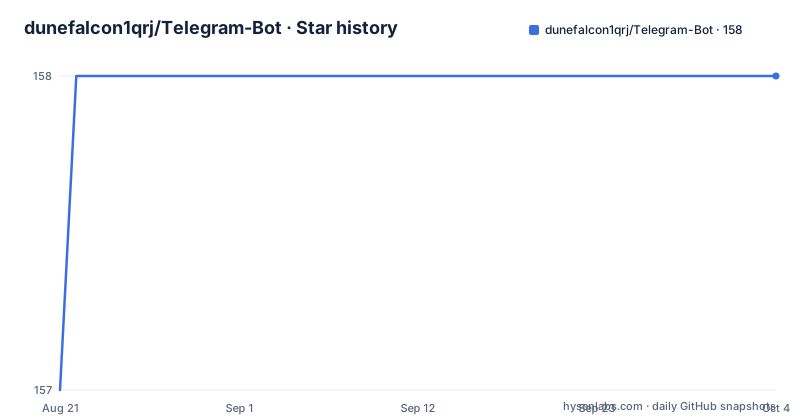
Star history
- dunefalcon1qrj/Telegram-Bot158 ★ · +1
| Repository | 2026-08-21 | 2026-10-04 |
|---|---|---|
| dunefalcon1qrj/Telegram-Bot | 157 | 158 |
1 Stars in the last 44 days, measured from the daily GitHub snapshot. Compare with other projects
Editorial analysis
What This Bot Actually Solves
The problem is timing. On Polymarket, spotting a large trader and following them usually means watching the market, then clicking through a confirmation popup that can lag or fail to appear. This bot removes that friction by putting the bet button inside the alert itself. The README claims the trade signs in a single tap, with no confirmation form to wait on. That is the core value proposition: speed of execution. The intended user is a Polymarket enthusiast who wants to react to whale moves within seconds and is comfortable doing so from a Telegram chat. It is not a tool for passive investors; it is built for active traders who monitor the market and want to act immediately.
The Mechanism: WebSocket Feeds and Server-Side Signing
The bot subscribes to Polymarket's live WebSocket feeds, specifically the `activity` and `orders_matched` streams, plus live prices and sports scores. Every trade is checked against each active user's filters, which include a minimum dollar amount and a probability range. If a trade matches, the user gets an alert with a bet button. For copy trading, the bot mirrors a followed trader's positions automatically, using a set budget, fixed amount, or multiplier. The critical architectural detail is that the wallet lives inside the bot. That means signing happens server-side, not in your browser or local wallet. The README is explicit: the wallet in the bot is your real Polymarket account, so deposits and withdrawals work through either the Polymarket website or the bot. Balance activation and signing go through the official Polymarket API, without extra proxy steps. This design is what enables the one-tap execution, but it also means the server holds your keys.
Getting It Running: Commands and Config
The repository does not provide a full setup guide in the README, but the tech stack is listed: Node.js with `node-telegram-bot-api` using polling, the Polymarket Gamma API, Data API, and CLOB, plus WebSocket feeds and Express for a landing page. There is a demo file at `demo/live-feed-example.js` that shows a standalone WebSocket connection to the live trade feed, including a zombie-connection heartbeat to keep it alive. The README notes this demo is not the actual bot and contains no business logic, filters, or Telegram integration. To run the bot yourself, you would need to install Node.js dependencies, set up a Telegram bot token, and configure Polymarket API credentials. The README does not give exact environment variables or launch commands, so expect to reverse-engineer the configuration from the source code. The public bot is free to use until 10.10.2026, according to the README, which suggests the operator plans to monetize or change terms after that date.
The Custodial Trade-Off: Keys Behind a PIN
The most significant design choice is that every private key and seed phrase is encrypted and stored on the server, tied to your account. Access is locked behind a personal PIN you set. The README says without the PIN, no one can see them. That is a custodial model. You are trusting the bot operator to keep the server secure and to not have a backdoor. The encryption is mentioned, but there is no detail on how the encryption keys are derived or stored. If the server is compromised, an attacker could potentially brute-force or extract the encrypted keys. If the operator goes rogue, they could reset the PIN or access the keys. This is a fundamental difference from using Polymarket directly with a browser wallet, where you control the private keys. The README's claim of 'instant, glitch-free signing' is only possible because the bot holds the keys. For users who value self-custody, this is a dealbreaker. The PIN is a convenience lock, not a security guarantee.
Limitations and Failure Modes
The bot depends on Polymarket's WebSocket feeds staying connected and the server staying online. The README mentions a heartbeat for the demo connection, but the actual bot's resilience is unproven. If the WebSocket drops and the heartbeat fails, alerts could be missed. Copy trading is another risk: the bot automatically opens positions mirroring a trader, and if the trader's strategy is bad, you lose money. There is no mention of stop-losses or position limits beyond the budget settings. The README also notes that the bot is not affiliated with Polymarket, so if Polymarket changes its API or terms, the bot could break. The project has no release history and no archived status, but the last push is unknown, which raises questions about maintenance. The public channel posts trades of $100k or more, but that threshold is fixed; there is no way to filter the public channel. For users who want to follow smaller whales, the personal alerts are the only way, and those require using the bot.
Alternatives: Non-Custodial and Manual Approaches
The obvious alternative is to use Polymarket's own website or app, which keeps your keys in your own wallet. That approach has the confirmation popup problem the README describes, but it gives you full control. Another alternative is to use a separate Telegram bot that only sends alerts, without execution. That would let you see whale trades and then manually place the trade on Polymarket, accepting the delay. There are also third-party analytics platforms that track whale movements, but they typically do not offer one-tap execution. The difference is that this bot combines alerting and execution in one place, which is convenient but requires handing over your keys. If you want to avoid custodial risk, you could run your own copy-trading bot that uses a non-custodial wallet, but that requires more technical effort. The README's demo file shows the WebSocket connection technique, so a developer could build a non-custodial version, but that is not provided.
Maintenance and License Implications
The project is licensed under MIT, which means you can fork, modify, and redistribute it, even for commercial use, as long as you include the original copyright notice. That is permissive. However, the maintenance situation is unclear. There are no recent releases listed, and the last push is unknown. The README says the bot is free until 10.10.2026, which implies the operator may change the terms, possibly by charging fees or shutting down. If you rely on the public bot, you are at the mercy of that timeline. If you self-host, you take on the maintenance burden, including keeping up with Polymarket API changes and Telegram API updates. The demo file suggests the author is willing to share the connection technique, but the full bot's code is not described in detail. You would need to inspect the repository to understand the full architecture. The MIT license is a plus, but the lack of release history is a warning sign for long-term reliability.
Editorial conclusion
Adopt this bot if you are an active Polymarket trader who values speed over self-custody and wants alerts and execution inside Telegram. Do not use it if you require non-custodial key control, because the README states that private keys and seed phrases are encrypted on the server and locked behind a PIN, meaning you never hold them. Before using, verify how the encryption keys are managed, whether the PIN can be reset by the operator, and test the withdrawal flow with a small amount. The project is a single-enthusiast effort with no release history, so treat it as experimental and limit funds to what you can afford to lose.
Frequently asked questions
What does the dunefalcon1qrj Telegram-Bot repository contain?
Three entries at the top level: LICENSE, README.md, and live-feed-example.js. There is no package.json and no source directory, and the README states that the script is a demo of the WebSocket connection technique, not the bot, with no business logic, filters or Telegram integration.
How does the Telegram-Bot decide which Polymarket trades to alert me about?
You set a minimum amount in dollars and a probability range as a percentage, with Start and Stop on one button. Each trade from the live WebSocket feeds is checked against the filters of every active user, and matching users get an alert with the bet button attached.
Where are my wallet keys stored when I use this Telegram bot?
Every private key and seed phrase is automatically encrypted and stored on the server tied to your account, and access is locked behind a personal PIN code that you set. The wallet inside the bot is your real Polymarket account, so deposits and withdrawals draw on the same balance.
What is copy trading in the Telegram-Bot?
You follow a specific trader and the bot mirrors their trades using a set budget, a fixed amount, or a multiplier. When copy trading is enabled the bot opens the position automatically, which is the only described action that does not wait for a tap.
Is the dunefalcon1qrj Telegram bot affiliated with Polymarket?
No. The disclaimer states it is an independent enthusiast project not affiliated with Polymarket, and that trading on prediction markets carries a risk of loss. The bot is presented as free until 10.10.2026, with no pricing given for after that date.
Official sources
Add this badge to your README
If you maintain this project, the badge below links readers to this analysis and shows its maintenance status from the daily GitHub snapshot. Paste the markdown into your README; add ?metric=license or ?metric=stars to the image URL for a different field.

[](https://hysenlabs.com/projects/dunefalcon1qrj-telegram-bot)Star history chart for your README
[](https://hysenlabs.com/projects/dunefalcon1qrj-telegram-bot)