Evalle/DCA Docker Certified Associate Exam Preparation Guide
Docker Certified Associate Exam Preparation Guide
At a glance
- What is it?
- Evalle/DCA is a documentation repository for candidates preparing for the Docker Certified Associate exam. It organizes official and supplementary links across six weighted exam domains, but it is a study index rather than a complete practice system or standalone lab environment.
- Who is it for?
- Candidates who already have Docker experience and want a map of the Docker Certified Associate syllabus may find Evalle/DCA useful, while applicants seeking guided labs, answer explanations, or a complete course should use additional resources. Before adopting it as the primary study plan, verify that the linked exam page, study guide version, product names, domain weights, and certification requirements still match the current Docker Certified Associate program.
- Can I use it commercially?
- Yes. Apache-2.0 is a permissive licence: you can use, modify and sell software built on it, as long as you keep its copyright and licence notices.
- Is it still maintained?
- Yes. The repository last received commits 180 days ago.
- What is it written in?
- GitHub does not report a main language for this repository.
Answers come from the project's GitHub data, last synced on October 23, 2026, and from our analysis. They are not legal advice.
Star history
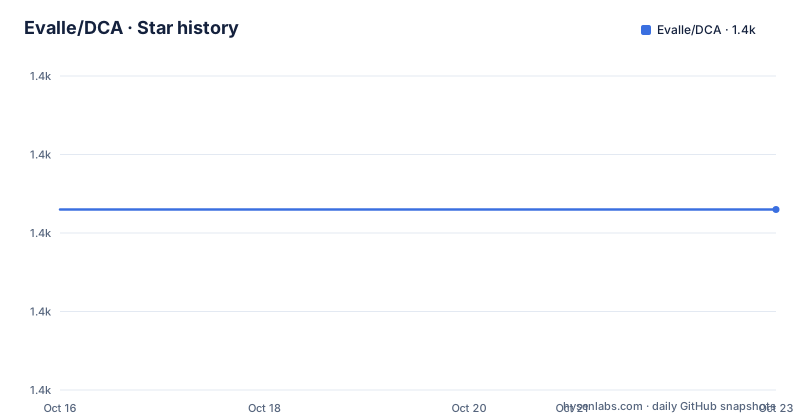
- Evalle/DCA1,413 ★ · +0
| Repository | 2026-10-16 | 2026-10-23 |
|---|---|---|
| Evalle/DCA | 1.4k | 1.4k |
0 Stars in the last 7 days, measured from the daily GitHub snapshot. Compare with other projects
Editorial analysis
What Evalle/DCA Covers and Who It Targets
Evalle/DCA is a guide for people preparing for the Docker Certified Associate Exam. The README describes its purpose as providing a point of knowledge for everyone who wants to pass the exam, with links to topics in each domain and a preference for official documentation. The intended audience includes candidates who have some practical Docker experience, because the README says the exam is designed for professionals with at least six to twelve months of Docker experience.
The guide is organized into six domains with explicit weights. Orchestration accounts for 25 percent of the exam, image creation, management, and registry account for 20 percent, while installation and configuration, networking, and security each account for 15 percent. Storage and volumes account for the remaining 10 percent. This weighting makes the repository useful as a syllabus map. A candidate can see which subject areas have the greatest exam weight and follow the corresponding Markdown file.
It is not an exam simulator. The README links to a separate repository containing 250 practice questions, but Evalle/DCA does not claim to provide those questions inside this project. The repository also does not describe a scoring system, detailed answer explanations, progress tracking, or a prescribed study schedule. Its core contribution is navigation. It connects candidates to documentation and related resources rather than replacing those resources.
Repository Structure and Study Flow
The top-level files show a straightforward documentation structure. The main README introduces the project, exam details, product-name changes, and links to each domain. The domain-specific files are `domain1-orchestration.md`, `domain2-image-management.md`, `domain3-installation.md`, `domain4-networking.md`, `domain5-security.md`, and `domain6-storage.md`.
A candidate can begin with the README to understand the exam format, then open the domain files in order of exam weight or personal weakness. Orchestration is the largest area and includes topics associated with Docker Certified Associate preparation such as Kubernetes Pods and Swarm. The other files cover image creation and management, installation and configuration, networking, security, storage, and volumes.
The repository does not present an application architecture, command-line interface, service, or database. Based on the repository layout, its intended data flow is human rather than automated. A reader selects a domain, follows the links listed in the corresponding Markdown file, and then consults official documentation or another linked resource. The GitHub Actions workflow for checking Markdown links provides a maintenance mechanism for link checking, although the README does not explain its exact configuration or runtime behavior.
This design keeps the guide lightweight. It does not duplicate entire documentation pages. Instead, its value depends on the quality, stability, and continued availability of external links. That dependency is also its main operational limitation.
Docker Certified Associate Exam Details
The README describes an exam consisting of 13 multiple-choice questions and 42 discrete option multiple-choice questions, also called DOMC questions. The stated time limit is 90 minutes. According to the repository, the exam is remotely proctored on a Windows or Mac computer, is available globally in English, and returns results immediately. It lists an online price of USD $199 or Euro €200.
Those details may help candidates plan their preparation, but they are properties of the exam program rather than features implemented by Evalle/DCA. The repository links to the official Docker Certified Associate page for scheduling and to the official study guide PDF. The README identifies the study guide as version 1.5 from January 2025. Candidates should check the current vendor page before relying on the price, delivery format, question count, or eligibility details.
The guide also notes that product names in the official study guide may not have kept up with renames. Docker Trusted Registry is described as having become Mirantis Secure Registry, and Docker Enterprise/UCP is described as having become Mirantis Kubernetes Engine. The repository retains links to announcements about both changes. This is a concrete example of why a documentation index must be read alongside the current vendor terminology.
Getting Started with the DCA Website
Evalle/DCA does not provide package installation instructions because it is a documentation project, not an installable software package. The README points readers to the web version at the DCA website and provides links to the official study guide and exam scheduling page. There is no documented `npm install`, `pip install`, Docker image build, or local server command in the repository files, so adding one would invent an unsupported setup step.
The documented first use is straightforward. Open the DCA website, choose a domain from the exam-domain table, follow the study link for that domain, and use the linked official documentation as the source of study material. For candidates who prefer the repository form, read `README.md`, open the relevant domain Markdown file, and follow its links. The page also points to a separate repository of 250 practice questions.
The first practical checkpoint is not a command output. It is whether the candidate can locate the relevant domain file and understand its exam weight. For example, a candidate concerned with orchestration should start with `domain1-orchestration.md`, while a candidate focusing on registry concepts should start with `domain2-image-management.md`. The README does not document a local validation command beyond the link-checking workflow badge.
Maintenance Signals and Upgrade Work
The repository is not archived, and its last push was on 2026-04-26. The repository has no GitHub releases, so there is no release history to compare when checking whether exam details or terminology have changed. The README identifies the guide version as v1.5 January 2025, which may refer to the guide content rather than a GitHub release.
Upgrade work for this project is likely editorial and link-oriented rather than dependency-driven. A maintainer would need to check the Docker Certified Associate study guide, the Mirantis Secure Registry and Mirantis Kubernetes Engine terminology, the exam format, prices, and external links. The `.mlc.config.json` file and the GitHub Actions workflow suggest a Markdown link-checking setup, but the README does not document the exact checker command or its configuration keys.
For users, the cost of adopting the guide is low in terms of installation, but the cost of relying on it indefinitely is uncertain because certification documents and vendor product names can change. Apache-2.0 permits use and modification of the licensed project under its terms. That is a licensing statement, not legal advice, and readers should review the repository license and the terms of any linked external documentation separately.
Limitations and the Alternative Study Approach
Evalle/DCA is the wrong tool for a candidate who wants a self-contained course with demonstrations, hands-on exercises, graded simulations, or answer rationales. Its README describes links and an external practice-question repository, but it does not document a local lab, containers for practice, an interactive checklist, or detailed explanations for every objective.
A real alternative is the official Docker Certified Associate study guide and its associated vendor exam information. The difference in approach is directness. Evalle/DCA acts as an index that gathers topic links across the repository, while the official study guide is presented by the README as the primary document for the exam syllabus. A third option is the linked practice-question repository, which provides a larger question collection but belongs to a separate project and should not be treated as part of Evalle/DCA.
Candidates should also account for the gap between reading links and operating Docker. The repository does not claim that following its pages recreates the six to twelve months of experience described for exam candidates. It is most useful beside real experience with Docker, not instead of it.
Editorial conclusion
Candidates who already have Docker experience and want a map of the Docker Certified Associate syllabus may find Evalle/DCA useful, while applicants seeking guided labs, answer explanations, or a complete course should use additional resources. Before adopting it as the primary study plan, verify that the linked exam page, study guide version, product names, domain weights, and certification requirements still match the current Docker Certified Associate program.
Frequently asked questions
What is Evalle/DCA used for?
Evalle/DCA is a Docker Certified Associate exam preparation guide that organizes links by six exam domains. It is intended to help candidates find study material, especially official documentation, for the certification exam.
Does Evalle/DCA include practice questions?
The README links to a separate repository called DCA-Practice-Questions that contains 250 practice questions. The README does not say that the questions are included in Evalle/DCA itself.
How do I start using Evalle/DCA?
Start with the README, choose one of the six domain files, and follow the study links in that file. The repository also provides a web version and links to the official study guide and exam scheduling page.
What exam topics are covered by Evalle/DCA?
The guide covers orchestration, image creation and management, installation and configuration, networking, security, and storage and volumes. The README assigns those domains weights of 25 percent, 20 percent, 15 percent, 15 percent, 15 percent, and 10 percent respectively.
Official sources
Add this badge to your README
If you maintain this project, the badge below links readers to this analysis and shows its maintenance status from the daily GitHub snapshot. Paste the markdown into your README; add ?metric=license or ?metric=stars to the image URL for a different field.

[](https://hysenlabs.com/projects/evalle-dca)Star history chart for your README
[](https://hysenlabs.com/projects/evalle-dca)Was this useful?