Github-Ranking: a script-generated README of the most starred and most forked repositories, with only ten rows per list
GitHub Ranking: GitHub stars and forks ranking list, including the Top 100 starred repos by language. Automatically updated daily.
At a glance
- What is it?
- EvanLi/Github-Ranking publishes top lists of GitHub stars and forks, overall and for 34 programming languages. The README is generated output, each list shows ten rows, and the rest sits in Top100 files.
- Who is it for?
- Github-Ranking is a good lookup table for who currently leads GitHub by stars or forks in a given language, and a poor guide to what is worth using. Read the stars list as a record of attention, read the forks list as a record of classroom and tutorial copying, and open the Last Commit column before you trust any entry.
- Can I use it commercially?
- Yes. MIT is a permissive licence: you can use, modify and sell software built on it, as long as you keep its copyright and licence notices.
- Is it still maintained?
- Yes. The repository last received commits 1 day ago.
- What is it written in?
- Mainly Python, according to GitHub's language statistics.
Answers come from the project's GitHub data, last synced on November 14, 2026, and from our analysis. They are not legal advice.
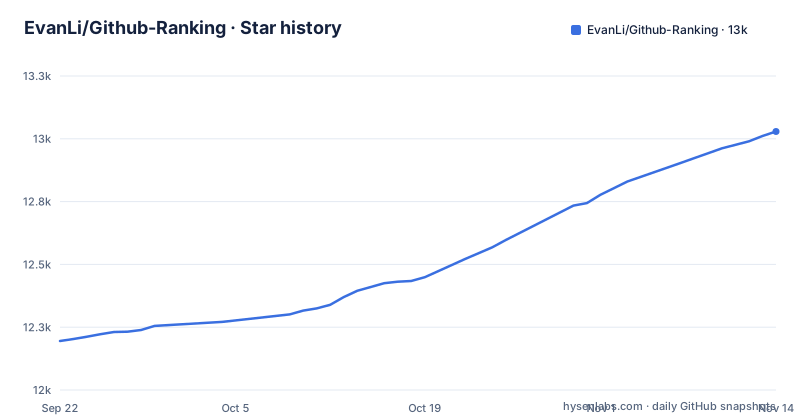
Star history
- EvanLi/Github-Ranking13,029 ★ · +834
| Repository | 2026-09-22 | 2026-11-14 |
|---|---|---|
| EvanLi/Github-Ranking | 12.2k | 13k |
834 Stars in the last 53 days, measured from the daily GitHub snapshot. Compare with other projects
Editorial analysis
The README is generated output, so every number is a snapshot from the last run
The README opens with a line reading Last Automatic Update Time: 2026-11-03T04:07:49Z, and the repository description says the lists are automatically updated daily. Nothing in the file is hand-written except a sponsor section and a table of contents. The rankings, counts and descriptions are written by a script and committed back into the repository.
That has two consequences. First, a star count you read is the count at the moment of the last run, not the live figure. The same project, rea, appears in both the stars list and the forks list with 423545 stars in one and 423546 in the other, which shows the two tables were filled from separate fetches seconds apart. Second, the repository metadata gives the last push as 2026-11-01 while the README stamp is 2026-11-03, so check the timestamp in the file you are reading and not the date on the repository page.
Each list shows ten rows in the README, and the top 100 lives in separate Top100 files
Every section begins with the words This is top 10, followed by a link to a longer list. The overall lists link to Top100/Top-100-stars.md and Top100/Top-100-forks.md, and the language sections link to files such as Top100/ActionScript.md. The README is therefore a front page, not the dataset.
If you need position 11 or 50, the README will not give it to you and you have to follow the link. If you want structured data rather than markdown tables, the repository also has a Data directory, but the README does not say what format it holds, so open it before you write code against it. Each table row carries the same eight columns: ranking, project name, stars, forks, language, open issues, description and last commit. There is no column for license, topic or contributor count, so those need a second source.
The forks ranking is led by course material and demo repositories, not by popular software
The top of the forks list is revealing. First place is jtleek/datasharing with 241467 forks and 6789 stars. Second is octocat/Spoon-Knife with 160853 forks, a repository described as being for demonstration purposes only. Third is rdpeng/ProgrammingAssignment2 with 143167 forks and 894 stars, the repository for a Coursera R Programming assignment. Further down are TheOdinProject/css-exercises with 94501 forks and 2734 stars, and Pierian-Data/Complete-Python-3-Bootcamp with 87073 forks.
The pattern is that forks follow assignments and tutorials, where every learner is told to fork the repository. A high fork count here measures how often a course tells people to copy it, not how many teams run the code. Use the forks table to find out what learners are copying, and do not use it as a proxy for production adoption. The stars-to-forks ratio is the quickest way to spot this: a fork count far above the star count points to classroom use.
Many stars-list entries are reading lists, so the language column is often Markdown or None
In the overall stars top 10, several entries are collections of links or study plans rather than programs. build-your-own-x is listed with the language Markdown. awesome and coding-interview-university show None. free-programming-books, public-apis and system-design-primer are listed with Python as their language, although their descriptions are a book list, a list of free APIs and an interview study guide. The descriptions read: Freely available programming books, A collective list of free APIs and Learn how to design large-scale systems.
So the language column is whatever GitHub reports for the repository, and it does not tell you whether the project is software. The per-language pages draw on the same field, which means a Python page can include repositories that contain mostly documentation plus helper scripts. When you filter the ranking to one language to find libraries, read the description column before you assume a row is code you can import.
Stars outlive activity, and the Last Commit column shows it
The last column records the date of the most recent commit, and it often contradicts the rank. In the forks top 10, datasharing was last committed on 2024-08-07, Spoon-Knife on 2024-08-21, ProgrammingAssignment2 on 2024-08-14 and SmartThingsPublic on 2023-07-18. In the stars top 10, coding-interview-university was last committed on 2025-08-28. In the ActionScript list, open-source-flash was last committed on 2021-02-24 and webcamjs on 2020-04-22.
A repository can sit high on the list years after its last change, because stars are cumulative and nothing removes them. If you use this ranking to choose a library, the Last Commit date is the first filter to apply, and the open issues count is the second. A project with thousands of open issues and a commit from yesterday is in a different state from one with zero issues and a commit from 2020. The ranking itself carries no maintenance judgment.
Only 34 languages have a section, and the set is fixed by the table of contents
The table of contents lists Most Stars, Most Forks and then 34 languages: ActionScript, C, C#, C++, Clojure, CoffeeScript, CSS, Dart, DM, Elixir, Go, Groovy, Haskell, HTML, Java, JavaScript, Julia, Kotlin, Lua, MATLAB, Objective-C, Perl, PHP, PowerShell, Python, R, Ruby, Rust, Scala, Shell, Swift, TeX, TypeScript and Vim script.
If your language is not on that list, there is no language page for it, and the only way to see its repositories is to find them in the overall lists. The set also includes unusual entries such as DM, TeX and Vim script, so the list looks like a result of the data collected rather than a curated choice. A language can appear or disappear depending on the collection, so check the table of contents of the current README rather than assuming a link from an older article still works.
The generator pins pandas 0.24.1 and requests 2.27.1, and the README gives no run instructions
The repository root contains auto_run.sh, requirements.txt, _config.yml, a Gemfile, and the Data, Top100 and source directories. The requirements file has two lines: pandas==0.24.1 and requests==2.27.1. Both are exact pins, and pandas 0.24.1 is a much older release line than the library's current ones.
If you intend to fork the project and run the generator yourself, expect to resolve version conflicts between the pandas pin and whatever Python version you use, and decide whether to loosen the pin. The README is generated output and has no section on how to run the code, so the source directory and auto_run.sh are the places to read. The homepage points at evanli.github.io/Github-Ranking, and the license is MIT. The repository has no GitHub releases, so there is no tagged version of the generator to pin yourself to.
Editorial conclusion
Github-Ranking is a good lookup table for who currently leads GitHub by stars or forks in a given language, and a poor guide to what is worth using. Read the stars list as a record of attention, read the forks list as a record of classroom and tutorial copying, and open the Last Commit column before you trust any entry. If you plan to run the generator yourself, check the pinned pandas and requests versions first.
Frequently asked questions
What are the top 10 repos on GitHub?
In this ranking by stars, the top three are build-your-own-x with 558948 stars, awesome with 529767 and public-apis with 495578. The list continues with freeCodeCamp, rea, free-programming-books, openclaw, system-design-primer, developer-roadmap and coding-interview-university.
How often does Github-Ranking update?
The repository describes itself as automatically updated daily. The README carries a Last Automatic Update Time stamp, 2026-11-03T04:07:49Z at the time of this snapshot.
How many languages does Github-Ranking cover?
Its table of contents has 34 language sections, from ActionScript to Vim script, in addition to the overall Most Stars and Most Forks lists. Each section shows the top 10 and links to a top 100 file.
Official sources
Add this badge to your README
If you maintain this project, the badge below links readers to this analysis and shows its maintenance status from the daily GitHub snapshot. Paste the markdown into your README; add ?metric=license or ?metric=stars to the image URL for a different field.

[](https://hysenlabs.com/projects/evanli-github-ranking)Star history chart for your README
[](https://hysenlabs.com/projects/evanli-github-ranking)Was this useful?