Everlyn-1: Inside the Open Autoregressive Video AI Research
The first open autoregressive foundational video AI model.
At a glance
- What is it?
- Everlyn-1 is a research repository for autoregressive image and video generation, video tokenization, and hallucination reduction in MLLMs. Its README points to three separate component repositories, but does not provide installation, model access, or runnable usage instructions.
- Who is it for?
- Researchers evaluating Everlyn-1 should adopt it as an entry point to three documented research directions, not as a ready-to-run video generation package. Engineers seeking model weights, installation commands, inference examples, licensing details, or a unified application interface should look elsewhere or confirm those items with Everlyn Labs.
- Can I use it commercially?
- Not without permission. GitHub finds no licence file in the repository, and without a licence all rights are reserved by default: you may read the code but not reuse it. Check the README, or ask the authors, before using it.
- Is it still maintained?
- Yes. The repository last received commits 16 days ago.
- What is it written in?
- GitHub does not report a main language for this repository.
Answers come from the project's GitHub data, last synced on October 22, 2026, and from our analysis. They are not legal advice.
Star history
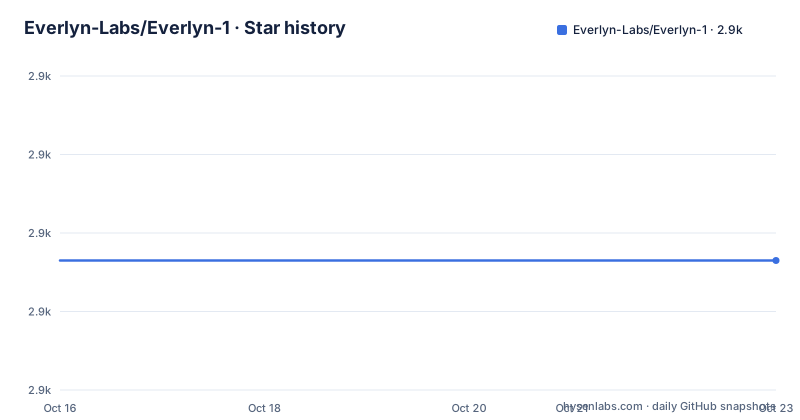
- Everlyn-Labs/Everlyn-12,893 ★ · +0
| Repository | 2026-10-16 | 2026-10-22 |
|---|---|---|
| Everlyn-Labs/Everlyn-1 | 2.9k | 2.9k |
0 Stars in the last 6 days, measured from the daily GitHub snapshot. Compare with other projects
Editorial analysis
Everlyn-1's Three Video AI Research Tracks
Everlyn-1 addresses research into autoregressive visual generation and multimodal model behavior. It is aimed at researchers and engineers who want to follow the project's work across video representation, generation, and hallucination control rather than simply download a finished application. The repository description calls it the first open autoregressive foundational video AI model, while the README presents it as a collection of research components. That distinction matters: the visible repository does not document a standalone model launch, command-line interface, web application, or model checkpoint.
The README groups the work into three areas. Wasserstein-VQ concerns vector quantization for autoregressive video models. EfficientARV concerns autoregressive generation of images and videos, with conditional tasks such as animation, inpainting, outpainting, video prediction, and interpolation. ANTRP concerns decoding in multimodal large language models and proposes a mechanism for reducing hallucinated content. The repository uses Git submodules for these components, with `ANTRP`, `EfficientARV`, and `Wasserstein-VQ` listed as top-level entries.
This structure makes Everlyn-1 closer to a research index than a single deployable package. The README directs readers to separate GitHub repositories for each component. Anyone assessing adoption therefore needs to distinguish the value of the umbrella repository from the maturity and usability of each linked project.
Wasserstein-VQ and Autoregressive Video Tokenization
The Wasserstein-VQ component targets a representation problem encountered by autoregressive video models: converting visual information into tokens that a discrete model can predict efficiently. The README states that the approach applies distribution matching based on the Wasserstein distance to vector quantization. Its stated aims are better codebook utilization and lower quantization error, with more stable training and improved performance in generative video tasks.
Codebook utilization and quantization error are concrete evaluation targets for anyone studying tokenization. Better use of a codebook means that fewer available entries may remain unused, while lower quantization error concerns how closely token representations preserve the input. The README connects these properties to generative video performance, but it does not provide datasets, metrics, measured values, or implementation files in this repository. The top-level `Wasserstein-VQ` entry appears to be linked through `.gitmodules`.
The repository does not establish whether `Wasserstein-1` exposes a common token format that EfficientARV can consume. Nor does it explain compatibility requirements between Wasserstein-VQ and a particular EfficientARV version. Those checks matter because tokenizer implementations can differ in vocabulary construction, codebook behavior, and data preprocessing. The repository supports research discovery, but the README leaves integration details to the linked repositories.
EfficientARV's Conditional Generation Scope
EfficientARV is the component most directly tied to image and video output. According to the README, it is designed to create an efficient autoregressive model that jointly generates images and videos. Its listed conditional generation tasks are image animation, inpainting, outpainting, video prediction, and video interpolation. It also has a stated aim of integrating generation capabilities into multimodal large language models for more interactive AI systems.
Joint image and video generation suggests a shared autoregressive framework rather than two unrelated output modes. The task list also covers editing and prediction workflows, but the README does not define their input formats, supported resolutions, frame limits, conditioning controls, or output file types. It does not document hardware requirements or identify the relationship between the repository description's claim of an open foundational video model and the scope of EfficientARV.
This makes EfficientARV promising as a subject for technical review, but insufficiently documented here for production planning. An engineer cannot determine from the visible README whether tasks share one checkpoint, whether image and video inputs are tokenized identically, or whether MLLM integration is available outside a research setup. Those are architectural questions for the linked EfficientARV repository, not facts that can be inferred from the task names.
ANTRP's Attention Intervention for MLLMs
ANTRP addresses hallucination in multimodal large language models through a decoding strategy. The README says the method intervenes in the variance of query-key parameters rather than penalizing summary tokens. It also introduces the Dynamic Token Propagation Mechanism, called TAME, which adjusts the eigenspectrum variance of attention weights. The stated purpose is to limit over-propagation of anchor tokens, and the README reports reduced hallucinated objects across various MLLMs without adding inference time.
This is distinct from the visual generation work. Wasserstein-VQ and EfficientARV concern video representation and generation, while ANTRP changes how information propagates through attention during multimodal language generation. It may therefore be relevant to engineers evaluating hallucination behavior in systems that interpret visual input, but the repository does not establish which generation components it can be combined with.
The README reports extensive experiments and a correlation between the eigenspectrum and hallucinations, but it does not provide experimental data, model names, datasets, thresholds, or a reproduction procedure in the visible text. It also says that TAME adds no inference time, yet gives no implementation detail in this repository. Those omissions prevent independent confirmation from Everlyn-1 alone. The separate ANTRP repository would need to provide the missing implementation and evaluation context.
Installation and First Use Are Undocumented
The README does not provide installation steps for Everlyn-1, commands for fetching the component repositories, pretrained checkpoints, environment variables, dependencies, or an inference example. It directs readers to [Everlyn.ai](https://www.everlyn.tech) and links to the three component repositories on GitHub. There is therefore no documented first use that can be reproduced from this repository.
The presence of `.gitmodules` indicates that the component directories are managed through Git submodule configuration, but the actual submodule URLs and initialization instructions are not shown in the visible README. A reader should not infer a clone command, dependency manager, Python version, GPU requirement, container image, API endpoint, or port from the repository listing.
There are also no GitHub releases. The umbrella repository consequently does not provide a release-based adoption path in the visible project data. Developers seeking to evaluate the work should begin with the linked component repositories and verify their installation requirements independently. The Everlyn website is the only external destination named by the README, and the document does not explain whether it hosts downloads, documentation, model access, or project information.
Maintenance Signals and Licensing Boundaries
Everlyn-1 is not archived, and its last push was on 2026-10-07. Those are the only maintenance facts available here. They do not establish release cadence, issue responsiveness, compatibility guarantees, or the maintenance status of Wasserstein-VQ, EfficientARV, and ANTRP. There are no GitHub releases through which the project could communicate versioned packages or upgrade notes.
The repository metadata does not identify a license. The README also contains no licensing section. That omission is a concrete adoption constraint for engineers and organizations that need to inspect permissions before using, modifying, redistributing, or deploying code and model artifacts. This article does not provide legal advice or assume that the separate component repositories use the same terms. License status must be checked in each relevant repository and in the terms attached to any weights or other assets.
Upgrade planning is similarly limited. There is no documented versioning policy, compatibility matrix, migration guide, or statement about breaking changes between tokenizer, generation, and decoding components. An engineer considering a combined stack would need to verify that the linked projects have compatible interfaces before treating them as one system.
Editorial conclusion
Researchers evaluating Everlyn-1 should adopt it as an entry point to three documented research directions, not as a ready-to-run video generation package. Engineers seeking model weights, installation commands, inference examples, licensing details, or a unified application interface should look elsewhere or confirm those items with Everlyn Labs. The first verification point is the scope and documentation of the linked Wasserstein-VQ, EfficientARV, and ANTRP repositories, because Everlyn-1 itself supplies no installation or deployment guidance.
Frequently asked questions
What is Everlyn-1 used for?
Everlyn-1 organizes research on autoregressive image and video generation, video tokenization, and hallucination reduction in multimodal large language models. The README links each area to a separate repository.
How do I install Everlyn-1?
The README does not provide installation commands, dependency requirements, or a runnable example. The repository includes component directories and `.gitmodules`, but it does not explain the required setup in the visible documentation.
Does Everlyn-1 include a video generation model or API?
The repository description calls Everlyn-1 an open autoregressive foundational video AI model, but the README does not document model weights, an API, or a ready-to-run application. It points to EfficientARV for research on image and video generation.
Official sources
Add this badge to your README
If you maintain this project, the badge below links readers to this analysis and shows its maintenance status from the daily GitHub snapshot. Paste the markdown into your README; add ?metric=license or ?metric=stars to the image URL for a different field.

[](https://hysenlabs.com/projects/everlyn-labs-everlyn-1)Star history chart for your README
[](https://hysenlabs.com/projects/everlyn-labs-everlyn-1)