Flarum 2.0: a PHP forum whose GitHub repository is only the skeleton app
Simple forum software for building great communities.
At a glance
- What is it?
- flarum/flarum is the starting application for Flarum, an MIT-licensed discussion platform with a PHP backend and a Mithril front end. The code that matters lives in flarum/core and the install steps live on docs.flarum.org, so this repository is where a forum starts rather than where it is built.
- Who is it for?
- Flarum suits teams that already run PHP hosting behind nginx and want a free, MIT-licensed forum they can extend through its Extension API. It is a poor fit for anyone expecting a container image or install commands in the repository itself, or for an existing 1.x forum that depends on extensions not yet confirmed for 2.0.
- Can I use it commercially?
- Yes. MIT is a permissive licence: you can use, modify and sell software built on it, as long as you keep its copyright and licence notices.
- Is it still maintained?
- Yes. The repository last received commits 9 days ago.
- What is it written in?
- Mainly PHP, according to GitHub's language statistics.
Answers come from the project's GitHub data, last synced on November 15, 2026, and from our analysis. They are not legal advice.
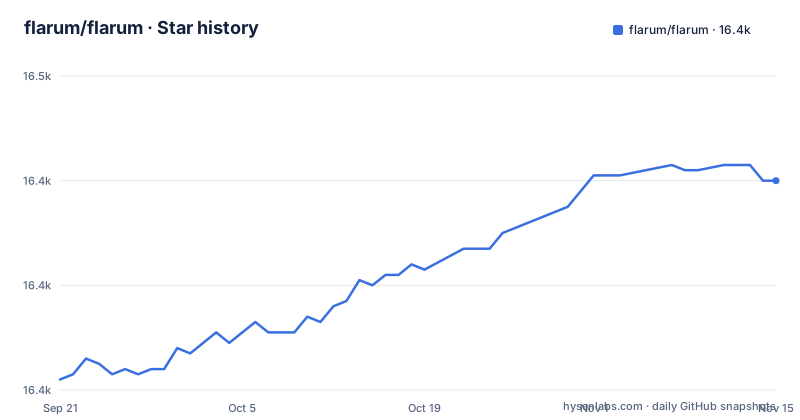
Star history
- flarum/flarum16,440 ★ · +38
| Repository | 2026-09-21 | 2026-11-15 |
|---|---|---|
| flarum/flarum | 16.4k | 16.4k |
38 Stars in the last 55 days, measured from the daily GitHub snapshot. Compare with other projects
Editorial analysis
flarum/flarum holds the skeleton, and flarum/core holds the forum
The README says it directly: this repository only holds the Flarum skeleton application, and most development happens in flarum/core. What you get here is the shell a forum is installed into. The top level has composer.json, extend.php, site.php, a file named flarum, a public/ directory, a storage/ directory, an .nginx.conf file and a CHANGELOG.md. There is no src/ tree of forum logic.
That changes how a reader should use the repository. Browsing it will not show how discussions, permissions or notifications work, because that code sits in the flarum/core package, which is published on Packagist. Anyone evaluating code quality, reading pull requests or tracking a bug should go to flarum/core. The skeleton matters for one thing: the shape of a fresh installation on disk, with web-facing files under public/ kept apart from storage/.
A PHP backend with a Mithril interface and an Extension API
Flarum is built with PHP, and the README gives that as the reason it is quick to deploy. The browser side uses Mithril, a JavaScript framework the README describes as performant with a tiny footprint. The pitch is a forum with no complex dependencies: no separate runtime beyond PHP on the server, and a light front end in the browser.
Customisation goes through the Extension API. Extensions and themes are how a Flarum forum gains features beyond the defaults, and choosing them is where much of the work of running a Flarum site ends up. The README names the Extension API without listing what it exposes. The API reference, like the install guide, is on docs.flarum.org, so expect to work from the documentation site rather than from this repository when writing your first extension.
How to install Flarum: the steps live on docs.flarum.org/install
The README contains no install commands. Its Installation section is a single pointer: read the installation guide at docs.flarum.org/install. For help, it lists the documentation at docs.flarum.org, the community forum at discuss.flarum.org and a Discord chat.
For a newcomer this means two documents to keep open. The repository shows which files a fresh install contains, and the guide explains how to get them onto a server and configured. Neither is complete on its own. The README does not state PHP version requirements, database support or web server prerequisites, so do not size a host from the GitHub page. Check the guide for those before you buy hosting, especially if your provider pins an older PHP release.
The composer.json at the root marks Composer as the tool that resolves the skeleton's PHP packages, flarum/core among them on Packagist.
An nginx config in the root, and no Dockerfile
The skeleton ships an .nginx.conf file at the top level. Teams already serving PHP behind nginx get a starting configuration in the box. Nothing equivalent appears for other servers among the top-level files, and the README does not describe how to use the nginx file either.
The gap that will catch more people is containers. There is no Flarum Docker setup here: no Dockerfile and no docker-compose file among the top-level entries, and the README says nothing about container deployment. A team whose platform only accepts container images has to write and maintain that image itself, including the PHP runtime, the web server and persistent storage for the storage/ directory. That is ongoing work the project does not take on.
Flarum 2.0 landed on the 2.x branch weeks after rc.8
The default branch is 2.x. The last push was on 2026-10-09, the same day v2.0.0 was tagged. Before that came v2.0.0-rc.7 on 2026-08-24 and v2.0.0-rc.8 on 2026-08-27, so the release candidates ran into late August before the final tag.
A major version is the point where existing forums have the most to check. The README does not describe an upgrade path from 1.x, and it does not say which extensions have been updated for 2.0. A forum that leans on several community extensions should treat each one as unconfirmed until its own page says it supports 2.0. Read CHANGELOG.md in this repository and the documentation before upgrading a live community, and keep a backup you have restored at least once.
Bugs, security reports and the stale master link all point elsewhere
Because the forum code lives in flarum/core, so does the security process. The README asks anyone who finds a vulnerability to follow the security policy at github.com/flarum/core/security/policy. Filing a security issue on the skeleton repository would put it in the wrong place and, worse, in public.
Contributions follow the same split. The contributing guide is at docs.flarum.org/contributing, and most pull requests belong in flarum/core.
One small inconsistency shows how thin the skeleton README is: its License section links to the LICENSE file on a master branch, while the repository's default branch is 2.x. The licence itself is not in doubt, but links in this README are worth checking before you rely on them.
MIT licensing, and where Flarum sits next to Discourse
Flarum is released under the MIT License. A site owner can modify the skeleton and core, keep those changes private, and build commercial extensions on top without a copyleft obligation to publish source. Keep the copyright and licence notice with the code you redistribute.
Flarum vs Discourse is the comparison most evaluators start with. The README makes no comparison with Discourse, phpBB, NodeBB or any other forum, so any claim about which is faster or easier would not come from the project. The visible difference is in stack: Flarum is PHP with a Mithril front end, while Discourse is a Ruby on Rails application. That one fact decides a lot in practice, since it determines whether your existing PHP hosting can run the forum at all.
Editorial conclusion
Flarum suits teams that already run PHP hosting behind nginx and want a free, MIT-licensed forum they can extend through its Extension API. It is a poor fit for anyone expecting a container image or install commands in the repository itself, or for an existing 1.x forum that depends on extensions not yet confirmed for 2.0. Read docs.flarum.org/install and CHANGELOG.md before installing, and send bugs to flarum/core rather than to this repository.
Frequently asked questions
Is Flarum free?
Yes. Flarum is open-source software released under the MIT License, so the software itself costs nothing to use and modify.
How do I install Flarum?
The flarum/flarum README sends you to the installation guide at docs.flarum.org/install. Support is available through the documentation, the community forum at discuss.flarum.org and the Flarum Discord chat.
What is Flarum?
Flarum is discussion platform software for websites, built with PHP on the server and Mithril in the browser, with an Extension API for customisation. The flarum/flarum repository holds only its skeleton application; most development happens in flarum/core.
Official sources
Add this badge to your README
If you maintain this project, the badge below links readers to this analysis and shows its maintenance status from the daily GitHub snapshot. Paste the markdown into your README; add ?metric=license or ?metric=stars to the image URL for a different field.

[](https://hysenlabs.com/projects/flarum-flarum)Star history chart for your README
[](https://hysenlabs.com/projects/flarum-flarum)Was this useful?