Fossify Messages: A No-Ads SMS/MMS Client with Backup and Blocking
An easy and quick way of managing SMS and MMS messages without ads.
At a glance
- What is it?
- Fossify Messages is a lightweight, open-source SMS/MMS app for Android. It focuses on privacy, blocking, and backup, but its feature set and maintenance cadence deserve scrutiny before you switch.
- Who is it for?
- Adopt Fossify Messages if you want a no-ad, no-internet-permission SMS/MMS client with built-in blocking and backup, and you trust the GPL-3.0 license and the Fossify project's maintenance record. Do not adopt it if you need rich multimedia features, end-to-end encryption, or a guarantee of long-term updates; the app's feature set is basic and its future depends on a small open-source team.
- Can I use it commercially?
- Yes, with conditions. GPL-3.0 is a copyleft licence: if you distribute software that includes it, you must release that software's source code under the same licence. Running it internally without distributing it does not trigger that obligation.
- Is it still maintained?
- Yes. The repository last received commits 5 days ago.
- What is it written in?
- Mainly Kotlin, according to GitHub's language statistics.
Answers come from the project's GitHub data, last synced on November 14, 2026, and from our analysis. They are not legal advice.
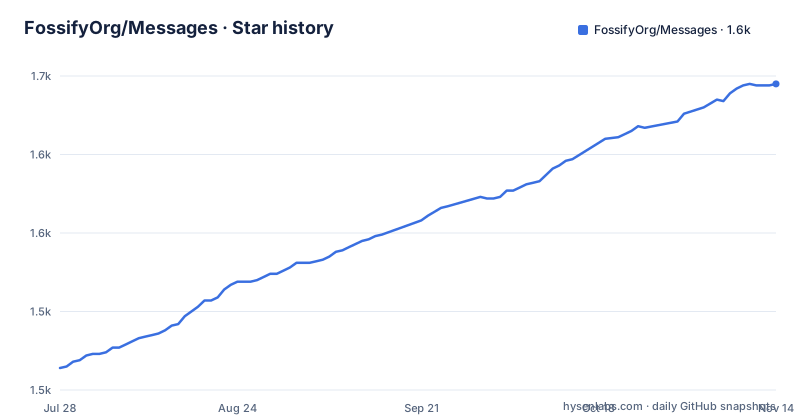
Star history
- FossifyOrg/Messages1,645 ★ · +181
| Repository | 2026-07-28 | 2026-11-14 |
|---|---|---|
| FossifyOrg/Messages | 1.5k | 1.6k |
181 Stars in the last 109 days, measured from the daily GitHub snapshot. Compare with other projects
Editorial analysis
What Fossify Messages Solves and Who It Serves
Fossify Messages targets Android users who are tired of ad-supported, permission-hungry SMS apps. The README emphasizes no internet access, and the source manifest does not declare the INTERNET permission directly. That is a useful privacy signal, but it does not by itself prove the absence of all data collection or eliminate the carrier network involved in SMS and MMS. The intended audience is privacy-conscious individuals who still rely on SMS and MMS for everyday communication, and who want a simple, fast client without the bloat of modern messaging apps. It also appeals to users who want to back up their texts locally and block spam without relying on carrier-level filters. The app is part of the Fossify suite, which suggests a broader ecosystem for users who want consistent, open-source replacements for common Android tools.
Core Features: Blocking, Backup, and Search
The README lists three standout features. First, blocking: you can block unwanted messages, even from unknown contacts, and you can also block messages containing specific words or phrases. This is a rule-based filter, not a learned spam classifier, so it gives you explicit control but requires manual setup. Second, backup: you can export and import your messages, which is a straightforward way to move conversations to a new device. The README does not specify the export format, but it is likely an XML or JSON file, common in such apps. Third, search: the app offers a quick search across conversations, which is a basic but essential feature. The blocking and backup features are the main differentiators from the stock Android Messages app, which lacks both in a user-friendly form. However, the README does not describe any encryption for backups, so the exported file is presumably plain text, a security consideration for sensitive conversations.
Architecture and Data Flow: Android Telephony and Permissions
The project describes itself as requiring no internet access, and its source manifest does not directly declare the Android INTERNET permission. It does declare SMS and MMS permissions: the app uses Android telephony services to handle messages, which travel through a mobile carrier rather than being purely local. MMS service may depend on a working mobile data connection and carrier configuration. Backups can be exported locally, so protect the exported file as sensitive data.
The absence of a directly declared INTERNET permission is not a guarantee of privacy: SMS and MMS are not end-to-end encrypted by these protocols, and carriers handle message traffic. Check the permissions of the specific installed build and test MMS with your carrier.
Getting Started: Installation and Setup
The README provides links to Google Play, F-Droid, and IzzyOnDroid, so installation is straightforward from any of these sources. The package ID is org.fossify.messages, which is useful for identifying the app on F-Droid. After installation, you set it as your default SMS app in Android settings, a step required by all SMS clients on modern Android. The blocking feature requires you to manually enter numbers or keywords in the app's settings, and the backup feature is a one-tap export or import. The README does not give exact command-line instructions or config keys, as this is a GUI app, not a developer tool. The recent releases, including 1.9.1 on 2026-07-19, indicate active development.
Limitations and When It Is the Wrong Tool
The most obvious limitation is the absence of end-to-end encryption. SMS and MMS are inherently unencrypted protocols, and this app does not add a layer like Signal or WhatsApp. If you need private messaging, this is the wrong tool. Another limitation is the lack of internet connectivity, which means no RCS (Rich Communication Services) support. RCS is the modern replacement for SMS, offering read receipts, typing indicators, and better media quality, but it requires a network connection. The README does not mention RCS, and given the no-internet design, it is almost certainly unsupported. Also, the blocking feature is keyword-based, so it may miss spam that uses obfuscated text or images. Finally, the backup feature is manual, so you must remember to export your messages regularly; there is no scheduled backup mentioned. For users who want hands-off backup or advanced spam filtering, this app will feel basic.
Alternatives and How They Differ
The most direct alternative is the stock Android Messages app from Google. It supports RCS, which can provide modern messaging features. Fossify Messages is ad-free and focuses on carrier SMS and MMS rather than RCS. Another alternative is QKSMS, an open-source SMS app that also focuses on privacy, but it has a different design and may have different blocking options. The key difference is that QKSMS has a more polished interface and supports scheduled messages, which Fossify does not mention. For users who want encryption, Signal is the obvious choice, but it is not an SMS/MMS client in the traditional sense; it uses its own protocol. The choice comes down to whether you prioritize offline operation and simplicity over modern features like RCS or encryption.
Maintenance, Licensing, and Upgrade Costs
The repository is under the GPL-3.0 license, which means you can use, modify, and distribute the source code, but any derivative work must also be GPL-3.0. This is a strong copyleft license; when distributing modified versions, follow the GPL requirements, including making corresponding source available under the applicable terms. The repository is not archived, and the last push was on 2026-07-19, with three releases in July 2026 alone, indicating active maintenance. However, the project is part of Fossify, a community-driven suite, so the maintenance depends on volunteer contributors. The upgrade cost is low for end users: you can update via F-Droid or Play Store, and the app size is small, so downloads are quick. For developers, the cost is in understanding the codebase, which is written in Kotlin, but the README does not provide a build guide, so you would need to explore the repository to find build instructions.
Editorial conclusion
Adopt Fossify Messages if you want a no-ad, no-internet-permission SMS/MMS client with built-in blocking and backup, and you trust the GPL-3.0 license and the Fossify project's maintenance record. Do not adopt it if you need rich multimedia features, end-to-end encryption, or a guarantee of long-term updates; the app's feature set is basic and its future depends on a small open-source team. Before switching, verify that the latest release (1.9.1) installs cleanly on your device, test the backup/import cycle with a few conversations, and confirm that the blocking rules cover the exact message patterns you need. If you require encrypted messaging, look elsewhere; this app is for plain SMS/MMS only.
Frequently asked questions
What can Fossify Messages block?
Three things: unwanted messages from any sender, including numbers not in your contacts, a stored list of blocked numbers that can be exported and imported, and messages containing specific words or phrases. The first two act on the sender and the third acts on the message content.
Does Fossify Messages need an internet connection?
The project describes the app as requiring no internet access, but SMS and MMS still use carrier services; MMS may require mobile data and suitable carrier settings. Test MMS on your device and network.
How do I get Fossify Messages, and which channel is the freshest?
The page links three channels: Google Play at the listing id org.fossify.messages, F-Droid at f-droid.org/packages/org.fossify.messages, and IzzyOnDroid at apt.izzysoft.de/fdroid/index/apk/org.fossify.messages. No version is printed against any badge, and the IzzyOnDroid target resolves to a bare APK file rather than a store page, so freshness has to be checked per channel.
What does Fossify Messages let me hide on the lock screen?
A choice of three display options: sender only, message content, or nothing at all. Whether the notification itself can be suppressed is not addressed on the page, and the setting is described as a customization rather than a security control.
Can I back up my messages with Fossify Messages?
Yes, by exporting and importing them, which the page presents as a way to switch devices without losing conversations. The blocked number list can be exported and imported separately, and no file format is named for either operation.
Is Fossify Messages open source and ad free?
The page says it is fully open source, free of ads, and does not request unnecessary permissions, with the source hosted under the FossifyOrg GitHub organization. The repository carries a GPL-3.0 license file alongside `CONTRIBUTING.md`, `CODEOWNERS`, and a `.github/` directory.
Official sources
Add this badge to your README
If you maintain this project, the badge below links readers to this analysis and shows its maintenance status from the daily GitHub snapshot. Paste the markdown into your README; add ?metric=license or ?metric=stars to the image URL for a different field.

[](https://hysenlabs.com/projects/fossifyorg-messages)Star history chart for your README
[](https://hysenlabs.com/projects/fossifyorg-messages)Was this useful?