parakeet.cpp: NVIDIA Parakeet Speech Recognition in Pure C++
Ultra fast and portable Parakeet implementation for on-device inference in C++ using Axiom with MPS+Unified Memory
At a glance
- What is it?
- parakeet.cpp runs NVIDIA's Parakeet ASR models without ONNX or Python, using the axiom tensor library with Metal GPU acceleration. It is a strong fit for Apple Silicon embedding, and a poor fit if you need Windows or a mature release history.
- Who is it for?
- Adopt parakeet.cpp if you are embedding speech recognition into a C++ or C-callable application on Apple Silicon or Linux x86_64, and if you accept that the project has no tagged releases, no documented rollback path and a source build that needs full Xcode on macOS.
- Can I use it commercially?
- Yes. MIT is a permissive licence: you can use, modify and sell software built on it, as long as you keep its copyright and licence notices.
- Is it still maintained?
- Activity is slowing. The repository last received commits 6 months ago.
- What is it written in?
- Mainly C++, according to GitHub's language statistics.
Answers come from the project's GitHub data, last synced on November 25, 2026, and from our analysis. They are not legal advice.
Star history
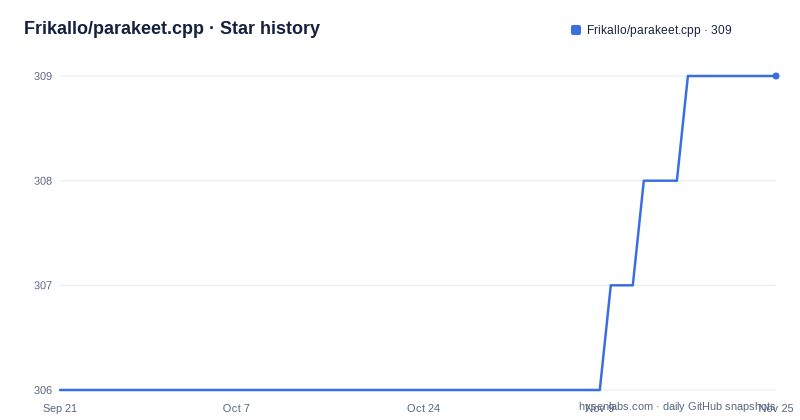
- Frikallo/parakeet.cpp309 ★ · +3
| Repository | 2026-09-21 | 2026-11-25 |
|---|---|---|
| Frikallo/parakeet.cpp | 306 | 309 |
3 Stars in the last 65 days, measured from the daily GitHub snapshot. Compare with other projects
Editorial analysis
The problem parakeet.cpp solves: Parakeet inference without a runtime stack
Most routes to running NVIDIA's Parakeet checkpoints drag in a Python interpreter, an ONNX runtime, or both. parakeet.cpp takes the opposite position. It implements Parakeet inference in C++20 on top of axiom, a tensor library by the same author that compiles Metal shaders through MPSGraph on Apple Silicon. The README describes the result as "No ONNX runtime, no Python runtime, no heavyweight dependencies."
The audience is narrow and specific. This is for engineers shipping a desktop or server binary that must transcribe audio in-process, where adding a Python dependency is unacceptable, and where the target machine is a Mac with Apple Silicon or a Linux x86_64 box. It is also for people embedding ASR behind a foreign-function interface: the project exposes a flat extern "C" C API, which the README lists as usable from Python, Swift, Go and Rust. If your deployment target is Windows, the README lists prebuilt binaries only for macOS arm64, macOS x86_64 and Linux x86_64, so you are outside the supported set.
The model coverage is broader than a single checkpoint. Six model classes are documented, spanning offline transcription (tdt-ctc-110m, tdt-600m), streaming (eou-120m, nemotron-600m), speaker diarization (sortformer) and a combined ASR-plus-diarization path that produces speaker-attributed words. That range is the real argument for the project: one binary, one audio pipeline, several decoding strategies.
How the encoder, decoders and audio pipeline fit together
Every ASR model in the project shares one front end. The README states the pipeline plainly: 16kHz mono WAV, an 80-bin Mel spectrogram, then a FastConformer encoder. The encoder itself is Conv2d subsampling at 8x followed by N Conformer blocks using relative positional attention. Streaming models swap that for a cache-aware streaming FastConformer with causal convolutions and bounded-context attention, which is what allows chunked audio input.
Above the encoder, the decoder is the variable. CTC uses greedy argmax or beam search. RNNT uses an autoregressive LSTM. TDT adds duration prediction on top of the LSTM, which the README describes as better accuracy than RNNT. The tdt-ctc-110m model carries both a TDT and a CTC head and lets you pick the decoder at the call site, which is unusual and useful: you can ship one weight file and choose speed or accuracy per request.
Several features sit outside the encoder-decoder path. Word timestamps with per-word confidence are available on all decoders. Beam search can fuse an optional ARPA n-gram language model. Phrase boosting uses a token-level trie for domain vocabulary. Batch transcription runs several files through one batched encoder forward pass. Silero VAD strips silence before ASR and remaps timestamps afterward. The README gives one performance figure, roughly 27ms of encoder inference on Apple Silicon GPU for 10 seconds of audio with the 110M model, described as 96x faster than CPU. Treat that as a vendor claim from the README, not an independent measurement.
Installing parakeet.cpp from the prebuilt tarball
The fastest path is the prebuilt archive attached to each GitHub release. The README gives this sequence for macOS arm64; substitute the tarball name for your platform.
tar -xzf parakeet-v0.1.0-macos-arm64.tar.gz
cd parakeet-v0.1.0-macos-arm64
xattr -dr com.apple.quarantine .
./bin/parakeet --help
The xattr step clears the Gatekeeper quarantine attribute, which macOS applies to downloaded archives. If you skip it, the binary may be blocked on first run. After that, ./bin/parakeet --help should print the CLI options. The archive is self-contained: it ships bin/parakeet and bin/example-server plus lib/libaxiom, with @rpath on macOS and $ORIGIN on Linux set so the binaries find their libraries relative to the install directory. You can move the extracted folder anywhere. The include/parakeet/ headers are included for embedders.
Note that the repository has no published GitHub releases, so the tarball names above come from the README's example and may not match what is currently published. Check the releases page before scripting a download.
Building from source and converting a Parakeet checkpoint
Building from source requires C++20, CMake 3.20 or newer, Clang 14 or GCC 12, and macOS 13 or later for Metal GPU. The Makefile wraps the CMake configure step and picks Ninja when it is available.
git clone --recursive https://github.com/frikallo/parakeet.cpp
cd parakeet.cpp
make build
make test
The --recursive flag matters because axiom lives in third_party/ as a submodule. Skipping it leaves you with an empty directory and a configure failure. make test builds and runs build/parakeet_tests.
On macOS there is a hard constraint the README calls out directly: building requires the full Xcode install, not just Command Line Tools, because axiom compiles its Metal shaders with xcrun metal and xcrun metallib. Those tools ship only with Xcode. If you only want to run parakeet, the README recommends the prebuilt tarball instead, since the .metallib is embedded into the shipped libaxiom.dylib and needs no Xcode or CLT on the user's machine.
Weights are not shipped. You download a .nemo checkpoint from HuggingFace and convert it to safetensors:
huggingface-cli download nvidia/parakeet-tdt_ctc-110m --include "*.nemo" --local-dir .
pip install safetensors torch
python scripts/convert_nemo.py parakeet-tdt_ctc-110m.nemo -o model.safetensors
The converter defaults to 110m-tdt-ctc and also supports 600m-tdt, eou-120m, nemotron-600m and sortformer via the --model flag. Note that conversion still needs Python and torch, so Python is removed from the inference path, not from the setup path. For VAD you also need Silero weights, produced by scripts/convert_silero_vad.py -o silero_vad_v5.safetensors.
Once you have a model file, the README's C++ usage is short:
#include <parakeet/parakeet.hpp>

parakeet::Transcriber t("model.safetensors", "vocab.txt");
t.to_gpu();
t.to_half();
auto result = t.transcribe("audio.wav");
The Transcriber takes the converted weights and a vocab.txt. to_gpu() enables Metal acceleration and to_half() switches to FP16, which the README describes as roughly 2x memory reduction. Both are optional. If you prefer linking the library into your own build, the README documents three integration routes: CMake find_package with the Parakeet::parakeet target, add_subdirectory, or pkg-config with the parakeet module.
Where parakeet.cpp is the wrong tool
The most concrete limitation is the build requirement on macOS. Full Xcode is a large install, and on a CI runner that only has Command Line Tools, make build will fail at the shader compilation step. The README's own advice is to use the prebuilt tarball in that situation, which means source builds are effectively gated on having Xcode present.
Platform coverage is the second boundary. Prebuilt binaries exist for macOS arm64, macOS x86_64 and Linux x86_64. There is no Windows binary documented, and the GPU path is Metal, so a Windows machine has neither a supported artifact nor an accelerated backend. If your product ships on Windows, this project does not solve your problem today.
The release situation is thin. The repository has no published GitHub releases, and the README references a v0.1.0 tarball name without the repository showing a versioning or compatibility policy. That matters for embedding: the C API is flat extern "C", so symbols are stable in form, but nothing in the README commits to ABI stability across versions. If you ship a binary that links libaxiom, plan to re-verify after each upgrade rather than assuming drop-in replacement.
There is also a dependency concentration worth naming. The tensor library, the Metal shader compilation and the automatic GPU dispatch all come from axiom, a project by the same author. That keeps the stack small, but it means an axiom bug or an axiom API change reaches you directly, and the README does not describe a fallback path if Metal acceleration is unavailable at runtime.
How parakeet.cpp differs from whisper.cpp
The obvious comparison is whisper.cpp, the C++ port of OpenAI's Whisper. Both avoid Python at inference time and both target on-device transcription, so the difference is in what they run and how they are structured. whisper.cpp implements Whisper checkpoints; parakeet.cpp implements NVIDIA Parakeet checkpoints. That distinction carries through to the decoder design: Whisper is an encoder-decoder transformer with a fixed decoding loop, while parakeet.cpp exposes CTC, RNNT and TDT decoders as separate classes with greedy and beam-search variants, and lets the tdt-ctc-110m model switch between its CTC and TDT heads at the call site.
The GPU story also differs in kind. whisper.cpp has a broad backend matrix spanning several GPU APIs. parakeet.cpp's acceleration is Metal through axiom's MPSGraph compiler, which is why the performance claim in the README is framed around Apple Silicon specifically. On a Mac, that narrowness is the point. Off it, it is a gap.
Feature overlap is partial. Both handle word timestamps. parakeet.cpp additionally documents speaker diarization through Sortformer with up to four speakers, and a combined DiarizedTranscriber that produces speaker-attributed words from a 110M ASR model plus a 117M diarization model. If your requirement is "who said what" rather than "what was said", that combined path is the feature to evaluate, and it is the clearest thing parakeet.cpp offers that a plain Whisper port does not.
Maintenance, licensing and what an upgrade costs
The repository is not archived, and the last push was on 2026-05-04. That is roughly four and a half months before today, so the codebase has recent activity but no release cadence to rely on. The repository has no published GitHub releases, which means there is no changelog to read before upgrading and no version number to pin against. If you depend on parakeet.cpp, track the main branch and the third_party/ submodule commit together, because axiom is vendored there and a submodule bump can change both the tensor API and the compiled Metal shaders.
The upgrade cost is concentrated in two places. First, the model conversion step: scripts/convert_nemo.py maps .nemo checkpoints to safetensors, and if NVIDIA changes checkpoint layout, conversion is where it breaks, not inference. Second, the shader build: on macOS, any change that touches Metal kernels requires full Xcode to rebuild, so contributors without Xcode cannot validate those changes.
The licence is MIT. That is permissive and compatible with closed-source embedding, but it is worth being precise about scope: the MIT licence covers this repository. The Parakeet model weights come from NVIDIA on HuggingFace and carry their own terms, and axiom is a separate project with its own licence file. Check both before shipping a product, and treat this as a pointer to the relevant files rather than legal advice.
Editorial conclusion
Adopt parakeet.cpp if you are embedding speech recognition into a C++ or C-callable application on Apple Silicon or Linux x86_64, and if you accept that the project has no tagged releases, no documented rollback path and a source build that needs full Xcode on macOS. Do not adopt it if you need Windows support, a stable versioned API, or a project with a long track record of releases; the last push was on 2026-05-04 and the README does not describe a deprecation or versioning policy. Verify first that the prebuilt tarball for your platform runs with ./bin/parakeet --help, that scripts/convert_nemo.py produces a safetensors file for your chosen model type, and that the C API headers under include/parakeet/ cover the symbols your host language needs.
Frequently asked questions
Does parakeet.cpp run on Windows?
The README lists prebuilt binaries only for macOS arm64, macOS x86_64 and Linux x86_64, and the GPU path is Metal, which is Apple-specific. No Windows artifact or Windows build instructions are documented.
Does parakeet.cpp need Python?
Not at inference time. The README states there is no Python runtime in the inference path. Python is still needed for setup, since scripts/convert_nemo.py converts .nemo checkpoints to safetensors using safetensors and torch.
What is Whisper CPP used for?
That question is about a different project, whisper.cpp, which parakeet.cpp does not document. The relevant comparison here is that whisper.cpp runs Whisper checkpoints while parakeet.cpp runs NVIDIA Parakeet checkpoints with CTC, RNNT and TDT decoders.
Official sources
Add this badge to your README
If you maintain this project, the badge below links readers to this analysis and shows its maintenance status from the daily GitHub snapshot. Paste the markdown into your README; add ?metric=license or ?metric=stars to the image URL for a different field.

[](https://hysenlabs.com/projects/frikallo-parakeet-cpp)Star history chart for your README
[](https://hysenlabs.com/projects/frikallo-parakeet-cpp)Was this useful?