theSVG: A Brand-Logo Catalog Where Every Icon Has Variants, a CI Validator and a Legacy Slug
7,400+ brand SVG icons for developers. Tree-shakeable, typed, open source. npm i thesvg
At a glance
- What is it?
- theSVG is an open catalog of brand logos and cloud icons delivered as SVG files, npm packages, a CDN, a CLI and an MCP server. Its promises are specific, and so are the places where a developer still has to check the details.
- Who is it for?
- theSVG suits developers who want brand logos as versioned, predictable assets across SVG, framework packages, CDN or MCP. It does not settle trademark questions or promise a fixed icon count.
- Can I use it commercially?
- Yes. MIT is a permissive licence: you can use, modify and sell software built on it, as long as you keep its copyright and licence notices.
- Is it still maintained?
- Yes. The repository last received commits 2 days ago.
- What is it written in?
- Mainly TypeScript, according to GitHub's language statistics.
Answers come from the project's GitHub data, last synced on November 22, 2026, and from our analysis. They are not legal advice.
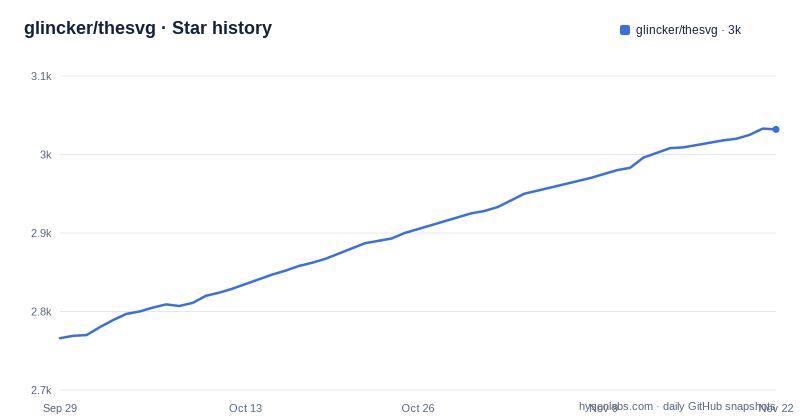
Star history
- glincker/thesvg3,032 ★ · +266
| Repository | 2026-09-29 | 2026-11-22 |
|---|---|---|
| glincker/thesvg | 2.8k | 3k |
266 Stars in the last 54 days, measured from the daily GitHub snapshot. Compare with other projects
Editorial analysis
The icon count disagrees between the repository description and the README
The GitHub description says 7,400+ brand SVG icons. The README header says 7,600+ brand logos and cloud icons, and the section explaining why the project exists says it now holds over 7,600 icons. Two numbers from the same project in two places is a small thing, but it tells you the catalog is growing faster than the descriptions are updated.
The practical consequence is that you should not hard-code an expected total, for example in a test that counts entries, and you should not use the figure to compare catalogs. Check for the specific brand you need on the site or through the manifest. The README also describes the contents as brand logos, cloud architecture diagrams and a set of interface icons of the project's own, so the catalog is broader than the phrase brand icons suggests.
The catalog began with a declined pull request, which explains its open admission policy
The origin story is short. The authors tried to add the logo of their own product, AskVerdict, to an existing open source logo library, and the request was declined as outside that project's scope. They call that a fair call for a curated set, and it made them want a catalog where any real brand, large or small, can be added through a simple review.
That sets the trade you are accepting. A curated library keeps a small, consistent set; theSVG chooses breadth and relies on review plus checks before each merge. The stated rule in the standards table is that if a brand is real, it belongs here. The upside is that obscure vendors have logos. The downside is that the catalog includes marks from companies you may never have heard of, so a search result is a match on a name, not a signal that the brand is established.
Five variants under one naming scheme, validated only on changed files
Each brand is meant to ship default, mono, light, dark and wordmark variants under a predictable path pattern, so that {slug}/{variant}.svg always works. A validator runs in CI on every changed file and rejects scripts, embedded rasters, null or NaN values, and files missing a viewBox. It also checks that mono files really are single color.
Two consequences follow. First, the path pattern makes it practical to generate URLs in code instead of looking each one up. Second, the validator is described as running on changed files, so it guards what enters the repository from a pull request, and you cannot read it as a promise that every file was re-audited on every release. The sources for each icon are said to be official brand assets, taken unmodified from the brand's kit or site, with no redraws. If a logo looks off, compare it with the brand's own kit, which the entry links.
When a brand changes its logo, the old mark stays under a -legacy slug
The rebrand rule is explicit. The new mark becomes current, and the old one is kept as a -legacy entry, linked both ways. Nothing silently disappears.
For a consumer, this changes how you pin a logo. If your code asks for a brand's slug, you get whatever is current, so a product's logo can change under you after an update to the catalog. If you need the previous mark for a historical page or a screenshot, request the -legacy entry deliberately. The cost is that the catalog now contains two slugs for one company, and a search for the name returns both. The README frames this as treating brand logos as versioned data, which is the reason to also pin your package version rather than float on a latest tag.
Many delivery channels and many package versions, and a major release only days old
The README lists SVG files, React, Vue, Svelte, CDN, CLI and MCP as ways to consume the catalog, and the badge row points at more: an npm package named thesvg, @thesvg/icons, @thesvg/mcp-server, a Figma plugin, a VS Code extension, a Raycast extension, an Iconify set, Neovim, Alfred and browser extensions, a Homebrew tap and a skills.sh entry. Packages in the workspace also include ui, ui-react, ui-vue, ui-svelte and ui-react-native.
The versions are not aligned. The recent releases are [email protected] on 2026-11-02, [email protected] on 2026-10-27, and @thesvg/[email protected] on the same day as 4.0.0. The root package.json is private and says 0.1.0, which is the monorepo shell and not a published number. A major release a week old, followed by a patch, is a reason to pin exact versions and read the changeset before upgrading. A CLI below 1.0 also gives no stability promise.
MIT covers the code, while each logo still belongs to its brand
The standards table says the project is open to everyone: MIT code, no accounts and no API keys. It also says every entry carries a license and a guidelines link taken from the brand. The repository root holds DISCLAIMER.md, LEGAL.md, LICENSING.md and TRADEMARK.md next to the LICENSE file, which is a signal that the licensing of the logos is handled separately from the code.
The consequence is that having a logo in a convenient package does not grant you permission to use it any way you like. A brand's guidelines may restrict color changes, spacing or the context in which the mark appears. Before putting a logo on a landing page, in an integrations grid or in a paid product, open that entry's guidelines link. The project can make the file clean and findable. It cannot make a trademark yours.
The dev script kills whatever listens on port 3333, and the build runs seven generators first
Contributors work in a pnpm workspace on a Next.js site, with next at 16.4.3. The dev script runs lsof against port 3333, passes the result to kill -9, and then starts next dev on that port. Anything of yours already listening on 3333, even unrelated to this project, is killed.
The build script is a chain: it emits SVGs, generates icon tones, the API, the feed, llms.txt, draw.io libraries and Excalidraw libraries, and only then runs next build. That is why the repository exposes a static manifest and llms.txt, but it also means a failure in any generator stops the whole build. Testing splits into test:brand and test:ui, each of which fans out into the packages' own test suites, and ui:check verifies the generated UI data. Expect a full test run to touch every workspace package.
Editorial conclusion
theSVG suits developers who want brand logos as versioned, predictable assets across SVG, framework packages, CDN or MCP. It does not settle trademark questions or promise a fixed icon count. Pin the package version after the fresh 4.0 release, and read each entry's license and guidelines link before shipping a logo in a product.
Frequently asked questions
What do people use SVG files for, according to theSVG?
theSVG serves brand logos, cloud architecture diagrams and interface icons as SVG files that developers drop into sites and apps. They can also take them as React, Vue and Svelte components, from a CDN, or through the CLI and MCP server.
How do I use an SVG from theSVG in HTML?
The catalog offers stable CDN URLs and a predictable {slug}/{variant}.svg path, with variants default, mono, light, dark and wordmark. You can also install the thesvg npm package for framework use.
Are the logos in theSVG free to use anywhere?
The code is MIT licensed, but every entry carries a license and a brand guidelines link. The logos remain the brands' marks, so check the entry's guidelines before shipping one.
Official sources
Add this badge to your README
If you maintain this project, the badge below links readers to this analysis and shows its maintenance status from the daily GitHub snapshot. Paste the markdown into your README; add ?metric=license or ?metric=stars to the image URL for a different field.

[](https://hysenlabs.com/projects/glincker-thesvg)Star history chart for your README
[](https://hysenlabs.com/projects/glincker-thesvg)Was this useful?