Clone Wars: A Curated Index of Open Source Site Clones for Learning
100+ open-source clones of popular sites like Airbnb, Amazon, Instagram, Netflix, Tiktok, Spotify, Whatsapp, Youtube etc. See source code, demo links, tech stack, github stars.
At a glance
- What is it?
- Clone Wars aggregates over 100 open source clones and alternatives to popular sites, each with source code, demos, and tech stacks. It is a learning resource, not a production toolkit, and its value depends on the maintainer's curation.
- Who is it for?
- Adopt Clone Wars if you are a developer or student seeking hands-on examples of full-stack architectures, with tutorials and demos in the tutorial table. Skip it if you need production-ready code or a maintained, quality-filtered index, since the list mixes learning clones with functional alternatives and relies on community contributions.
- Can I use it commercially?
- Yes, with strict conditions. AGPL-3.0 is a network copyleft licence: if people use a modified version over a network, for example as a hosted service, you must offer them its source code under the same licence.
- Is it still maintained?
- Probably not. The repository last received commits 27 months ago, on August 6, 2024.
- What is it written in?
- GitHub does not report a main language for this repository.
Answers come from the project's GitHub data, last synced on November 15, 2026, and from our analysis. They are not legal advice.
Star history
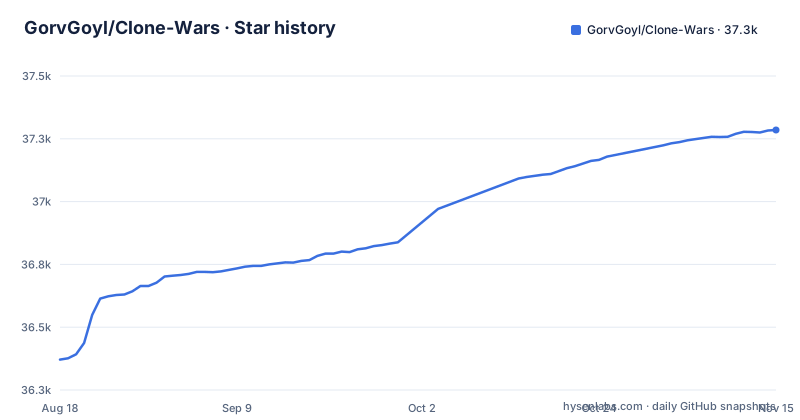
- GorvGoyl/Clone-Wars37,285 ★ · +914
| Repository | 2026-08-18 | 2026-11-15 |
|---|---|---|
| GorvGoyl/Clone-Wars | 36.4k | 37.3k |
914 Stars in the last 89 days, measured from the daily GitHub snapshot. Compare with other projects
Editorial analysis
What Clone Wars Solves and Who It Serves
Clone Wars addresses a specific pain: finding real, inspectable codebases that mimic popular websites. Instead of searching GitHub blindly, a developer gets a table of over 100 clones and alternatives for sites like Airbnb, Amazon, Instagram, Netflix, TikTok, Spotify, WhatsApp, and YouTube. Each row links to the repository, a demo, and the tech stack. The intended audience is clear from the README: people learning to build full-stack applications. The project's creator, Gourav Goyal, positions it as a learning aid, not a production resource. It is for someone who wants to see how a React frontend pairs with Firebase, or how a Django backend serves a Discord-like chat, without starting from scratch.
How the List Is Organized: Two Tables, Two Purposes
The repository splits its content into two tables. The first, 'Clones with Tutorials,' lists full-stack clones that come with free tutorials, usually YouTube videos or freeCodeCamp articles. For example, an Airbnb clone uses Sanity SDK, Next.js, and React Hooks, with separate backend and frontend repos. The second table, 'Clones and Alternatives,' contains two kinds of projects. Clones are UI-similar but not fully functional, mostly built for practice. Alternatives are fully functional open source replacements for popular software. The README suggests that checking GitHub stars gives a rough idea of which is which. This dual structure is practical: a learner can pick a tutorial-backed clone to follow along, or a functional alternative to study a production-grade codebase.
The Curation Mechanism: Community-Driven Maintenance
The maintenance model is explicit and honest. The README includes a contribution guide and a plea: 'I need your help to maintain this list up to date.' The creator also mentions looking for a maintainer to merge pull requests for new clones. This means the list's accuracy depends on volunteers catching broken demos, outdated repos, or new projects. The repository has no GitHub releases and its last push was 2024-08-06, so you cannot assume freshness. For a resource that points to external code, this is a real operational constraint. A dead demo link or a deprecated tech stack could mislead a learner who follows it without checking.
Getting Started: How to Use the Resource
There is no installation or setup for Clone Wars itself. You access the list in two ways: the GitHub repository's README or the project homepage at gourav.io/clone-wars, which the README describes as offering 'full tables with better view.' To use it, you pick a clone from the table, click the repository link, and clone that project. For tutorial-backed entries, you follow the linked YouTube or freeCodeCamp course. For example, the Instagram clone's tutorial is a freeCodeCamp article, and the repo uses React Native, Firebase Firestore, Firebase storage, Redux, and Expo. The tech stack column is the key filter: if you want to practice Vue.js, find the Twitter clone built with Vue and Quasar. There are no commands to run from this project itself, since it is a list, not a codebase.
A Genuine Limitation: Mixed Quality and Purpose
The biggest weakness is that the list mixes learning clones with functional alternatives without a clear quality bar. The README admits clones are 'mostly made for learning purposes' and may not be fully functional. That is fine for practice, but it creates a trap: a novice might mistake a UI-only clone for a production-ready app. The star count hint is vague; a project with many stars could still be abandoned or incomplete. Also, the list is static. It does not rank clones by code quality, test coverage, or security. If you need a dependable base for a real product, this is the wrong tool. You would have to evaluate each entry individually, which defeats the purpose of a curated index. The resource is a starting point, not a filter.
Alternatives: What Else Exists and How It Differs
Clone Wars focuses on clones that mimic the look and feel of specific sites, often for education, and pairs them with tutorials. One other route is GitHub topic pages, like searching for 'netflix-clone,' which returns many repos but without curation or tutorials. Clone Wars adds the tutorial link and tech stack in one place, which GitHub search does not. If you want a learning path with hand-holding, Clone Wars is the better fit.
Licence and Maintenance Costs
The repository itself is licensed under AGPL-3.0. That licence applies to the list and its content, not to the individual clones listed. Each linked project has its own license, which you must check before using its code. The AGPL-3.0 on Clone Wars means if you fork the list or build on it, you must share your changes under the same terms, but that is unlikely to matter for most readers. The maintenance cost is on the community. The creator asks for contributions and a co-maintainer, which signals that upkeep is a burden. For users, the cost is time spent verifying that a listed clone still exists and works. There is no versioning or changelog for the list itself, so you cannot track what changed between visits. The repository is not archived, but without a recent push, it may be dormant.
Who Should Adopt It and What to Verify First
Clone Wars is for self-directed learners who want concrete examples of popular app architectures. If you are following a tutorial, the demo links and tech stack columns save you from guessing. It is also useful for teachers assembling course materials. You should not adopt it as a source of production code. Before using any clone, verify three things: the linked repository's last commit date, its license, and whether the demo is live. The README's own request for maintenance is a warning that entries can go stale. Also, check if the tutorial matches the current code, since tutorials age quickly. If you find a broken link, the contribution guide likely tells you how to report it. The project works best as a jumping-off point, not a destination.
Editorial conclusion
Adopt Clone Wars if you are a developer or student seeking hands-on examples of full-stack architectures, with tutorials and demos in the tutorial table. Skip it if you need production-ready code or a maintained, quality-filtered index, since the list mixes learning clones with functional alternatives and relies on community contributions. Before relying on any entry, verify the repository's last commit, license, and whether the demo link still works, as the README itself asks for help keeping the list current. The project's real value is as a discovery tool, not a canonical source.
Frequently asked questions
What does the Clone-Wars repository actually contain?
A Markdown list of 100+ open source clones and alternatives of popular sites, alongside a LICENSE, an image folder and a GitHub Pages config file. There is no source tree, no package manifest and no release; the homepage at gourav.io/clone-wars renders the same tables in a fuller view.
How do I tell a learning clone from a real alternative in the Clone-Wars list?
The second table holds both kinds, and the README says seeing GitHub stars will give you a rough idea about which one is which. Clones look similar UI-wise but are not fully functional and are made for learning, while alternatives are fully functional open source alternatives of popular software.
Can I reuse code from a Clone-Wars entry in a commercial project?
The repository's own AGPL-3.0 grant covers the Markdown rather than the code in the repositories it links. Open the repository the row points to and read its own licence before you reuse anything.
Is the Clone-Wars list still being updated?
The last push to the repository was on 2024-08-06 and it has no GitHub releases. The README asks for help to maintain the list up to date and links to issue 209, where a maintainer is being sought to merge pull requests of new clones.
Does Clone-Wars have a YouTube clone with setup instructions?
It has several YouTube rows built on different stacks, including a React JS project using Rapid API and Material UI 5, and another on the Yii2 PHP Framework. Each row carries its own demo and repository link.
Official sources
Add this badge to your README
If you maintain this project, the badge below links readers to this analysis and shows its maintenance status from the daily GitHub snapshot. Paste the markdown into your README; add ?metric=license or ?metric=stars to the image URL for a different field.

[](https://hysenlabs.com/projects/gorvgoyl-clone-wars)Star history chart for your README
[](https://hysenlabs.com/projects/gorvgoyl-clone-wars)Was this useful?