gouthampradhan/leetcode: A Java Solution Bank with Video Walkthroughs
GitHub describes it as Leetcode solutions. The repository metadata lists Java as its primary language. This article stays within the project description and details documented in the GitHub repository README.
At a glance
- What is it?
- A personal Leetcode solutions repository in Java, organized by topic, with some solutions linked to YouTube explanations. Useful as a reference for interview prep, but it lacks build tooling and license clarity.
- Who is it for?
- Adopt this repository if you are a Java developer preparing for coding interviews and want a topical index of accepted solutions, especially if you value video walkthroughs linked from the README. Do not use it as a primary learning resource if you need explanation depth or verified complexity analysis, since most files contain only code.
- Can I use it commercially?
- Not without permission. GitHub finds no licence file in the repository, and without a licence all rights are reserved by default: you may read the code but not reuse it. Check the README, or ask the authors, before using it.
- Is it still maintained?
- Probably not. The repository last received commits 22 months ago, on December 19, 2024.
- What is it written in?
- Mainly Java, according to GitHub's language statistics.
Answers come from the project's GitHub data, last synced on October 22, 2026, and from our analysis. They are not legal advice.
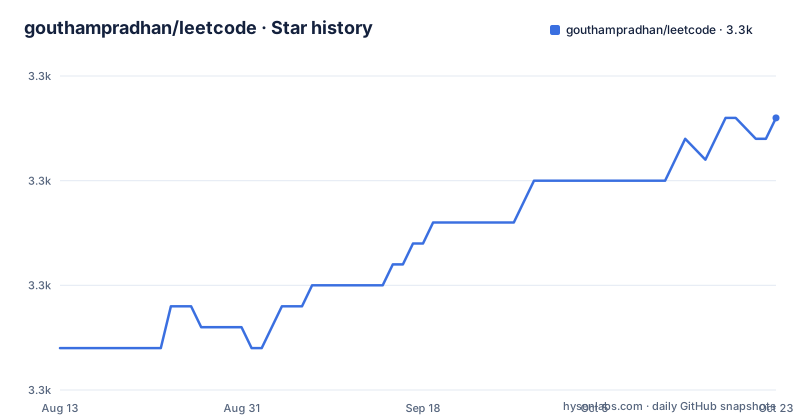
Star history
- gouthampradhan/leetcode3,322 ★ · +10
| Repository | 2026-08-13 | 2026-10-22 |
|---|---|---|
| gouthampradhan/leetcode | 3.3k | 3.3k |
10 Stars in the last 70 days, measured from the daily GitHub snapshot. Compare with other projects
Editorial analysis
What This Repository Actually Offers
The repository is a collection of Java solutions to Leetcode problems, organized by algorithmic category. The README lists dozens of files under folders like array, backtracking, and binary_search, each named after the problem it solves. The stated purpose is to share accepted solutions to common interview problems, and some entries include a link to a YouTube channel called codernaut. This is not a framework, a library, or a tutorial. It is a personal archive of code, meant to be browsed by problem name or category. The target audience is a Java developer who already knows how to solve problems and wants a quick reference, or someone who wants to see how another engineer approached a specific task.
How the Solutions Are Structured and Why That Matters
The organization is by data structure or technique: array, backtracking, binary_search, and likely more folders beyond the truncated README. Each Java file corresponds to one problem, with a class name that often matches the problem name, such as TwoSum.java or ProductOfArrayExceptSelf.java. This flat, topic-based layout makes navigation predictable. You can open the array folder and scan for a problem you are practicing. However, there is no evidence of a build system like Maven or Gradle, no test suite, and no package-level documentation. The source path src/main/java suggests a Maven-style convention, but no pom.xml is mentioned. For an engineer, this means you can read the code directly, but you cannot compile and run it as a project without adding your own build configuration. The absence of tests is a real gap: you cannot verify that a solution still works after Leetcode changes its test cases.
The YouTube Video Links: A Differentiator
The README explicitly states that some solutions have a YouTube video link, pointing to a channel named codernaut. This is unusual for a solutions repository. Most similar projects offer only code. The video links could be valuable for learners who benefit from a spoken explanation of the approach, especially for hard problems like First Missing Positive or Regular Expression Matching. But the README does not say which problems have videos, nor does it embed the links directly in the list. You would have to open each Java file to see if a comment or annotation points to a video. That is a usability flaw: the promise of video support is not surfaced at the index level. If the author intends videos to be a selling point, they should mark them in the README table. As it stands, the videos are a hidden feature.
Getting Started: Commands and Configuration
There are no installation instructions, no build commands, and no dependency declarations in the README. The repository layout with src/main/java implies a standard Java project, but without a pom.xml or build.gradle, you cannot run mvn compile or gradle build. To use the code, you would copy a single Java file into your own project or use a Java compiler directly, for example: javac TwoSum.java. Since the solutions are self-contained (they likely use only standard library classes), this works for most files. But some problems, like Read N Characters Given Read4, may rely on a Leetcode-provided API that is not included. You would need to stub that interface yourself. The lack of a build file means the repository is not a drop-in module; it is a set of source snippets. For a quick lookup, that is fine. For integration into a larger codebase, you will do manual work.
Limitations and Failure Modes
The most obvious limitation is the missing license. The metadata says license unknown. That means you have no legal clarity on copying, modifying, or redistributing the code. For personal study, that is usually acceptable, but for a company or a published project, it is a blocker. Another limitation is the lack of time or space complexity annotations. The README gives difficulty labels like Easy, Medium, Hard, but no Big O analysis. A serious interview candidate needs to understand why a solution is efficient, not just that it is accepted. The code itself may contain comments, but the README does not summarize them. Also, the repository is not actively maintained; the last push is unknown, and there are no recent releases. Leetcode problems change, and solutions that passed years ago may fail now. The absence of tests means you cannot detect that without running each file yourself. Finally, this is a single author's perspective. Some solutions may be clever but non-standard, or vice versa. There is no peer review or community discussion visible.
Comparison with Alternative Approaches
A common alternative is a repository like LeetCode-Solutions by a large community, which often includes multiple languages, detailed explanations, and complexity analysis in the README. The difference is in depth: community repositories tend to document the reasoning behind each solution, sometimes with links to discussion threads. gouthampradhan/leetcode offers code and occasional video links, but no written rationale. Another alternative is the official Leetcode discussion forum, where you get upvoted solutions and real-time feedback from other users. That approach is more interactive but less organized by topic. A third alternative is a paid course or a book like Cracking the Coding Interview, which provides structured pedagogy. This repository is a reference index, not a teaching tool. If you need to understand the 'why', go elsewhere. If you need a quick Java snippet for a known problem, this works.
Maintenance and Upgrade Cost
The repository has no release history and no visible commit frequency. The last push is unknown, which suggests it may be dormant. For a user, that means you cannot expect fixes or updates. If a Leetcode problem changes its constraints, the solution might not be re-verified. The cost of using this repository is the time you spend manually checking each solution against the current Leetcode version. There is no test harness to automate that. For a single problem, you can copy the code, run it in the Leetcode editor, and see if it passes. For a batch, that is tedious. The lack of a license also adds a legal cost if you plan to incorporate the code into a project that you distribute. You would need to contact the author or choose another source. In short, the maintenance burden falls entirely on the consumer.
Editorial conclusion
Adopt this repository if you are a Java developer preparing for coding interviews and want a topical index of accepted solutions, especially if you value video walkthroughs linked from the README. Do not use it as a primary learning resource if you need explanation depth or verified complexity analysis, since most files contain only code. Before relying on it, verify that each solution still passes on the current Leetcode platform, as problem constraints and test cases change over time. Also check the license or contact the author if you plan to reuse code beyond personal study, because the repository does not declare one. The project is a snapshot of one engineer's accepted answers, not a maintained library, so treat it as a reference index rather than a canonical source.
Frequently asked questions
What is in the gouthampradhan/leetcode repository?
Accepted Java solutions to common LeetCode interview problems, grouped by topic into directories under src/main/java, with the README linking each problem name to a file and a difficulty label. The README also says some solutions have a video link and points at a YouTube channel.
Which language are the gouthampradhan/leetcode solutions written in?
Java. Every entry links to a .java file, and the repository root has a build.gradle with the sources under src/main/java, arranged as one directory per topic such as array, backtracking and binary_search.
How do I build gouthampradhan/leetcode?
The README does not say. The root holds only .gitignore, README.md, build.gradle and src, so there is no Gradle wrapper, no test directory and no build or run command on the page.
Are the difficulty labels in gouthampradhan/leetcode reliable?
They are hand written and inconsistent. One array entry is labelled Median, which is not a difficulty on the Easy, Medium and Hard scale those labels use, and at least one entry, Search Insert Position, carries no label at all.
What license does gouthampradhan/leetcode use?
Nothing in the repository states one. The repository header records no recognised licence value, and there is no LICENSE file among the four top level entries.
Official sources
Add this badge to your README
If you maintain this project, the badge below links readers to this analysis and shows its maintenance status from the daily GitHub snapshot. Paste the markdown into your README; add ?metric=license or ?metric=stars to the image URL for a different field.

[](https://hysenlabs.com/projects/gouthampradhan-leetcode)Star history chart for your README
[](https://hysenlabs.com/projects/gouthampradhan-leetcode)