guardian/grid: architecture, local services, and adoption limits
The Guardian’s image management system
At a glance
- What is it?
- Guardian Grid is a Scala and Play Framework image management system composed of hypermedia APIs, an AngularJS interface, and AWS-backed infrastructure. It fits organizations operating a substantial media library, but its README leaves deployment and startup procedures largely in the documentation tree.
- Who is it for?
- Grid is appropriate for engineering teams evaluating the Guardian's microservice-based media architecture or operating a comparable image catalog backed by Elasticsearch and AWS. It is a poor fit for users seeking a documented, single-command desktop image tool or a lightweight build-time asset pipeline.
- Can I use it commercially?
- Yes. Apache-2.0 is a permissive licence: you can use, modify and sell software built on it, as long as you keep its copyright and licence notices.
- Is it still maintained?
- Yes. The repository received new commits within the last day.
- What is it written in?
- Mainly Scala, according to GitHub's language statistics.
Answers come from the project's GitHub data, last synced on October 23, 2026, and from our analysis. They are not legal advice.
Star history
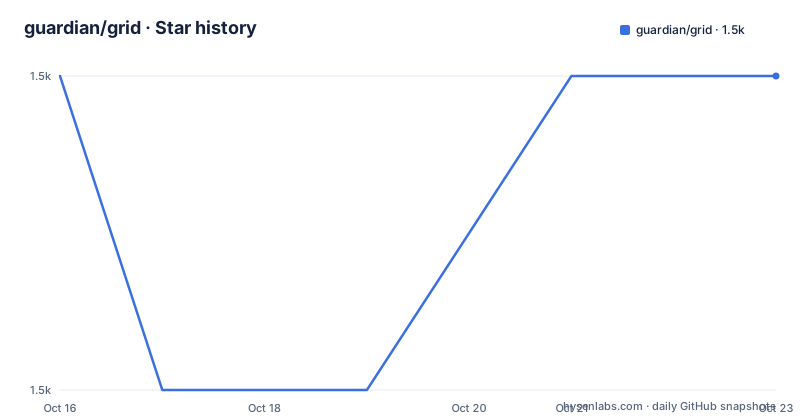
- guardian/grid1,461 ★ · +0
| Repository | 2026-10-16 | 2026-10-23 |
|---|---|---|
| guardian/grid | 1.5k | 1.5k |
0 Stars in the last 7 days, measured from the daily GitHub snapshot. Compare with other projects
Editorial analysis
What Grid's media model is intended to solve
Grid addresses the problem of storing, finding, and reusing an image collection as part of a publishing operation. The README describes it as The Guardian's image management system. It connects that purpose to media that is organized, accessed economically, and used to produce high-quality content. This places Grid closer to an internal editorial platform than to a generic image-processing library. Its intended users are teams that need a searchable catalog and operational services around media assets, rather than developers who only need to resize a local image.
The repository layout supports that interpretation. Top-level entries include `cropper/`, `image-loader/`, `image-cache-purger/`, `image-counter-lambda/`, `image-embedder-lambda/`, `media-api/`, `metadata-editor/`, `quarantine-status/`, and `usage/`. Names such as `metadata-editor`, `image-counter-lambda`, and `usage` point to separate concerns around asset information, counting behavior, and usage handling. This is not presented as one command that processes every image operation. It is a collection of services around a media estate.
The README points to `docs/00-about/01-vision.md` for the project's core principles. That is an important boundary for evaluation. The root document identifies the purpose and technology stack, but it does not define supported image formats, storage retention rules, metadata fields, role permissions, or the exact behavior of these services. An adopter should not infer those details from directory names alone.
Grid's microservice and hypermedia architecture
Grid runs as a set of independent microservices written in Scala with Play Framework. According to the README, those services expose hypermedia APIs using the `argo` specification, while an AngularJS web interface provides user access. This separates the browser experience and service implementations from the API layer, but the README does not publish an endpoint catalog or describe how clients discover and follow those links.
Elasticsearch is the stated search dependency. The repository's `docker-compose.yml` assigns Elasticsearch version `8.18.3`, configures a 1 GB heap through `ES_JAVA_OPTS`, mounts a repository-provided configuration file, and exposes port `9200`. Those details make search an explicit operational dependency rather than an incidental feature. They do not establish production sizing, query behavior, index mappings, or recovery expectations.
AWS services provide additional storage and communication mechanisms. Local development uses LocalStack to represent several AWS services on one host, including CloudFormation, CloudWatch, DynamoDB, Kinesis, S3, SNS, SQS, and IAM. The architecture therefore includes both request-facing web services and cloud-backed components. The README does not document the data path for a single upload, search, crop, or deletion request, so it would be misleading to claim that every operation passes through every listed service.
The local development stack behind guardian/grid
The repository includes `docker-compose.yml`, but the README does not provide an exact install or startup command. It directs developers to `./docs` for setup and running guides. A complete first launch therefore cannot be reproduced from the root documentation alone. The README does not say which command should start the stack, whether a `.env` file must be populated, what prerequisites are required, or which services must run before the Grid applications can be opened.
The compose file confirms several concrete local dependencies. It defines Elasticsearch on `9200`, a locally built `imgops` service on `9008`, Cerebro on host port `9090`, and a local OIDC provider on `9014`. LocalStack exposes its gateway at `127.0.0.1:4566` and an external-service range from `4510` through `4559`. Its configured region is `eu-west-1`, and the enabled service list includes `cloudformation`, `cloudwatch`, `dynamodb`, `kinesis`, `s3`, `sns`, `sqs`, and `iam`.
The OIDC container loads `./dev/config/users.json` and imports environment settings from `./dev/.env`. That file is referenced but its contents are not shown in the README. This creates a setup dependency that the root documentation does not explain. The compose file also mounts `/var/run/docker.sock`, which gives the local environment access to the host Docker socket. An organization should account for that boundary before using the development configuration on a shared machine.
Search, AWS emulation, and first-use boundaries
A first real use would begin in the repository's setup documentation rather than with an application command stated by the README. Based on the repository layout, a developer would need to establish the local dependencies in `docker-compose.yml`, provide the environment settings expected by the OIDC provider, and follow `docs/` for starting the Scala services and accessing the AngularJS interface. The README does not give the final URL for that interface, a sample image ingestion request, or a command that performs a crop.
Cerebro provides a separate local service on `9090`, based on the compose mapping, but the README does not explain whether it is intended as the normal developer interface or only as an Elasticsearch administration tool. LocalStack makes AWS-facing development possible without immediately calling every AWS service, yet the compose file does not establish whether a particular Grid workflow requires S3, Kinesis, SQS, SNS, DynamoDB, or a subset of them.
The repository also contains `e2e-tests/` and `stress-test/`, which show that testing assets exist. Their presence does not reveal supported environments, pass rates, performance limits, or whether they are expected for local use. There are also no GitHub releases. An evaluator cannot use a release history to choose a version or assess a documented upgrade path. The actual entry points must come from the setup guides under `docs/`.
Grid's operational limits and maintenance signals
Grid's architecture brings operational cost because it distributes media functions across multiple microservices and depends on Elasticsearch, AWS integrations, and a web interface. The repository signals this breadth through `cdk/`, `riff-raff.yaml`, `get-stack-resource.sh`, `scripts/`, service-specific modules, and local infrastructure definitions. Those files indicate that deployment and infrastructure work form part of the project, but the README does not describe the production topology or the exact responsibilities of each deployment tool.
The last repository push was on 2026-10-16, and the repository is not archived. No GitHub releases are present, however, so there is no documented release cadence, compatibility matrix, migration guide, or stable-version policy in the repository summary. The README's badge and documentation links point to a `master` branch even though the stated default branch is `main`. That discrepancy should be checked against the actual branch layout during setup rather than silently resolved in an evaluation.
Grid is licensed under `Apache-2.0`, with `LICENSE` and `NOTICE` files present. This identifies the stated licensing model for the code, but the README does not describe how the license interacts with separately operated services, The Guardian content, or third-party AWS resources. No legal conclusion about a deployment can be made from the license label alone.
A different approach for smaller image workflows
A static asset pipeline is a real alternative when the requirement is limited to transforming files during a build. Grid instead presents a service architecture with persistent search, metadata-oriented components, usage handling, cloud communication, and an interactive application. The difference is not merely the programming language. A build pipeline processes declared assets through configured transformations, while Grid is designed around services that expose APIs and support operations across an organized media collection.
That makes Grid more relevant for editorial organizations with shared media libraries and service-backed workflows. It is the wrong choice when the only requirement is deterministic image resizing at build time, deploying AWS integrations is unacceptable, or the team cannot operate Elasticsearch and several independent services. The README does not present a simple library-only usage mode, so adopting Grid for a narrow transformation task would add infrastructure before demonstrating a clear need for catalog or media-management features.
Editorial conclusion
Grid is appropriate for engineering teams evaluating the Guardian's microservice-based media architecture or operating a comparable image catalog backed by Elasticsearch and AWS. It is a poor fit for users seeking a documented, single-command desktop image tool or a lightweight build-time asset pipeline. Before adoption, inspect `docs/` for prerequisites and startup procedures, then verify that the AWS integrations, local dependencies, and AngularJS frontend fit the target environment. The first unresolved item is the absence of a complete installation tutorial at the repository root.
Frequently asked questions
What is guardian/grid used for?
Grid is The Guardian's image management system for accessing and organizing media used in content production. It combines image-related services, search, metadata functions, and usage-related components.
What technologies does guardian/grid use?
The backend is built with Scala and Play Framework, exposes hypermedia APIs based on `argo`, and uses an AngularJS web interface. Elasticsearch provides search, while AWS services support storage and communication.
How do I set up guardian/grid for local development?
The README points to `docs/` for setup and running guides. `docker-compose.yml` defines Elasticsearch, `imgops`, Cerebro, LocalStack, and an OIDC provider, but the README does not state the exact startup command or initial interface URL.
Official sources
Add this badge to your README
If you maintain this project, the badge below links readers to this analysis and shows its maintenance status from the daily GitHub snapshot. Paste the markdown into your README; add ?metric=license or ?metric=stars to the image URL for a different field.

[](https://hysenlabs.com/projects/guardian-grid)Star history chart for your README
[](https://hysenlabs.com/projects/guardian-grid)Was this useful?