Aethon: a Tauri VPN client for the Aether core on Windows and Android
Independent production-ready Windows GUI for Aether — Tauri v2 and Rust
At a glance
- What is it?
- Aethon is an independent Tauri v2 client that bundles the Aether 1.9.0 networking core and an Xray 26.3.27 routing engine for system-wide VPN routing or a local SOCKS5 proxy. The 2.1.1 release adds a self-verifying update pipeline, and the Windows binaries are still unsigned.
- Who is it for?
- Aethon fits Windows 10/11 x64 and Android 8.0+ users who want a GUI over the Aether core with verified, self-updating packages and AGPL-licensed client code. It does not fit iOS users, and it does not fit anyone unwilling to click past a SmartScreen warning on an unsigned Windows binary or to wait for the suspended Psiphon integration.
- Can I use it commercially?
- Yes, with strict conditions. AGPL-3.0 is a network copyleft licence: if people use a modified version over a network, for example as a hosted service, you must offer them its source code under the same licence.
- Is it still maintained?
- Yes. The repository last received commits 44 days ago.
- What is it written in?
- Mainly Rust, according to GitHub's language statistics.
Answers come from the project's GitHub data, last synced on November 21, 2026, and from our analysis. They are not legal advice.
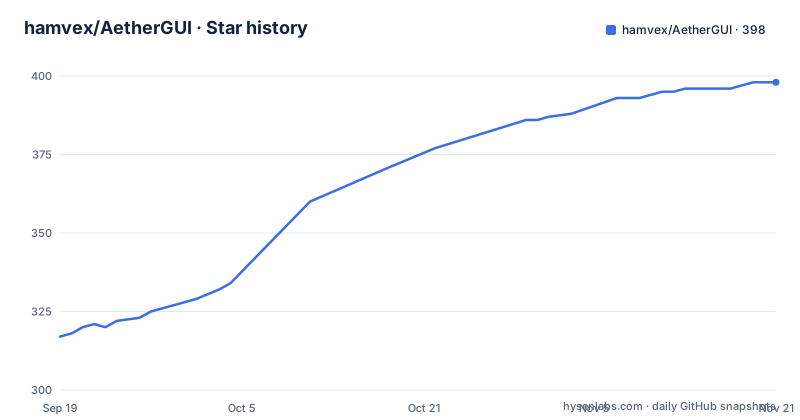
Star history
- hamvex/AetherGUI398 ★ · +81
| Repository | 2026-09-19 | 2026-11-21 |
|---|---|---|
| hamvex/AetherGUI | 317 | 398 |
81 Stars in the last 63 days, measured from the daily GitHub snapshot. Compare with other projects
Editorial analysis
Three names, one stack
This project answers to three names, and sorting them out is the first step. The repository is hamvex/AetherGUI, the application is called Aethon, and the engine it wraps is Aether, an independent networking core by CluvexStudio. The README describes Aethon as a Windows and Android client for that core, and version 2.1.1 bundles a verified Aether 1.9.0 core together with an Xray 26.3.27 routing engine.
The client offers two postures: system-wide VPN routing through a TUN adapter, or a proxy-only local SOCKS5 listener that defaults to 127.0.0.1:1819. The GUI is built with Tauri v2 and Rust, and the whole client is licensed AGPL-3.0. Existing VPN services, state management, routing recovery, Smart Connect and split tunneling carry over from earlier releases.
Installing on Windows and Android
Downloads live on the GitHub releases page for v2.1.1. Windows users pick between a recommended x64 setup installer, an MSI, or a portable zip; Android users pick a universal APK containing ARMv7, ARM64 and x86_64 libraries, a per-architecture APK, or a Play App Bundle. A SHA256SUMS.txt file covers the release. The README warns that Windows binaries are currently unsigned and may trigger a SmartScreen warning, while Android packages are signed with the established Aethon signing certificate.
On Windows, the documented first run is: install or extract, launch, keep VPN Mode for system-wide routing or choose Manual SOCKS5 for proxy-only use, pick a protocol and scan mode, then press Connect. VPN mode may request administrator permission to configure the TUN adapter and protected routes. Diagnostics provides live logs, connection testing and network recovery. On Android, you install the APK, approve the VPN permission on first connection, choose a mode and protocol, connect, and optionally add the Aethon VPN Quick Settings tile. The application ID stays io.github.hamvex.aethergui for update compatibility.
The update pipeline checks itself
Version 2.1.1 turns updating into a verified pipeline rather than a manual download ritual. Both clients check at startup and every 12 hours while running, with a manual Check for Updates control in settings, and they surface the current version, the latest version, update status and GitHub release notes. An Automatically download updates preference exists; Android downloads over Wi-Fi through the system DownloadManager so transfers resume, while Windows pulls the official x64 setup installer and shows progress in the app.
Verification runs on both platforms: SHA-256 checks against the release digests, and Android additionally verifies that a downloaded APK was signed with the same certificate as the installed app. Update URLs are restricted to the official repository, and the README documents the endpoint both clients poll:
https://api.github.com/repos/hamvex/AetherGUI/releases/latestFuture releases must carry the Windows installer, the universal Android APK, digest files and release notes, so no custom update backend is required. One policy note the README itself raises: distributing the Android APK through Google Play would require reviewing REQUEST_INSTALL_PACKAGES and the self-update flow against current Play rules.
What 2.1.1 changed in routing
The Windows release notes for 2.1.1 centre on making routing failures survivable. Routing-helper and Xray lifecycle management became transactional within a single session, the app now recovers from stale Aethon-owned TUN adapters and failed routing sessions, and Xray exit diagnostics were preserved in sanitized form with immediate reconnect cleanup. Scan Mode returned, along with protocol-specific MASQUE HTTP/3 or HTTP/2 transport controls, and obsolete MASQUE obfuscation values are migrated without being confused with Scan Mode.
The interface work chases Android parity in the other direction: English and Persian translations with right-to-left layout support were added, a Windows language selector arrived, and the compact Connect, Configurations and Settings navigation was kept.
The suspended Psiphon hop, stated plainly
The README is unusually direct about a feature that is not there. The Windows Psiphon second-hop integration is marked experimental and suspended, and it is not included in the current release. It awaits official Psiphon integration guidance and valid SponsorId and PropagationChannelId configuration values.
The boundaries are specific: Psiphon is not exposed in the UI, the production backend does not launch it, and its executable is not bundled in current installers. The completed implementation, a pinned source revision, reproducible build instructions, licence and provenance remain in the repository for a future reactivation review, and npm run fetch:psiphon is described as a developer-only source-build command. The README closes the section by saying no Psiphon traffic success is claimed, which is the right posture for an integration waiting on third-party credentials.
Building from source
The client is a Tauri v2 workspace, and the package.json scripts show the seams. The frontend and packaging scripts are standard Tauri, while the fetch scripts pull pinned external engines:
"dev": "tauri dev",
"build": "tauri build",
"test": "node tests/frontend.test.mjs",
"build:android": "cd android && gradlew.bat assembleRelease"
Other scripts not shown there drive the assembly: fetch:core and fetch:routing run PowerShell scripts that retrieve the Aether core and the Xray routing engine, fetch:android pulls Android assets, and package:release assembles a release. The Android build produces a release APK from the android/ Gradle project. Dependencies are light: @tauri-apps/cli as a dev dependency, with the Tauri API and plugin-opener as runtime dependencies.
The tree also carries tests/, a SECURITY.md, an SBOM in AETHON_SBOM.json and AETHON_SBOM.md, plus NOTICE.md and TRADEMARK.md alongside the AGPL licence, which is more compliance furniture than most GUI clients of this size ship.
Releases, dates and what to verify
The release cadence is short: v1.2.1 on 2026-08-18, v2.0.0 on 2026-08-19, and v2.1.1 on 2026-09-13, with the last push on the same date. Version 2.1.1 pins the core at 1.9.0 and the routing engine at 26.3.27 on both platforms, so the client's capabilities move only when a new bundle lands.
Three checks are worth making before you rely on it. Read SECURITY.md and compare your download against SHA256SUMS.txt, since the Windows builds are unsigned. Confirm the bundled Aether core version against the upstream CluvexStudio/Aether project if core-level behaviour matters to you. And if you read about the Psiphon second hop anywhere, remember it is suspended in the current release.
Editorial conclusion
Aethon fits Windows 10/11 x64 and Android 8.0+ users who want a GUI over the Aether core with verified, self-updating packages and AGPL-licensed client code. It does not fit iOS users, and it does not fit anyone unwilling to click past a SmartScreen warning on an unsigned Windows binary or to wait for the suspended Psiphon integration. Before installing, verify your download against SHA256SUMS.txt, read SECURITY.md, and check the bundled core version against the upstream Aether project, since the client is only as current as its 1.9.0 bundle. The last push was on 2026-09-13, the same day v2.1.1 shipped.
Frequently asked questions
Is Aethon the same project as Aether?
No. Aether is the networking core by CluvexStudio, while Aethon is hamvex's independent GUI client for it, bundling a verified Aether 1.9.0 core and an Xray 26.3.27 routing engine.
Why does Windows warn me about Aethon?
The README states the Windows binaries are currently unsigned, which is why SmartScreen may appear. The release publishes SHA256SUMS.txt for verification, and the Android packages are signed.
Does Aethon support iOS?
No iOS package is documented. The current release covers Windows 10/11 x64 and Android 8.0 or newer on ARMv7, ARM64 and x86_64.
Official sources
Add this badge to your README
If you maintain this project, the badge below links readers to this analysis and shows its maintenance status from the daily GitHub snapshot. Paste the markdown into your README; add ?metric=license or ?metric=stars to the image URL for a different field.

[](https://hysenlabs.com/projects/hamvex-aethergui)Star history chart for your README
[](https://hysenlabs.com/projects/hamvex-aethergui)Was this useful?