HProxy free-proxy-list: a continuously verified proxy feed with real metadata
The biggest free proxy list. 780,000+ proxies collected globally and verified around the clock, thousands live & working right now. HTTP, HTTPS, SOCKS4 & SOCKS5 with country, anonymity grade & latency. Powered by HProxy.
At a glance
- What is it?
- This repository aggregates proxies from 100+ public sources, verifies them around the clock, and publishes filtered txt, json, and csv files. The core judgement: it is a practical data source for quick scripts, but you must treat every entry as untrusted and short-lived.
- Who is it for?
- Adopt this repository if you need a quick, no-signup source of many proxy candidates for low-stakes tasks like scraping public pages or testing proxy logic. Skip it if you need reliable proxies for production traffic, because free proxies are ephemeral and untrusted by nature.
- Can I use it commercially?
- Yes. MIT is a permissive licence: you can use, modify and sell software built on it, as long as you keep its copyright and licence notices.
- Is it still maintained?
- Yes. The repository received new commits within the last day.
- What is it written in?
- GitHub does not report a main language for this repository.
Answers come from the project's GitHub data, last synced on October 22, 2026, and from our analysis. They are not legal advice.
Star history
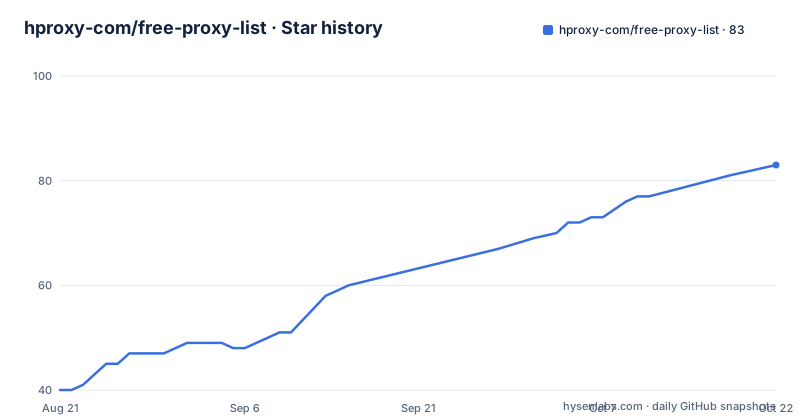
- hproxy-com/free-proxy-list83 ★ · +43
| Repository | 2026-08-21 | 2026-10-22 |
|---|---|---|
| hproxy-com/free-proxy-list | 40 | 83 |
43 Stars in the last 62 days, measured from the daily GitHub snapshot. Compare with other projects
Editorial analysis
What this repository actually gives you
The HProxy free-proxy-list solves a mundane but real problem: collecting free public proxies from many scattered sources and normalizing them into one place. The README claims over 671,906 proxies tracked all-time, with 42,168 live at the time of writing. That number is a snapshot, not a promise. The value is not the raw count; it is the attached metadata. Each proxy in all.json and all.csv carries protocol, anonymity grade, country, city, latency in milliseconds, and uptime over 24 hours and 7 days. Most free proxy lists hand you a bare ip:port and nothing else. This one gives you enough to filter before you even make a request. The target audience is developers who need a quick pool of candidates for scraping, testing, or geolocation checks, and who do not want to assemble their own aggregator.
How verification works, as far as the documentation shows
The README describes a pipeline: candidates are pulled from over 100 public sources every few minutes, then tested through HTTP, HTTPS, SOCKS4, and SOCKS5 around the clock. Each proxy is labeled with the protocols it actually answered on, not just the ones it was listed under. That distinction matters because a proxy advertised as SOCKS5 might only respond on HTTP. The repository also grades anonymity as transparent, anonymous, or elite, based on whether the proxy leaks your real IP. Latency and uptime are measured, not guessed. The published files hold proxies confirmed working within the last 48 hours. That freshness window is short, which is good for accuracy but means the list changes constantly. The README does not explain how often the files are regenerated beyond saying the list is refreshed every few minutes. The exact testing methodology, such as what request is sent or how many retries, is not documented in the material.
Getting the data: raw files, CDN, and code snippets
You do not need to clone the repository to use it. The README points to raw GitHub URLs for every file. For example, curl https://raw.githubusercontent.com/hproxy-com/free-proxy-list/main/all.txt returns every proxy as ip:port lines. The by-country folder has per-country files like US.txt. For richer data, all.json and all.csv include protocol, anonymity, country, city, latency, and uptime. The README also mentions a jsDelivr CDN mirror at https://cdn.jsdelivr.net/gh/hproxy-com/free-proxy-list@main/all.json to avoid rate limits. There is a Python example using requests: fetch all.txt, split by whitespace, pick a random proxy, and pass it as an http and https proxy to a request. A curl one-liner picks the first line of http.txt and uses it with -x. A Node.js snippet shows fetching the same txt file. The files are raw endpoints, so you can treat them as a simple API without authentication.
Filtering options and what they mean in practice
The repository ships pre-filtered files: http.txt, https.txt, socks4.txt, socks5.txt, elite.txt, anonymous.txt, fast.txt, and by-country files for 133 countries. The elite file contains high-anonymity proxies, the anonymous file contains the anonymous tier, and fast.txt lists proxies with latency under 2 seconds. The counts in the README give a sense of scale: 2,868 HTTP, 2,467 HTTPS, 2,683 SOCKS4, 3,352 SOCKS5, 4,649 elite, and 4,012 fast. These numbers are snapshots from the README, not current values. The filtering is useful, but you should not assume that elite means safe. The anonymity grade only indicates whether the proxy leaks your IP in the test the project runs. It says nothing about whether the proxy operator is logging your traffic. For sensitive requests, a free proxy from any list is a risk.
The obvious limitation: free proxies are ephemeral and untrusted
The biggest limitation is inherent to free proxies, not this repository. The README itself warns to treat them as public and likely unsafe, though the text is truncated before the full warning. The 48-hour freshness window means a proxy that works today may be dead tomorrow. The pool of 42,168 live proxies is large, but many will be slow or unreliable for real workloads. The uptime fields help, but they only reflect the project's own tests, not your specific target site. Another limitation is that the raw txt files give you no metadata, so if you want to filter by country or anonymity, you must parse all.json or all.csv. The README does not document the exact schema of those files beyond listing field names. If you need a stable, guaranteed proxy for a production system, this list is the wrong tool. You would be better off with a paid residential proxy service, which the README mentions as an option on hproxy.com.
A real alternative: running your own proxy checker
Instead of relying on this aggregated list, you could build your own proxy checker. The approach differs fundamentally: this repository gives you pre-verified candidates, but you have no control over the verification frequency or methodology. A self-hosted checker would pull from the same public sources, test proxies against your own target endpoints, and maintain your own live pool. Tools like Scrapy with its built-in proxy middleware, or a simple Python script using aiohttp to test many proxies concurrently, would give you full control. The trade-off is maintenance: you must handle source scraping, deduplication, protocol detection, and failure handling yourself. This repository saves you that work, but you inherit its verification schedule and its blind spots. If your use case requires testing against a specific site that blocks certain proxy types, running your own checker is the only way to know for sure.
Maintenance and licence considerations
The repository is under the MIT license, which means you can use the code and data freely with attribution. There are no recent releases listed, and the last push date is unknown, but the README shows an update date of 29.08.2026, indicating active maintenance at the time of writing. The project is not archived, so it is likely still being updated. The maintenance cost for you as a user is low: you do not need to install anything, just fetch files. However, you must handle the constant churn. If you cache the list, you need a refresh strategy. The README suggests using the CDN mirror to avoid rate limits, which implies that raw GitHub URLs could be rate-limited if you poll too frequently. The Apify actor is offered as an alternative with no signup, but it is a separate service. The licence does not cover the proxies themselves; they are third-party resources with their own unknown terms.
Editorial conclusion
Adopt this repository if you need a quick, no-signup source of many proxy candidates for low-stakes tasks like scraping public pages or testing proxy logic. Skip it if you need reliable proxies for production traffic, because free proxies are ephemeral and untrusted by nature. Before using any entry, verify the proxy yourself against your target, check the anonymity field in all.json, and never send credentials through a proxy from this list. The repository is a convenient aggregator, not a guarantee of safety or uptime.
Frequently asked questions
Is a free proxy list safe to use?
The repository's claims are about verification rather than safety. It states that candidates are pulled from more than 100 public sources every few minutes, tested over HTTP, HTTPS, SOCKS4 and SOCKS5, and labelled with country, city, anonymity grade, latency and uptime, with no signup or API key. Nothing in it describes encryption, operator trust or logging.
How do I get the free proxy list?
Pull the files from this repository or fetch them directly, with no signup and no API key and no stated limit on the raw files. Text files hold one ip:port per line, while the JSON and CSV versions add protocol, anonymity grade, country, city, latency and uptime, and filtered files exist per protocol, per country across 134 countries, and by anonymity tier.
How many proxies are in the free-proxy-list repository?
Three figures answer three different questions: 878,294 proxies tracked so far, 7,689 live at that moment, and 89,151 that answered within the last 48 hours. The repository description still says 780,000 or more collected, which lags the number the README reports.
Do the free proxy lists include usernames and passwords?
No. The text files hold one ip:port per line and nothing else, so there are no authenticated entries to configure. The extra fields exist only in the JSON and CSV versions, where each proxy carries its protocol, anonymity grade, country, city, latency and uptime.
How often is the free-proxy-list data updated?
This repository is refreshed several times a day, with each refresh visible in the commit list on the main branch, while the live list on hproxy.com refreshes every few minutes. The per-protocol and per-country counts therefore describe the 48-hour pool rather than what is up right now.
Official sources
Add this badge to your README
If you maintain this project, the badge below links readers to this analysis and shows its maintenance status from the daily GitHub snapshot. Paste the markdown into your README; add ?metric=license or ?metric=stars to the image URL for a different field.

[](https://hysenlabs.com/projects/hproxy-com-free-proxy-list)Star history chart for your README
[](https://hysenlabs.com/projects/hproxy-com-free-proxy-list)