StatsBomb Open Data: free football event data as plain JSON files
Free football data from StatsBomb
At a glance
- What is it?
- The hudl/open-data repository publishes StatsBomb event, lineup, match and 360 data as JSON, with no API key and no server. It is a good fit for analysts who want to read a season locally, and a poor fit for anyone who needs live feeds or a queryable warehouse.
- Who is it for?
- Adopt hudl/open-data if you want a static, citable event dataset for football analytics research and you are comfortable reading JSON yourself. Do not adopt it if you need live match feeds, a hosted query endpoint or a guaranteed update cadence, because the repository is a file dump, not a service.
- Can I use it commercially?
- Check first. The repository uses a licence we do not classify automatically, so read its LICENSE file before any commercial use.
- Is it still maintained?
- Yes. The repository last received commits 11 days ago.
- What is it written in?
- GitHub does not report a main language for this repository.
Answers come from the project's GitHub data, last synced on November 23, 2026, and from our analysis. They are not legal advice.
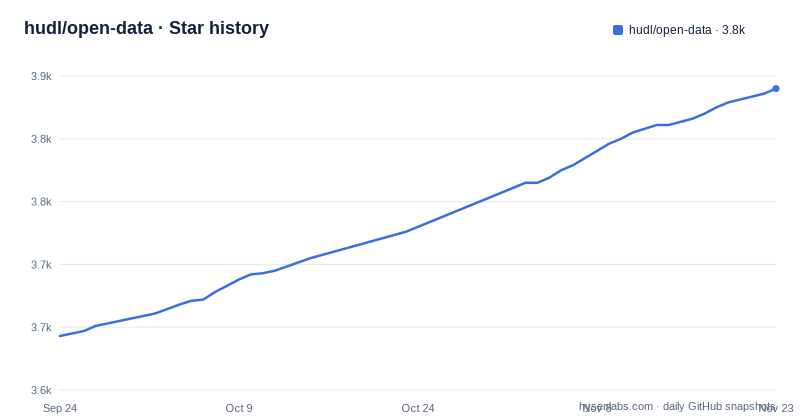
Star history
- hudl/open-data3,840 ★ · +197
| Repository | 2026-09-24 | 2026-11-23 |
|---|---|---|
| hudl/open-data | 3.6k | 3.8k |
197 Stars in the last 60 days, measured from the daily GitHub snapshot. Compare with other projects
Editorial analysis
What problem StatsBomb Open Data solves, and who it is for
Public football event data is normally locked behind commercial licences or a paid API. This repository removes that barrier for a subset of competitions: StatsBomb states that it has made "certain leagues of StatsBomb Data freely available for public use for research projects and genuine interest in football analytics." The unit of distribution is a JSON file, not an endpoint, so the practical audience is people who already work with dataframes, notebooks or a scripting language and who can read a directory tree.
The stated motivation is community building as much as data sharing. The README says StatsBomb hopes that free data will "extend the wider football analytics community and attract new talent to the industry." That framing matters when you evaluate the project: it is a research and portfolio resource first, and an operational data source second. If you are building a product that needs guaranteed uptime, this is not the layer to build it on.
The folder layout is the API
There is no query language and no server. The README describes the data as JSON files exported from the StatsBomb Data API, organised by entity type. Competitions and seasons live in a single file, data/competitions.json. Matches are split per competition and season: data/matches/ contains one folder per competition ID, and each file inside is named for a season ID. Events and lineups are split per match, in data/events/ and data/lineups/, with each file named for a match ID. StatsBomb 360 data, which the README says covers "selected matches" only, sits in data/three-sixty/, again named by match ID.
That means the join key across the whole dataset is the identifier embedded in the filename and in the JSON payloads. To find the events for a given game you first read competitions.json, then the relevant matches file, then the event file whose name matches the match ID. The cost of this design is that every consumer writes the same traversal code. The benefit is that the data is trivially cacheable, diffable and archivable: you can copy a folder to a laptop and work offline. The repository also ships a doc directory, which the README describes as containing "some documentation about the meaning of different events and the format of the JSON." Note the word "some": the README does not promise a complete schema reference, so expect to inspect real payloads rather than rely on a specification.
Getting StatsBomb Open Data onto your machine and reading a first file
There is nothing to install in the package-manager sense. The README points you at the data directory inside the repository, which is cloned from the project's homepage at https://statsbomb.com/resource-centre/. Once you have a local copy, the first thing to inspect is the competition list, because every other path in the repository is derived from IDs listed there. The repository provides no command-line tool and no loader script, so the README's own instruction is simply to start from the data directory and follow the naming conventions.
From there, the workflow the README describes is: read data/competitions.json to get competition and season IDs, use those to locate the file in data/matches/, then use the match IDs from that file to open the corresponding entries in data/events/ and data/lineups/. Because the README gives no code samples, there is no official snippet to copy. The README does direct you to the doc directory for "some documentation about the meaning of different events and the format of the JSON", and that is the closest thing to a getting-started guide in the repository. Read it before writing a parser, since the event payloads are the part most likely to surprise you.
Where the static-file approach breaks down
The biggest limitation is coverage, and it is deliberate. The README says "certain leagues" are free, not all of them, and 360 data applies to "selected matches" only. Before you design a study around a competition, verify that the competition and season you want actually appear in competitions.json. A season that is absent is not a bug to report; it is outside the free subset.
The second limitation is freshness. The repository is a snapshot dump rather than a feed. The repository has no published GitHub releases, and the README does not describe an update schedule, a changelog or a deprecation policy. If your analysis depends on data from the current matchday, this is the wrong tool, and no amount of scripting around the file layout will fix that. The third issue is licensing ambiguity: the repository metadata reports the licence as NOASSERTION, and the terms live in LICENSE.pdf, a PDF rather than a machine-readable licence file. The README adds a condition that is easy to miss: if you publish or distribute research based on the data, you must state StatsBomb as the source and use their logo from the media pack. That is an attribution requirement attached to the data, and it is worth reading the PDF in full before you publish anything.
StatsBomb Open Data compared with a general open data portal
The obvious alternative is a municipal or national open data portal, the kind of thing people mean when they search for open data catalogs and portals. The difference is not quality, it is shape. A city portal typically exposes a catalogue and a query interface over many unrelated datasets, so you filter and download through a web API. StatsBomb Open Data does the opposite: one narrow subject, football events, delivered as a fixed directory of JSON files that you clone and read locally.
That trade-off cuts both ways. You give up discoverability and server-side filtering, and you take on the job of writing your own loader and of keeping a local copy in sync. In exchange you get a dataset that is small enough to version-control, that needs no credentials, and whose structure is visible in the file names. For a research notebook or a teaching exercise, the file-based approach is usually less work than standing up a client for a portal API. For a dashboard that must reflect the latest results, it is more work, because you have to poll the repository yourself.
Maintenance, licence and the cost of upgrading
The repository is not archived, and the last push was on 2026-09-07, so there is recent activity. That is a statement about the repository, not a promise about the data: the README describes no release process, so there is no version number to pin and no migration guide to follow. Upgrading in practice means pulling the branch again and re-reading whatever changed. If StatsBomb alters an event type or adds fields, you find out by diffing your local copy or by your parser failing, because the README does not document a schema version.
On licensing, the metadata says NOASSERTION and the actual terms are in LICENSE.pdf. Treat that as a signal to read the document rather than assume an open licence. The README's own condition is explicit about attribution: publishing or distributing research based on the data requires stating StatsBomb as the source and using their logo from the media pack. Nothing here is legal advice; the point is simply that the terms are in a PDF and include an attribution obligation, which is more than a typical permissive licence asks for.
Editorial conclusion
Adopt hudl/open-data if you want a static, citable event dataset for football analytics research and you are comfortable reading JSON yourself. Do not adopt it if you need live match feeds, a hosted query endpoint or a guaranteed update cadence, because the repository is a file dump, not a service. Before building on it, open data/competitions.json to confirm which competitions and seasons are actually present, and read the doc directory to check that the event format is documented well enough for your pipeline.
Frequently asked questions
How do I use StatsBomb Open Data?
Start from the data directory in the repository. Competitions and seasons are in data/competitions.json, matches are under data/matches/ by competition and season ID, and events and lineups are under data/events/ and data/lineups/ by match ID.
Is StatsBomb Open Data free to use?
The README states that certain leagues are made freely available for public use for research projects and genuine interest in football analytics. The repository metadata reports the licence as NOASSERTION, and the terms themselves live in LICENSE.pdf.
Do I need an API key to read StatsBomb Open Data?
No. The README describes the data as JSON files exported from the StatsBomb Data API and stored in the repository, so you read the files rather than authenticate against an endpoint.
Does StatsBomb Open Data include 360 data for every match?
No. The README says StatsBomb 360 data is provided for selected matches, stored in data/three-sixty/ with each file named for a match ID.
What must I do if I publish research based on StatsBomb Open Data?
The README asks that you state the data source as StatsBomb and use their logo, which is available in their media pack.
Official sources
Add this badge to your README
If you maintain this project, the badge below links readers to this analysis and shows its maintenance status from the daily GitHub snapshot. Paste the markdown into your README; add ?metric=license or ?metric=stars to the image URL for a different field.

[](https://hysenlabs.com/projects/hudl-open-data)Star history chart for your README
[](https://hysenlabs.com/projects/hudl-open-data)Was this useful?