timm (PyTorch Image Models): feature extraction, pruning, and the training scripts behind the model zoo
The largest collection of PyTorch image encoders / backbones. Including train, eval, inference, export scripts, and pretrained weights -- ResNet, ResNeXT, EfficientNet, NFNet, Vision Transformer (ViT), MobileNetV4, MobileNet-V3 & V2, RegNet, DPN, CSPNet, Swin Transformer, MaxViT, CoAtNet, ConvNeXt, and more
At a glance
- What is it?
- huggingface/pytorch-image-models ships the timm package: a large set of PyTorch image backbones plus train, validate, inference and export scripts. Recent changes tighten the model API, which helps new code and can break older code that leaned on silent fallbacks.
- Who is it for?
- timm offers a broad collection of image models, pretrained weights and training utilities. Features and compatibility vary by version, architecture and environment: check the installed release and its documentation, and test feature extraction, pruning and checkpoint resume on the selected model before relying on them.
- Can I use it commercially?
- Yes. Apache-2.0 is a permissive licence: you can use, modify and sell software built on it, as long as you keep its copyright and licence notices.
- Is it still maintained?
- Yes. The repository last received commits 6 days ago.
- What is it written in?
- Mainly Python, according to GitHub's language statistics.
Answers come from the project's GitHub data, last synced on November 13, 2026, and from our analysis. They are not legal advice.
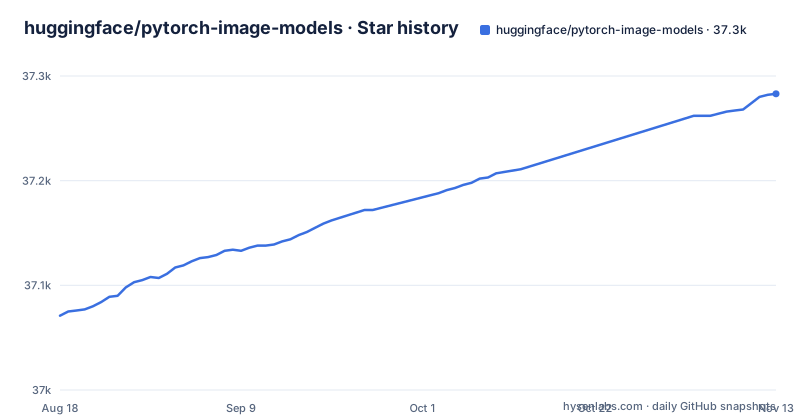
Star history
- huggingface/pytorch-image-models37,283 ★ · +212
| Repository | 2026-08-18 | 2026-11-13 |
|---|---|---|
| huggingface/pytorch-image-models | 37.1k | 37.3k |
212 Stars in the last 87 days, measured from the daily GitHub snapshot. Compare with other projects
Editorial analysis
Every model now exposes forward_intermediates and prune_intermediate_layers
The October 24, 2026 entry in What's New states that `forward_intermediates()` and `prune_intermediate_layers()` are supported by every model. Support was newly added for CSPNet, NFNet, DLA, DenseNet, CoaT, ConViT, ConvMixer, CrossViT, HRNet, Inception-v3, Inception-ResNet-v2, NASNet, PNASNet, SelecSLS, SENet, Sequencer2d, VGG, Visformer, Xception and Aligned Xception. NaFlexViT and MobileNetV5 encoders gained `prune_intermediate_layers()`, and CoaT, ConViT, ConvMixer, CrossViT and Visformer gained `features_only` support. These are main-branch release notes; confirm the installed version contains the change and test the selected model's feature shapes, stages and downstream integration.
prune_head=True leaves unused parameters on CoaT, CrossViT and HRNet
With `prune_head=True`, pruning removes the whole head: head norm, pre-logits layers and attention pooling. The project says this avoids unused parameters in the stated pruning paths, which can allow DistributedDataParallel without `find_unused_parameters`; test the actual model and training path. There is a stated exception. CoaT, CrossViT and HRNet still leave unused parameters when you take only some of their parallel scales or branches. If you train one of those three under DDP with a partial set of branches, you still need `find_unused_parameters`, so the DDP simplification promised by the pruning change does not apply to you. Pass `prune_head=False` if you want to keep the head. Pruning a hierarchical model to an earlier stage also removes the final norm and head sized for the last stage, so `forward_features()` ends at the last kept feature and `num_features` and `head_hidden_size` match it.
Pool types and constructor arguments that used to pass silently now raise
Two consistency changes will surface in older code. First, pool types a model cannot apply now raise at creation or at `reset_classifier()` instead of being ignored or failing later in forward. Second, the October 13 entry says unknown constructor arguments raise `TypeError` everywhere. A script that passed a stray keyword to `create_model` and never noticed will stop at model construction after an upgrade. On the positive side, `head_hidden_size` now reports the actual pooled pre-logits width in all models, including concat pooling (`catavgmax`) and after `reset_classifier()`, and `reset_classifier()` keeps the current pooling. Code that sized a linear probe from `head_hidden_size` can trust the number instead of special casing families.
train.py resume, milestone snapshots and sweep.py
The repository root holds the scripts: `train.py`, `validate.py`, `inference.py`, `benchmark.py`, `onnx_export.py`, `onnx_validate.py`, `avg_checkpoints.py`, `clean_checkpoint.py`, `distributed_train.sh` and the newer `sweep.py`. In `train.py`, `--resume auto` resumes in place from the experiment's own `last.pth.tar` with checkpoint history, `model_best` and `summary.csv` handled as described in the notes. Exact reproducibility also depends on data, random state and the environment. `--stop-epoch N` stops without changing the schedule, and `--save-epochs N [N ...]` keeps `milestone-N.pth.tar` snapshots. YAML `--config` values are validated against the script's arguments. `sweep.py` runs grid or random search over any `train.py` argument on a pool of local GPUs and is resumable. Its WSD mode trains one stable trunk per hyperparameter combination and branches cooldowns from milestone checkpoints.
The plateau scheduler cannot resume exactly and is deprecated
`PlateauLRScheduler` (`--sched plateau`) is deprecated. timm schedulers are stateless functions of the epoch or update count. The metric driven plateau schedule never fit that model, and its state is not checkpointed, so resuming a plateau run was never exact. The practical consequence: if an existing recipe uses `--sched plateau` and gets interrupted, the resumed learning-rate path may differ from an uninterrupted run, so verify it before comparing results. The project's direction is `cosine` or the new WSD scheduler (`--sched wsd` with `--lr-decay-fn` and `--lr-stable-timescale`). Moving a recipe off plateau changes its learning rate curve, so expect to retune rather than reuse old results.
Foreach optimizers chunk by L2 cache, and EMA precision changes with dtype
The October 9 entry adds foreach (multi-tensor) implementations for RMSpropTF, LaProp, LAMB, LARS and AdaBelief. Foreach steps are chunked by device L2 cache size, and `TIMM_FOREACH_CHUNK_SIZE` overrides that. AdamWLegacy and NAdamW gain RMS update clipping via `clipping_threshold`, and NovoGrad gets decoupled and corrected weight decay variants named `novogradw` and `novogradc`. Fixes cover FP16 update stalls at small learning rates and low precision state handling for Kron, AdaBelief and NovoGrad, and `p.grad` is no longer modified in place. For model EMA, ModelEmaV3 uses stochastic rounding by default for bfloat16 EMAs, while float16 models keep a float32 EMA, so a float16 model and its EMA copy do not share a dtype.
Multi-label training reads targets three ways but only through four readers
Since September 25, 2026, `train.py` and `validate.py` accept `--task multilabel`, trained with BCE through `MultiLabelClassificationTask`. Targets can be lists of class indices, dense multi-hot vectors with `--target-format multihot`, or one binary field per class with `--target-key a,b,c`, using `/` paths into nested fields. Those formats are supported by the `hfds`, `hfids`, `tfds` and `wds` readers. If your multi-label data sits in a plain image folder layout outside those readers, the new flags do not reach it, and you will need to convert the dataset into one of the supported formats before the multi-label path applies.
One package with five runtime dependencies and a Python 3.8 floor
pyproject.toml names the package `timm`, builds it with `pdm-backend`, and reads the version from `timm/version.py`. It declares `requires-python = ">=3.8"`, with classifiers listing Python 3.8 through 3.12, and dependencies on `torch`, `torchvision`, `pyyaml`, `huggingface_hub` and `safetensors`. requirements.txt is stricter: `torch>=1.7`, `huggingface_hub>=0.17.0`, `safetensors>=0.2`, and it also lists `numpy`. The project's November 3, 2026 notes announce release 1.0.31; consult current releases and package metadata for later changes. What's New entries are dated October, so confirm the installed version actually contains a change before writing code against it. Documentation lives at huggingface.co/docs/timm, including a new Model API page.
Editorial conclusion
timm offers a broad collection of image models, pretrained weights and training utilities. Features and compatibility vary by version, architecture and environment: check the installed release and its documentation, and test feature extraction, pruning and checkpoint resume on the selected model before relying on them. When changing a training schedule or upgrading a recipe, validate the resulting learning-rate trajectory and results.
Frequently asked questions
Does every timm model support forward_intermediates()?
The October 24, 2026 main-branch notes say both `forward_intermediates()` and `prune_intermediate_layers()` are supported across models in that revision. Older releases may differ; check the installed version and test the selected architecture and outputs.
Can timm train.py resume a run automatically?
The October 2026 notes describe `--resume auto` using the experiment's last checkpoint and preserving its history. The notes also deprecate `--sched plateau` because its metric-driven state was not checkpointed. Verify the behavior and checkpoint contents in the installed version; exact reproducibility also depends on data, random state and environment.
Which Python and PyTorch versions does timm require?
pyproject.toml sets requires-python to >=3.8, and requirements.txt asks for torch>=1.7 along with torchvision, pyyaml, huggingface_hub>=0.17.0, safetensors>=0.2 and numpy.
Does timm support multi-label classification?
Yes. train.py and validate.py accept --task multilabel, trained with BCE, with targets read through the hfds, hfids, tfds and wds readers.
Official sources
Add this badge to your README
If you maintain this project, the badge below links readers to this analysis and shows its maintenance status from the daily GitHub snapshot. Paste the markdown into your README; add ?metric=license or ?metric=stars to the image URL for a different field.

[](https://hysenlabs.com/projects/huggingface-pytorch-image-models)Star history chart for your README
[](https://hysenlabs.com/projects/huggingface-pytorch-image-models)Was this useful?