deeplearning-biology: a reading list for applying neural networks to biology
A list of deep learning implementations in biology
At a glance
- What is it?
- A single-file Markdown list of deep learning implementations and review papers across genomics, protein biology, single-cell work and drug discovery, originally published on Follow the Data. Useful as a map of the field, useless as a library.
- Who is it for?
- Treat this repository as a map rather than a dependency. It earns its place if you are choosing a subfield, looking for the review that explains a method before you implement it, or want to see whether variant calling or protein design has enough public work to be worth your time.
- Can I use it commercially?
- Not without permission. GitHub finds no licence file in the repository, and without a licence all rights are reserved by default: you may read the code but not reuse it. Check the README, or ask the authors, before using it.
- Is it still maintained?
- Yes. The repository last received commits 40 days ago.
- What is it written in?
- GitHub does not report a main language for this repository.
Answers come from the project's GitHub data, last synced on October 20, 2026, and from our analysis. They are not legal advice.
Star history
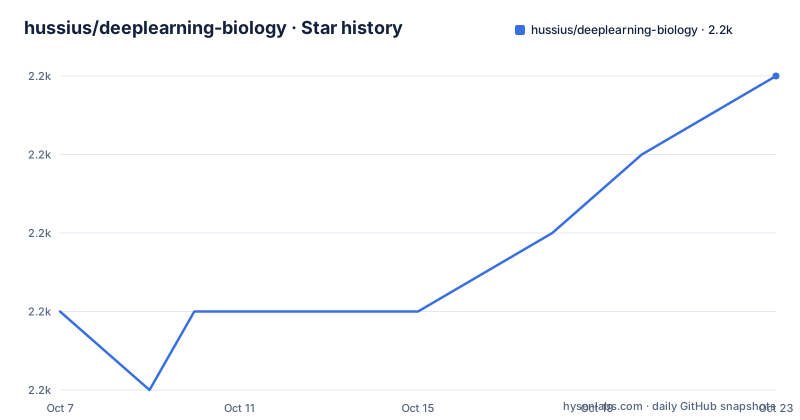
- hussius/deeplearning-biology2,162 ★ · +2
| Repository | 2026-10-07 | 2026-10-20 |
|---|---|---|
| hussius/deeplearning-biology | 2.2k | 2.2k |
2 Stars in the last 13 days, measured from the daily GitHub snapshot. Compare with other projects
Editorial analysis
A list, not a framework
The repository contains one file and a README. That is the entire technical structure, and saying so plainly is the most useful thing this article can do.
The README describes itself as a list of implementations of deep learning methods to biology, originally published on a blog called Follow the Data. It states the slant explicitly: genomics, because that is the subfield the author follows most closely. The author also points readers to another list, awesome-deepbio by Gokcen Eraslan, for wider coverage.
So the artifact is editorial rather than technical. There is no package to install, no model to download and no API to call. What you get is a categorised index of other people's papers and codebases, with the author's judgment about what belongs where. That makes it a different kind of resource from the other projects in this space: it will not get stale in the way a dependency does, because it is not one, but it also gives you nothing you can evaluate at a glance.
The last push was on 2026-09-12, so the list is being touched. It is not archived. No language, license or topics are recorded for the repository, which fits a documentation-only project but means you have no stated terms for reuse of the curated content itself.
The table of contents is the real content
The README's table of contents is where the shape of the field is visible, and it is worth reading as a taxonomy rather than a menu. The categories run from sequence modelling and multi-omics integration through protein biology, which splits three ways into structure prediction, protein design and function prediction, and then into genomics, which splits six ways.
The genomics subsections are variant calling, gene expression, imaging and gene expression, predicting enhancers and regulatory regions, non-coding RNA, methylation, and single-cell applications. After genomics come chemoinformatics and drug discovery, biomarker discovery, metabolomics, generative models, population genetics, and systems biology.
That ordering says something about relative activity. Single-cell applications get their own slot rather than being folded into gene expression, which reflects how much of the field's recent method development has happened there. Protein biology gets the most granular treatment of any category, split by task rather than by technique, which suggests the author found the protein literature organised that way. Systems biology appears last and with no subcategories, which reads more like a remainder than a considered omission.
The category structure is the most durable part of the document. Individual papers move on, but the fact that variant calling and protein design have enough distinct literatures to warrant their own sections does not change quickly.
Reviews come first, and they come with dates
The README opens with a reviews section, and it handles freshness differently from the rest of the list. Review papers are described as not being implementations as such but containing useful pointers, and because review papers in this field are more time-sensitive, the author adds the month of journal publication to each entry. There is also a caveat worth keeping: the original preprint may in some cases have been available online long before the published version.
The earliest entries are dated. A primer on deep learning in genomics from Nature Genetics in November 2018, deep learning in biomedicine from Nature Biotechnology in October 2018, and a guide to deep learning in healthcare from Nature Medicine in January 2019. Between them they cover convolutional networks, recurrent networks, graph convolutional networks, autoencoders and GANs, plus multi-modal learning, transfer learning and model explainability.
Two entries carry a personal note. The genomics primer is described as featuring the author as one of its co-authors, and it ships with a Colaboratory notebook tutorial that sets up a convolutional network for learning binding motifs and then inspects predictions after training. That notebook is the closest thing this repository has to a runnable example.
A 2021 review from November covers relational deep learning for polypharmacy side effects, combination synergy and drug-drug interaction prediction, presented as a unified theoretical view of relational machine learning models with definitions, architecture comparisons and evaluation protocols.
The date discipline here is the part other lists usually skip. A review from 2018 is not wrong, it is just a different thing from a review from last year, and having the month attached makes that visible.
How this sits against awesome-deepbio
The README points at awesome-deepbio by Gokcen Eraslan as something else to look at, and the comparison is instructive. Both are curated lists in the awesome-list tradition: no code, structured Markdown, contribution by pull request.
The difference is emphasis. This list names a genomics slant openly in its second line, and its structure reflects one researcher's reading habits. The other covers deep learning for biology more broadly, which the implicit suggestion is where you go if genomics is not your field or if you want coverage this author did not prioritise.
Neither list gives you what a benchmark table would: no datasets compared, no metrics normalised, no reproduction status. A curated list is a set of pointers with an opinion attached, and the value is in the curation rather than the data. If you need to know whether three papers used the same train and test split, you have to go and read them, which is arguably the right place to be.
For a reader starting out, the reviews are the higher-value half of this repository. Reading one good 2018 or 2019 review will tell you what problems were considered tractable then, and comparing that against a current paper tells you what moved. The implementations list tells you what exists; the reviews tell you what the field thinks matters.
What a list like this cannot tell you
The obvious limitation is staleness, and it deserves more nuance than the usual list critique. Individual entries here go back to 2018, and a list that mixes eight-year-old reviews with recent implementations without flagging which parts have held up is asking you to do the triage yourself. The date annotations on reviews mitigate this for that section only.
A second limitation is that nothing here is evaluated. Each entry gives a title, a link and usually a short descriptive paragraph copied or adapted from the paper's abstract. There is no indication of whether the code still runs, whether the model checkpoints were released, whether the method has been superseded, or whether the authors' claims were reproduced. For a field where a large share of published deep learning results are never independently validated, that is a meaningful gap.
Third, the genomics slant means coverage is uneven by construction, and the author says so. If your problem is metabolomics or chemoinformatics, this list will be thinner than one dedicated to your subfield.
None of that makes it a bad resource. A curated list is not claiming to be a benchmark, and using one for triage rather than for conclusions is the right way to read it. What it does claim is that these are the papers and implementations worth your attention, which is a claim about attention, and a reasonable one to make in a field with this much output.
Editorial conclusion
Treat this repository as a map rather than a dependency. It earns its place if you are choosing a subfield, looking for the review that explains a method before you implement it, or want to see whether variant calling or protein design has enough public work to be worth your time. It does not serve as a comparison table, because the entries carry a title and a link and nothing about datasets, results or maintenance state, and nothing in the list is versioned alongside the field it describes. Open the reviews section first, pick the subfield matching your data, and treat every implementation link as a starting point to evaluate on its own repository, checking its license and last commit before you build on it.
Frequently asked questions
What is the deeplearning-biology repository?
It is a curated Markdown list of deep learning implementations and review papers applied to biology, originally published on the Follow the Data blog. It contains no code of its own, just one README with categorised links.
Which biology subfields does the list cover?
Sequence modelling, multi-omics integration, protein biology split into structure prediction, design and function prediction, genomics split into variant calling, gene expression, imaging, enhancers, non-coding RNA, methylation and single-cell, plus chemoinformatics, biomarker discovery, metabolomics, generative models, population genetics and systems biology.
Is the list limited to genomics?
It has a deliberate genomics slant, which the README explains by saying genomics is the subfield the author follows most closely. It also links to awesome-deepbio by Gokcen Eraslan as a broader alternative.
How current are the entries in deeplearning-biology?
Mixed. The reviews section annotates each entry with its journal publication month, reaching back to 2018, while the implementation entries carry no dates at all. The repository itself was last pushed on 2026-09-12 and is not archived.
Does the list include runnable code or tutorials?
Not within the repository. The closest thing is a Colaboratory notebook linked alongside the 2018 Nature Genetics primer on deep learning in genomics, which walks through a convolutional network for learning binding motifs and inspecting its predictions.
Official sources
Add this badge to your README
If you maintain this project, the badge below links readers to this analysis and shows its maintenance status from the daily GitHub snapshot. Paste the markdown into your README; add ?metric=license or ?metric=stars to the image URL for a different field.

[](https://hysenlabs.com/projects/hussius-deeplearning-biology)Star history chart for your README
[](https://hysenlabs.com/projects/hussius-deeplearning-biology)