MML-Book: one reader's exercise solutions for Mathematics for Machine Learning
Code / solutions for Mathematics for Machine Learning (MML Book)
At a glance
- What is it?
- A personal self-study repository with Jupyter notebook solutions for six chapters of the MML textbook, the textbook PDF committed to the tree, and no license file.
- Who is it for?
- Treat this repository as one person's notebook rather than a maintained solution set, because that is exactly what the README says it is. It has real value for a specific job: if you are working through Mathematics for Machine Learning and want to compare your derivation against someone else's for chapters 2 through 7, having both notebook and PDF renderings side by side saves time.
- Can I use it commercially?
- Not without permission. GitHub finds no licence file in the repository, and without a licence all rights are reserved by default: you may read the code but not reuse it. Check the README, or ask the authors, before using it.
- Is it still maintained?
- Yes. The repository last received commits 38 days ago.
- What is it written in?
- Mainly Jupyter Notebook, according to GitHub's language statistics.
Answers come from the project's GitHub data, last synced on November 7, 2026, and from our analysis. They are not legal advice.
Star history
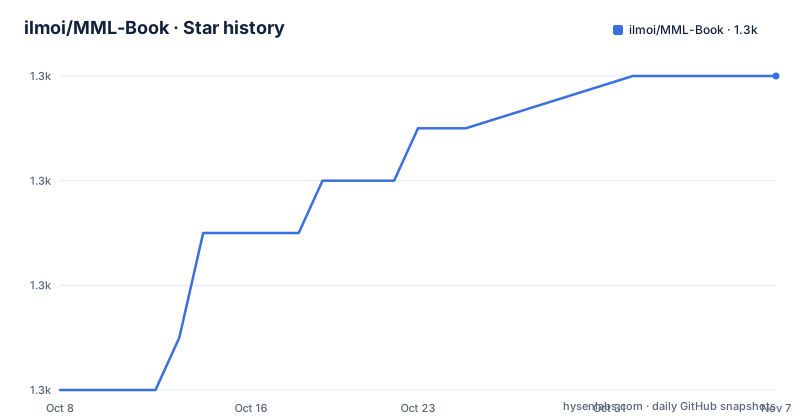
- ilmoi/MML-Book1,272 ★ · +6
| Repository | 2026-10-08 | 2026-11-07 |
|---|---|---|
| ilmoi/MML-Book | 1.3k | 1.3k |
6 Stars in the last 30 days, measured from the daily GitHub snapshot. Compare with other projects
Editorial analysis
What the README is honest about
The title of this project is its own qualifier: Mathematics for Machine Learning, my Self Study. That framing is carried through consistently and it is worth taking at face value, because the alternative reading, a maintained solutions repository for the textbook, is not what the contents support.
The README divides the work into three parts. The first is Python code, described as code the author played with to better understand various concepts, with one specific note: the mix of Gaussians was tricky in particular. The second is chapter exercise solutions, described as solutions for each chapter, with a practical warning that notebooks might take a bit of time to render all the LaTeX. The third is listed simply as Misc, followed by a colon and a closing bracket, which conveys the same message about that directory that the title conveys about the whole project.
So the author is not claiming completeness or authority. The wording describes a record of one person's progress. That is not a criticism, since self-study repositories are useful precisely because they show the path a reader actually walked, but it does change what you should expect before you start reading.
Six chapters of solutions, and which ones are missing
The exercise section links chapters 2 through 7, and each chapter gets two links: a Jupyter notebook rendered through nbviewer, and a PDF committed to the repository. The pattern is uniform across all six, which suggests a deliberate and completed effort rather than a partial one that was abandoned halfway.
What is missing is the other half of the book. The MML textbook runs well beyond seven chapters, with later sections on neural networks and reinforcement learning, and none of those appear in the README. Chapter 1 is absent too, though chapter 1 in that book is matrix algebra with no exercises, so its absence is unremarkable. The omission of the later chapters is not.
The gap matters for anyone using this as a check on their own work, because the later chapters are where the book's material diverges most from current practice. Early chapters on linear algebra, calculus and probability decomposition still map cleanly onto what people teach today. A notebook of derivations for a reinforcement learning chapter would raise harder questions about whether the reader's approach still holds, and no such check is provided here.
The link targets are also worth noting. They point at the `master` branch through nbviewer rather than at a commit SHA, so what you see rendered today is whatever the branch currently contains.
The textbook PDF sits in the repository root
The repository tree contains `mml-book.pdf` at the root, next to the README and the exercise directory. This is a copyrighted textbook, and the commit places a full copy inside a public Git repository.
There is no license file. The license field for the project is null, the tree has no LICENSE entry, and the README carries no licensing statement. That is a real constraint on what you can do with the notebooks even setting aside copyright, because code with no license is code you have no explicit permission to copy, modify or redistribute. If you want to reuse a derivation from one of these notebooks in your own project, there is no grant here to point at, and the author's intent is not recorded anywhere.
The same absence has a second effect: anyone auditing this repository for licensing questions gets no answer. For a personal study repository that is a defensible omission, since the author may not have intended redistribution at all. It only becomes a problem when the notebooks get quoted, forked, or lifted into coursework, which is precisely the use most people arrive at a solutions repository with.
Notebooks, a stray .DS_Store, and no environment
GitHub classifies the repository's primary language as Jupyter Notebook, which is an accurate signal about where the substance lives. The tree itself is small and legible: a README, the `end of chapter exercises` directory, a `misc` directory, a `python code to play with` directory, the PDF, and one file that does not belong, `.DS_Store`.
That `.DS_Store` is a macOS Finder metadata artifact, and its presence tells you the repository was worked on from the desktop rather than maintained as a checked-out project. It is harmless. It is also the kind of detail that tells you the repository was not set up with a contributing guide, a pre-commit hook, or any of the scaffolding that accompanies intentional ongoing maintenance.
More consequential is the absence of an environment file. There is no requirements.txt, no environment.yml, no pyproject.toml, and no lockfile anywhere in the tree. For notebooks this is a genuine usability question rather than a style complaint: notebooks written several years ago often depend on versions of NumPy, matplotlib or scikit-learn whose behaviour has since changed, particularly around array printing and plotting defaults. Anyone reproducing these notebooks is left to guess a working set from the imports visible in each file.
The repository also has no releases. There is no tag history, no version, and nothing to pin, so there is no way to refer to a known-good state of the notebooks other than a commit hash.
Activity without a maintenance policy
The repository has 1265 stars, 201 forks and 21 open issues, and it was pushed on 2026-09-30. Those numbers describe a repository people find useful and return to, which is about the highest compliment you can pay a personal study project.
Recent pushes and lack of releases are not in conflict. A person returning to a study repository tends to add a notebook or fix a rendering problem, not to prepare a release with a changelog. The default branch is `master`, the older convention, which is consistent with the repository having been created before `main` became standard and simply never migrated.
The open issue count is the most interesting number here, because 21 issues against a repository with no contributing guide means those threads are the de facto support channel. If you are stuck on an exercise, opening or reading an issue is more likely to get you an answer than anything in the README, which contains no usage guidance beyond the install-free observation that this is code to read.
For a repository whose topics include self-study, that is the right shape. The star count reflects the value of seeing someone else's worked derivations; the issue count reflects that nobody promised to maintain them.
Editorial conclusion
Treat this repository as one person's notebook rather than a maintained solution set, because that is exactly what the README says it is. It has real value for a specific job: if you are working through Mathematics for Machine Learning and want to compare your derivation against someone else's for chapters 2 through 7, having both notebook and PDF renderings side by side saves time. It has no value as a dependency, since there is nothing to install, no release to pin, and no license, which means no clear permission to reuse the code in your own work. The chapters that matter most for modern practice, the neural network chapters and the reinforcement learning chapter, are exactly the ones with no solutions here.
Frequently asked questions
Does this repository contain solutions for all chapters of the MML book?
No. The README links exercise solutions for chapters 2 through 7, each as both a Jupyter notebook on nbviewer and a PDF in the repository. Chapter 1 has no exercises in the textbook, but the later chapters covering neural networks and reinforcement learning have no solutions here.
Do I need to install anything to use these notebooks?
There is no install step and no package. The tree has no requirements.txt, environment.yml, pyproject.toml or lockfile, so you supply your own scientific Python stack and may need to adjust for version drift in NumPy, matplotlib or scikit-learn. The repository has no releases either, so there is no version to pin.
Can I reuse the code and solutions from this repository?
Be cautious. The project has no LICENSE file and its license field is null, and the README makes no licensing statement, so there is no explicit grant permitting you to copy, modify or redistribute the notebooks. Treat them as reference material for reading, and ask the author directly before reusing anything.
What does the Python code directory contain?
Loose exploratory code rather than a library. The README describes it as code the author played with to better understand various concepts, and singles out mix of Gaussians as having been particularly tricky. There is also a separate `misc` directory the README lists without explanation.
Official sources
Add this badge to your README
If you maintain this project, the badge below links readers to this analysis and shows its maintenance status from the daily GitHub snapshot. Paste the markdown into your README; add ?metric=license or ?metric=stars to the image URL for a different field.

[](https://hysenlabs.com/projects/ilmoi-mml-book)Star history chart for your README
[](https://hysenlabs.com/projects/ilmoi-mml-book)Was this useful?