itgoyo/TelegramBot: A Directory of Telegram Bots and Services
持续收集更新全网最全最有趣的Telegram机器人🤖大全,相信总有你需要的一款机器人~
At a glance
- What is it?
- itgoyo/TelegramBot is a link directory rather than a Telegram bot application or developer library. It is useful for Chinese-speaking readers seeking search bots, channels, commerce services, and references for creating a bot through BotFather, but it offers no documented installation process or release history.
- Who is it for?
- Use this repository when you need a quick, Chinese-language map of Telegram bots and related services rather than an installable tool. Do not adopt it as an application, SDK, API client, or production dependency.
- Can I use it commercially?
- Not without permission. GitHub finds no licence file in the repository, and without a licence all rights are reserved by default: you may read the code but not reuse it. Check the README, or ask the authors, before using it.
- Is it still maintained?
- Yes. The repository last received commits 12 days ago.
- What is it written in?
- GitHub does not report a main language for this repository.
Answers come from the project's GitHub data, last synced on November 7, 2026, and from our analysis. They are not legal advice.
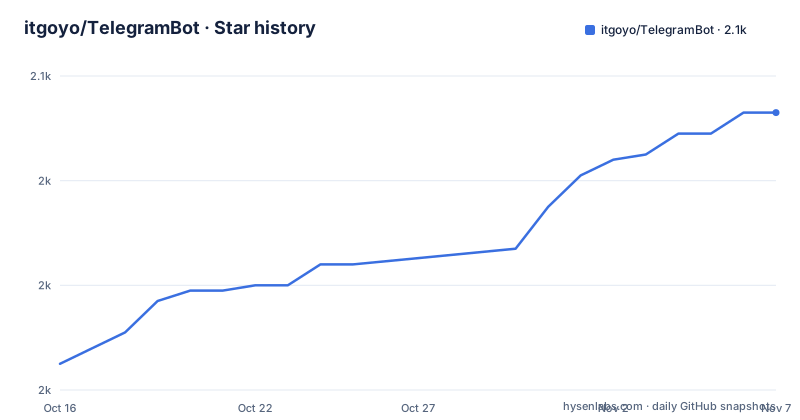
Star history
- itgoyo/TelegramBot2,053 ★ · +48
| Repository | 2026-10-16 | 2026-11-07 |
|---|---|---|
| itgoyo/TelegramBot | 2k | 2.1k |
48 Stars in the last 22 days, measured from the daily GitHub snapshot. Compare with other projects
Editorial analysis
What itgoyo/TelegramBot Actually Contains
itgoyo/TelegramBot solves a discovery problem for readers who know that a useful Telegram service may exist but do not know its handle, channel, or website. The repository is aimed primarily at Chinese-speaking Telegram users because its README, descriptions, labels, and linked site are written in Chinese. Its catalog includes search bots, public channels, commerce pages, VPN and traffic-card offers, cryptocurrency services, content channels, and contact points for custom bot development.
This is a curated directory, not executable software. Based on the repository layout, the only top-level files are `README.md` and `ad.txxt`. There is no package manifest, source directory, dependency lockfile, Docker configuration, executable, or application interface. The README calls the collection “10000+” high-quality Telegram groups, channels, and bots, but that figure describes the claimed scope of the directory. The repository does not document the collection method, verification criteria, deduplication process, or automated update mechanism behind that claim.
That distinction matters for adoption. If the requirement is to integrate Telegram search through an API, this repository does not describe such an interface. If the requirement is to discover available bots and related links, its tables provide a concrete starting point. The README also links to `@BotFather`, explaining that Telegram developers can create and manage their own bots there and receive an API token for connecting a bot to the Telegram API. That sentence describes BotFather, but it does not turn this repository into a bot-creation framework.
The README's Telegram Search and Channel Catalog
The catalog's main mechanism is simple link-based discovery. It groups entries in Markdown tables, with a name, a Telegram or web link, and a short description. Search bots include `@soso`, `@jiso`, `@haisou`, `@jisou`, `@smss`, `@CJSY`, and `@kuai`. The documented interaction is to send a keyword to a bot so that it can locate associated groups, channels, videos, music, news, images, files, or posts. These are descriptions of third-party services, not capabilities implemented by `itgoyo/TelegramBot`.
Several links include `?start=` parameters. For example, the SOSO entry links to `@soso` with a start parameter, while several other entries use different start values. The README does not explain how these referral or attribution parameters operate, so they should be treated as documented link components rather than assumed to be a repository-owned API contract.
The README also lists channels such as `@chiguawuxian`, `@dongnanyadaquan`, `@kejidiyixian`, and `@taobaohaowu`, as well as larger Telegram search groups. This mix is useful for manual exploration because it offers several routes to the same broad task. It also creates a maintenance burden. Telegram accounts, channels, search quality, referral incentives, and external websites can change without a corresponding versioned release in this repository. The last push was on 2026-09-11, which confirms a recent repository update, but it does not confirm that any individual linked service is active or trustworthy.
Bot Creation and Telegram API References
The README includes a short developer-oriented route through `@BotFather`. It states that BotFather is where users create and manage bots and that developers receive an API token for controlling a bot and connecting it to the Telegram API. This makes the repository slightly more useful to developers than a purely promotional channel list, but there is still no bot code, webhook setup, callback handler, message parser, database layer, deployment guide, or library selection.
The README also points readers to Telegram's official application registration page at `https://my.telegram.org/auth?to=apps`. It then shows a table containing an `App api_id`, an `App api_hash`, a title, and a short name. Those values appear as illustrative or shared credentials in the README. The repository does not explain who owns them, whether they may be reused, or whether Telegram treats registration data differently from bot tokens. Its security policy is also undocumented.
For a developer who already knows the Telegram API and needs a reference handle, opening `@BotFather` and reviewing the official registration page may be useful. For someone seeking a complete starting project, the repository stops too early. There is no documented programming language, framework, authentication flow, or deployment target. The custom-development contact `@tgxiunv` is separate from any open-source implementation in this repository. The README says the contact handles small bot features, but gives no code delivery terms, maintenance commitments, scope definition, or licensing details.
No Installation Path for the Repository
The repository provides no installation instructions because it does not present itself as an installable package. There is no documented command for cloning, building, installing dependencies, or starting a service. There is also no documented test suite, executable, configuration schema, environment file, container image, or deployment target.
A first real use therefore consists of reading `README.md`, choosing a category, opening a listed Telegram handle or website, and confirming what the external service does before entering a keyword, payment, account information, or API credential. The most direct starting links documented by the project are `@soso` for keyword searches, `@jiso` for finding groups and channels, `@haisou` for broader Telegram content searches, and `@BotFather` for bot creation. The project also identifies `https://tg10000.com` as its official website and `@tgcn_wiki` as a Telegram Chinese channel.
The repository does not document how links are accepted, removed, corrected, or reported. It also gives no command for regenerating the directory, so there is no supported update workflow to reproduce. A first-use review should treat the README as a set of pointers rather than an installation guide. Anyone expecting to run `itgoyo/TelegramBot` locally will find no runnable target.
Commercial Links and Trust Boundaries
The directory extends well beyond neutral bot discovery. It includes advertising links, shops, VPN services, cryptocurrency exchanges, traffic cards, Telegram Premium-related sales, group-growth services, flash-exchange offers, and content described with terms such as free or low priced. The README contains promotional claims and referral links. Those claims belong to the listed external services, and the repository supplies no independent audit or verification for price, user count, traffic allowance, payment processing, privacy handling, or service continuity.
This gives the catalog a clear trust boundary. Telegram handles can point to external operators, websites, shops, and exchanges. Clicking one of those entries leaves the directory's context. A reader should inspect the destination, fees, refund terms, payment currency, required account data, and operator identity independently. The repository's inclusion of an entry does not establish endorsement by Telegram, GitHub, or the project author.
Some entries also concern sensitive or potentially disruptive services, including mass messaging tools, follower services, channel copying, and claims about bypassing restrictions for private-channel downloads. The README describes or links these services, but it does not explain their implementation, permissions, authorization model, or compliance requirements. They are poor choices for readers who need a transparent open-source workflow or an auditable API. Readers seeking only search bots can ignore the commercial and promotional sections, but the mixed catalog means careful link-by-link review is unavoidable.
Where a Programmatic Alternative Fits
The main alternative is to use Telegram's own BotFather and official Telegram API documentation for bot creation rather than treating this directory as a software foundation. The approach differs materially. `itgoyo/TelegramBot` supplies a human-maintained catalog of existing handles and websites. The Telegram API route requires the developer to implement the application behavior, select a client library, handle authentication, process updates, and deploy the resulting bot.
For example, a developer who needs searchable bot results would have to create a bot through `@BotFather`, register application information through the official Telegram web portal, implement a keyword handler, and configure how results are returned. Those implementation steps are not present in this repository. This limitation does not make the directory useless, but it changes its role from a framework to a discovery list.
Another alternative is to use a manually maintained internal bookmark list or a directory restricted to a single use case. That approach can reduce exposure to unrelated commercial links and referral destinations. It would require the user to curate entries independently. In comparison, this repository offers breadth and Chinese-language discovery information, while offering little documentation about data quality, update automation, licensing, or operational ownership.
Maintenance Scope and License Uncertainty
The repository is not archived, and its last push was on 2026-09-11. There are no GitHub releases, so no versioned migration path or release notes are available. Maintenance appears to consist primarily of repository content changes rather than a documented software release process. The README's claim of continuous collection is not backed by a stated automation schedule, contribution guide, validation policy, or changelog.
The repository metadata and README do not identify a license. That is an important adoption constraint. The absence of a documented license means the repository does not clearly grant permission to copy, modify, redistribute, or incorporate its catalog into another product. This is not a software runtime decision with dependency upgrades, but it still affects whether organizations can reuse the curated content as an internal dataset or publish a derivative list.
The directory also mixes first-party links with external destinations. A small README update can add or alter a link without changing the underlying third-party bot, channel, store, or payment page. As a result, repository recency does not establish the safety or availability of every listed destination. The practical maintenance cost is editorial: links need individual review, descriptions can become outdated, and commercial claims need rechecking. The project does not document who performs those tasks or how quickly corrections are made.
Editorial conclusion
Use this repository when you need a quick, Chinese-language map of Telegram bots and related services rather than an installable tool. Do not adopt it as an application, SDK, API client, or production dependency. Verify each linked service, operator, payment request, API credential policy, and current availability before proceeding, especially because the repository has no releases, no documented license, and mixes Telegram discovery links with advertising and unrelated services.
Frequently asked questions
What is itgoyo/TelegramBot used for?
It is a directory of Telegram bots, channels, groups, search services, shops, and related links. The README does not present it as an executable bot application or an installable library.
How do I install itgoyo/TelegramBot?
The repository documents no installation, build, or runtime command. A reader can inspect `README.md` and follow its links, but the repository itself cannot be installed as an application.
How do I create a Telegram bot with this project?
The README directs readers to `@BotFather` for bot creation and management and to Telegram's application registration page for `api_id` and `api_hash` information. It does not include a bot implementation or a complete setup tutorial.
Official sources
Add this badge to your README
If you maintain this project, the badge below links readers to this analysis and shows its maintenance status from the daily GitHub snapshot. Paste the markdown into your README; add ?metric=license or ?metric=stars to the image URL for a different field.

[](https://hysenlabs.com/projects/itgoyo-telegrambot)Star history chart for your README
[](https://hysenlabs.com/projects/itgoyo-telegrambot)Was this useful?