baoyu-design: run Claude Design as a local Agent Skill in Cursor, Claude Code and more
Run Claude Design locally as an Agent Skill — Cursor, Claude Code & more. Produce polished UI mockups, prototypes, decks & wireframes as self-contained HTML, without claude.ai/design. Best with Opus or Claude.
At a glance
- What is it?
- baoyu-design by JimLiu brings claude.ai's Artifact types to local agents: editable slide decks, design canvases, design systems, data dashboards and motion films, each opened in its own editor that runs on your machine. Every artifact stays in your repo, with no website or separate subscription.
- Who is it for?
- Install baoyu-design if you already use a capable coding agent and want claude.ai's Artifact types, editable decks, canvases, design systems, dashboards and films, as files you own and edit in editors that run on your machine. The repository description says it is best with Opus or Claude, and the original self-contained HTML mockup skill now lives in archive/baoyu-design/.
- Can I use it commercially?
- Check first. The repository uses a licence we do not classify automatically, so read its LICENSE file before any commercial use.
- Is it still maintained?
- Yes. The repository last received commits 2 days ago.
- What is it written in?
- Mainly JavaScript, according to GitHub's language statistics.
Answers come from the project's GitHub data, last synced on November 13, 2026, and from our analysis. They are not legal advice.
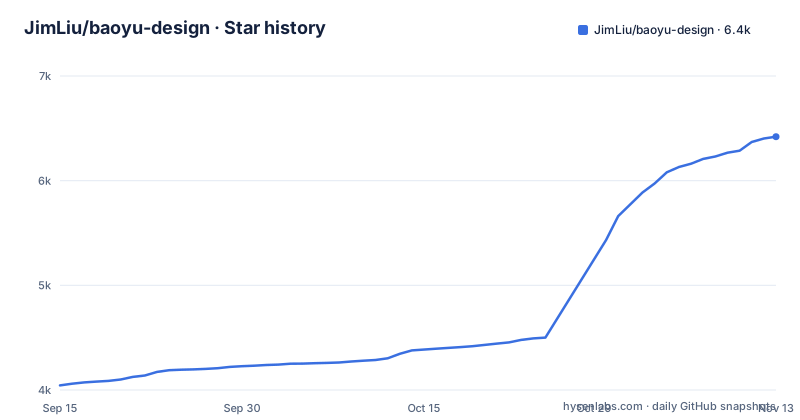
Star history
- JimLiu/baoyu-design6,420 ★ · +2,376
| Repository | 2026-09-15 | 2026-11-13 |
|---|---|---|
| JimLiu/baoyu-design | 4k | 6.4k |
2,376 Stars in the last 59 days, measured from the daily GitHub snapshot. Compare with other projects
Editorial analysis
What baoyu-design is
baoyu-design brings claude.ai's Artifact types to local agents: editable slide decks, design canvases, design systems, data dashboards and motion films, each opened in its own editor that runs on your machine. The original baoyu-design skill, which produced self-contained HTML mockups and prototypes, has been archived to archive/baoyu-design/.
The README's pitch is about where the work happens and who owns the result: no website, no separate subscription, no upload step. The agent already on your machine does the work, and every artifact stays in your repo. The audience is developers and designers who use Cursor, Claude Code, Claude Desktop or another file-capable agent and would rather keep design output as versionable files than produce it on a website.
Why run it locally
The README's case is about where the work happens: no website, no separate subscription, no upload step. The agent already on your machine does the work, and every artifact stays in your repo. The repository description says it is best with Opus or Claude.
The Artifact skills write their type's own file format into a folder and open it in that type's editor page, served from your machine. The agent writes the files and the editor shows each write at once; your edits in the editor are saved back into the same files, so you and the agent can take turns. Comments stay in the project's local comments.json, and every change is kept as a version in the project's history/ folder.
What it can make
The repository now ships seven skills. claude-slides makes slide decks (project/deck.json plus one HTML file per slide) that export to PDF, HTML or PowerPoint. claude-design makes a canvas of artboards with .dc.html Design Components, exportable as HTML, PDF or PNG. claude-design-system makes design systems with tokens, a README brand book, component previews, fonts and asset groups. claude-dashboard makes data-backed dashboards over CSV, TSV or JSON datasets, with a Sources panel that traces every number to its rows. claude-motion makes motion films, 10 to 30 seconds unless you ask for more and 15 minutes at most, exportable as MP4 or GIF.
Two supporting skills sit beside them. motion-director finds the point of a film, writes and voices the narration and times every scene to the words; it needs claude-motion beside it. dataviz is a chart guide the agent reads before writing chart code in any medium, with a palette validator script. The five editors also ship as DeepSeek Harness plugins, installed from npm by name.
How the skill is built
The original baoyu-design skill now lives in archive/baoyu-design/, and package.json's only test script runs node --test over archive/baoyu-design/agents/tests/*.test.mjs. The current skills each sit in their own folder under skills/, such as skills/claude-slides/ and skills/dataviz/.
The Artifact skills share a collaboration layer. share <root> (or open <root> --lan) opens a project to your local network and prints a link per role: editor, commenter and viewer. There is no account and nothing leaves your network; it is plain http, so anyone there with a link gets in. When two people save the same slide at once, the version records whose change it replaced and both get a notice with Compare and Bring back.
Getting started and prerequisites
The prerequisite is a local agent: the README names Cursor, Claude Code, Claude Desktop or any file-capable coding agent, and the repository description says it is best with Opus or Claude. The five editors are also available as DeepSeek Harness plugins installed from npm by name.
Licence, releases and limits
GitHub reports the licence as NOASSERTION; the repository carries a LICENSE file and a NOTICE.md. It is bilingual, with English and Simplified Chinese READMEs and changelogs. package.json marks it private with version 2.8.2 and a single test script over the archived skill's agent tests. Recent releases are v2.8.2, v2.8.1 and v2.8.0, all on 2026-11-03, with the last push on 2026-11-02.
One limit is worth keeping in view: sharing works over your local network as plain http, so anyone there with a link gets in.
Editorial conclusion
Install baoyu-design if you already use a capable coding agent and want claude.ai's Artifact types, editable decks, canvases, design systems, dashboards and films, as files you own and edit in editors that run on your machine. The repository description says it is best with Opus or Claude, and the original self-contained HTML mockup skill now lives in archive/baoyu-design/.
Frequently asked questions
What is baoyu-design and how is it different from claude.ai/design?
It brings claude.ai's Artifact types (editable slide decks, design canvases, design systems, data dashboards and motion films) to a local agent like Cursor or Claude Code, each opened in its own editor that runs on your machine. Every artifact stays in your repo, with no website, separate subscription or upload step.
Which agents and model does baoyu-design need?
The README names Cursor, Claude Code, Claude Desktop or any file-capable coding agent, and the repository description says it is best with Opus or Claude.
Where does the output go?
Each Artifact skill writes its type's own file format into a project folder, such as project/deck.json plus one HTML file per slide, and your edits in the editor are saved back into the same files. Decks export to PDF, HTML or PowerPoint, canvases to HTML, PDF or PNG, and films to MP4 or GIF.
Official sources
Add this badge to your README
If you maintain this project, the badge below links readers to this analysis and shows its maintenance status from the daily GitHub snapshot. Paste the markdown into your README; add ?metric=license or ?metric=stars to the image URL for a different field.

[](https://hysenlabs.com/projects/jimliu-baoyu-design)Star history chart for your README
[](https://hysenlabs.com/projects/jimliu-baoyu-design)Was this useful?