academicons: a specialist icon font for the logos of academic sites
An icon font for academics
At a glance
- What is it?
- academicons is a font of icons for the websites and organisations of academia, the ones mainstream icon packages leave out, and it is designed to sit alongside a larger set rather than replace one. Contributing to it is harder than it looks, because a new icon has to arrive as a vector file and has to survive being reduced to a single colour.
- Who is it for?
- academicons suits a site about research, publishing or academic software that needs to show which service a paper came from or which repository a dataset lives in, and that already uses an icon font it wants to extend. It does not suit a project that needs a general purpose icon set, because everything in it is academic specific, and it does not suit a designer who expects to add a logo by dropping a file in, because the icon has to be monochrome and vector based.
- Can I use it commercially?
- Not without permission. GitHub finds no licence file in the repository, and without a licence all rights are reserved by default: you may read the code but not reuse it. Check the README, or ask the authors, before using it.
- Is it still maintained?
- Activity is slowing. The repository last received commits 6 months ago.
- What is it written in?
- Mainly CSS, according to GitHub's language statistics.
Answers come from the project's GitHub data, last synced on November 7, 2026, and from our analysis. They are not legal advice.
Star history
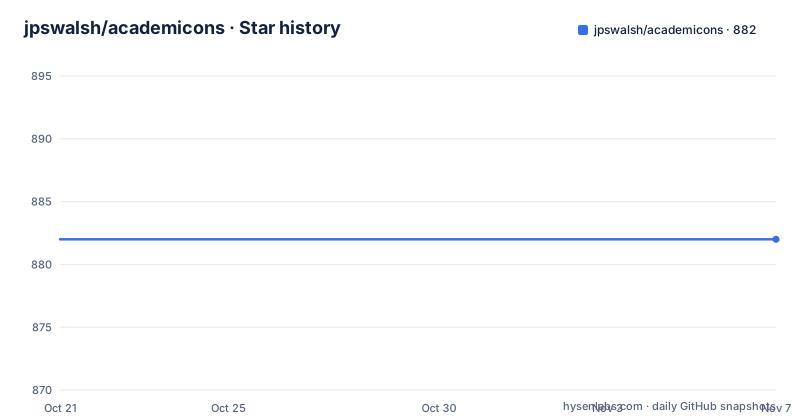
- jpswalsh/academicons882 ★ · +0
| Repository | 2026-10-21 | 2026-11-07 |
|---|---|---|
| jpswalsh/academicons | 882 | 882 |
0 Stars in the last 17 days, measured from the daily GitHub snapshot. Compare with other projects
Editorial analysis
A font for the sites academia uses and the icon sets skip
The description is a single sentence and it is precise about the scope. Academicons is a specialist icon font for academics, and it contains icons for websites and organisations related to academia that are often missing from mainstream font packages. That last clause is the design rationale. A general icon set covers a bank, a cart and a cloud, and it has no reason to cover a preprint server, a citation database or a specific repository, so those end up drawn by hand, inconsistently, one project at a time. The project says it can be used by itself, but that its primary purpose is to be used as a supplementary package alongside a larger icon set, which is the sensible framing. The full set with instructions for its use is published as a site at the project's GitHub pages address, and the repository topics list the primary language as CSS with the rest being font, icon font, icon set and icons. The author is James Walsh, and the repository is not archived.
The font is OFL, the stylesheets are MIT, the docs are CC BY
The licensing is split three ways, which is the normal arrangement for a project that ships a font alongside generated CSS and documentation, but it is worth reading carefully because the obligations differ. The Academicons font itself is licensed under the SIL OFL 1.1, which is the standard open font licence and permits embedding and redistribution in documents and applications, with the requirement that the font not be sold on its own and that any derivative keep the licence. The Academicons CSS, LESS and SASS files are licensed under the MIT License, and the Academicons documentation is licensed under the CC BY 3.0 License, which requires attribution when the documentation is reused. The package manifest names the licence as OFL-1.1, which is the font rather than the whole package, and the repository's own licence field is not one GitHub can classify, so the README section is the authoritative statement. If you are embedding these icons in a commercial product, the OFL terms on the font file are what governs, and the MIT terms on the stylesheet are the more permissive part of the package.
Installing it is a stylesheet and a font file
The package is published to npm under the name academicons, and the manifest points its main entry at css/academicons.css, which tells you how it is meant to be consumed: you include the stylesheet, the stylesheet pulls in the font, and you use the icon by its class name. The repository layout backs that up. There is a css directory holding the stylesheets, and the licence section names three formats, CSS, LESS and SASS, so the same icon set is available in whichever preprocessor your build uses. There is a fonts directory with the font files themselves, an svg directory with the individual vector sources, a source directory, and a docs directory. The svg directory is the interesting one for anyone who wants to reuse a single glyph outside the font, and the source directory is presumably where the vector work is kept. There is a package-lock.json, so the npm publish is a package in the ordinary sense, and an .npmignore that controls what is shipped.
Adding an icon requires a vector file and a monochrome version
The contribution rules are the substantive part of the README and they explain why this font is small. New icons are requested by opening an issue, but a request will be ignored unless three conditions are met. The first is that the organisation already uses a logo or icon of appropriate dimensions, roughly square, and if it does not there is not much that can be done. The second is that an icon of appropriate resolution can be provided or linked, ideally a vector file such as SVG, EPS or AI, or a PDF with the vector file embedded, since those are easy to work with and give the most faithful reproductions. High resolution raster images such as JPEG, PNG or GIF can work, but only if the resolution is high enough that the underlying shapes can be reproduced, and icons made from rasters take much longer to prepare because each component has to be hand drawn and the exact typeface used for any letters has to be worked out. The third is that the icon can be reduced to monochrome, which the project calls one of the basic requirements of a versatile icon and says is often overlooked.
Why a colourful logo is a rejected request
The monochrome condition is the one that surprises people, and the reason given is that academia is full of unprofessional designers, so it is sometimes the case that a logo relies entirely on the use of different colours. In certain cases the maintainer can be creative, with the dblp logo given as an example, but more often than not it will be impossible to create a monochrome version, and in that case the request will probably be ignored unless an alternate logo can be found. The reason a monochrome icon is a requirement rather than a preference is structural rather than aesthetic. An icon font is a single-colour rendering mechanism, so every glyph in it has to work at one size in one tint, and a logo whose meaning is carried by two colours cannot be expressed in it without redesigning the mark. The practical upshot for a requester is that supplying a vector, single colour version of the mark, rather than the logo as it appears on the website, is what makes the request actionable.
Favicons are almost never enough, and arXiv was the exception
The favicon discussion is the part of the README that reveals how the icons were actually made. Favicon files can be useful in conjunction with larger logos that have non-ideal aspect ratios, where they can indicate which part of the logo to strip down to, but they are pretty much useless by themselves. The only time an icon was made from a favicon was for arXiv, and there were two stated reasons: it was heavily requested, and the maintainer was able to get feedback on the new icon from Paul Ginsparg, who made the original. So the exception needed both demand and a source for the truth about the mark. A request submitted without a usable file will be ignored until someone else comes along and provides it. The release history shows how a maintained font grows, with v1.9.6 and v1.9.5 published on the same day in August 2025 and v1.9.4 from 2023, and the manifest still at version 1.9.5, so the published npm version and the newest release tag are one behind each other. The last push was on 2026-05-08.
Editorial conclusion
academicons suits a site about research, publishing or academic software that needs to show which service a paper came from or which repository a dataset lives in, and that already uses an icon font it wants to extend. It does not suit a project that needs a general purpose icon set, because everything in it is academic specific, and it does not suit a designer who expects to add a logo by dropping a file in, because the icon has to be monochrome and vector based. Before you request an icon, check the three conditions the project sets out, and if you want to use the font commercially, read the OFL 1.1 terms for the font itself against the MIT terms for the stylesheets.
Frequently asked questions
What is academicons and what is it for?
It is a specialist icon font for academics, containing icons for websites and organisations related to academia that are often missing from mainstream font packages. It can be used on its own, but its primary purpose is to be used as a supplementary package alongside a larger icon set, and the full set with usage instructions is on the project pages site.
How do I add a new icon to academicons?
Open an issue on the repository. The request will be ignored unless the organisation already has a roughly square logo, an icon of appropriate resolution can be provided or linked, ideally a vector file such as SVG, EPS or AI or a PDF with the vector embedded, and the icon can be reduced to monochrome.
What licence applies to the academicons font and its stylesheets?
The font itself is under the SIL OFL 1.1, the CSS, LESS and SASS files are under the MIT License, and the documentation is under CC BY 3.0. The package manifest names OFL-1.1, which covers the font rather than the whole package.
Why can a favicon not be used on its own as an academicons icon?
A favicon is generally useful only alongside a larger logo with a non-ideal aspect ratio, where it can indicate which part to strip down, and is largely useless by itself. The only icon made from a favicon was arXiv, and that needed both heavy demand and feedback from the person who made the original icon.
Official sources
Add this badge to your README
If you maintain this project, the badge below links readers to this analysis and shows its maintenance status from the daily GitHub snapshot. Paste the markdown into your README; add ?metric=license or ?metric=stars to the image URL for a different field.

[](https://hysenlabs.com/projects/jpswalsh-academicons)Star history chart for your README
[](https://hysenlabs.com/projects/jpswalsh-academicons)Was this useful?