kanition/pbrtbook: A Chinese TeX Translation of Physically Based Rendering
pbrt 中文整合翻译 基于物理的渲染:从理论到实现 Physically Based Rendering: From Theory To Implementation
At a glance
- What is it?
- kanition/pbrtbook is a Chinese translation and annotation project for Physically Based Rendering: From Theory to Implementation, built as a downloadable PDF and LaTeX source. It suits readers who want the third-edition material in Chinese, but it is a translation project rather than a renderer or a fully localized web edition.
- Who is it for?
- Adopt this repository when your priority is a Chinese PDF and inspectable LaTeX translation of the third edition, with local annotations that need editorial review. Do not treat it as a rendering engine, a replacement for the official interactive website, or a complete Chinese edition of every fourth-edition resource.
- Can I use it commercially?
- Check first. The repository uses a licence we do not classify automatically, so read its LICENSE file before any commercial use.
- Is it still maintained?
- Activity is slowing. The repository last received commits 6 months ago.
- What is it written in?
- Mainly TeX, according to GitHub's language statistics.
Answers come from the project's GitHub data, last synced on November 7, 2026, and from our analysis. They are not legal advice.
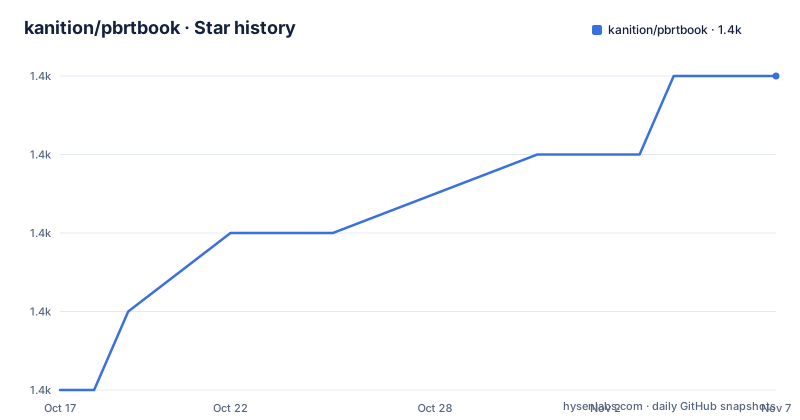
Star history
- kanition/pbrtbook1,357 ★ · +4
| Repository | 2026-10-17 | 2026-11-07 |
|---|---|---|
| kanition/pbrtbook | 1.4k | 1.4k |
4 Stars in the last 21 days, measured from the daily GitHub snapshot. Compare with other projects
Editorial analysis
What kanition/pbrtbook adds to the PBRT reading path
This repository addresses a language and format problem for readers studying Physically Based Rendering: From Theory to Implementation. The original book is available through the pbr-book.org website, where its online edition can present expandable and collapsible example code. kanition/pbrtbook instead presents a Chinese integrated translation, with the material organized for PDF reading and the source published for inspection. The intended audience is Chinese-speaking readers who need the book's theory, implementation explanations, equations, and code references in a translated form. It is also relevant to instructors or self-directed graphics programmers who want to study the text through LaTeX rather than treat the PDF as the only artifact.
The project is based on the third edition. The README names Matt Pharr, Wenzel Jakob, and Greg Humphreys as the original authors and Kanition as the translator. That distinction matters because this repository is not a new renderer called pbrt and does not replace the official pbrt source repositories. It is a translation and editorial project around the book. The repository also includes supplementary material written by the translator, plus marked annotations where wording or explanations have been changed or added. The README warns that long English sentences can produce awkward or inaccurate Chinese sentences, so the translation should be read as an edited interpretation rather than as a mechanically generated substitute for the original.
The LaTeX source reveals the book's compilation model
The repository layout is centered on main.tex, structure.tex, content/, bibliography.bib, StyleInd.ist, and a Pictures directory. That arrangement indicates a LaTeX book project rather than a standalone application. main.tex is the likely entry point, structure.tex describes the document organization, content contains the chapter material, and bibliography.bib supplies bibliographic entries for the book's citations. StyleInd.ist appears to be an editor or language-support file associated with the TeX workflow. The README explicitly states that the book is written in LaTeX and that its source has been published so readers can obtain a newer version.
The generated artifact is the PDF linked from the README's release download. The repository distinguishes source, compiled output, and supporting assets, which makes it possible to inspect how the translation is assembled. The template is The Legrand Orange Book, attributed in the README to Mathias Legrand and Vel. The README also notes that the PDF retains code-link navigation despite the constraints of PDF layout, so a reader can move between text and referenced code more easily than with a plain scan.
This architecture has a practical consequence. The PDF is convenient for reading, while the TeX source is the more appropriate place to inspect translations, equations, notes, and document structure. The repository does not present itself as an interactive book browser. Its source-oriented workflow is better suited to readers who want to study the translation itself or contribute corrections.
A first practical use starts with the release PDF
The README provides a direct download link for v0.7.2 and links to the release page for the translation progress and update log. It also links to the original pbr-book.org site and to the official third- and fourth-edition code repositories. A first use can therefore begin by downloading the linked PDF and keeping the source repository available when a passage, equation, or code reference needs closer inspection. The reader should expect a PDF organized like the third-edition book, rather than a software installation with a command-line renderer.
The README does not provide install commands, package names, compiler versions, or a complete build recipe. It points to CONTRIBUTING.md for compilation instructions. A reader who wants to build the book locally should open CONTRIBUTING.md first and follow the instructions there. The direct release link is the confirmed path for obtaining the compiled book.
Supplementary chapters change the translation's scope
The translation includes more than a chapter-for-chapter conversion. The README lists eleven supplementary chapters assembled by the translator, including 四元数, 分解旋转矩阵, 牛顿迭代法, 微分几何基础, 辐射度学、光度学与色度学, 几何光学, 傅里叶变换, 初等数论基础, 微面模型相关推导, and 经典电磁理论下的光学基础. These titles point toward background material that supports the book's treatment of transforms, numerical methods, differential geometry, color, imaging, and surface reflection.
That addition is useful for self-study because it places related mathematical and physical concepts near the relevant book chapters. It also creates an editorial boundary. Readers looking for the exact third-edition wording need to distinguish the original translated text from translator-written material. The README says that added chapters are supplementary and that other self-initiated changes or additions are marked as “译者注”. That marking gives readers a way to see where the Chinese edition departs from the source, although it does not guarantee that every correction or interpretation is technically uncontroversial.
The additions make the repository more than a language mirror, but they are not a replacement for the original book. The official website remains the place described by the README for the online format and expandable code. The Chinese project is best understood as a locally edited translation package with supporting exposition.
Reading PBRT in PDF versus pbr-book.org
The main alternative described by the repository is the original online edition at pbr-book.org. That site offers a web presentation in which example code can be expanded and folded. The Chinese project instead emphasizes a PDF download and a LaTeX source tree. The difference is concrete: one favors browser navigation and inline code interaction, while the other favors a distributable document and source-level inspection.
For a reader who mainly needs searchable Chinese prose, the PDF may be easier to store and print. For a reader who wants to inspect the chapter hierarchy or work with translation changes, the repository's content directory and TeX files are more relevant. For a reader who needs the original wording or interactive code presentation, the official website remains the more direct reference. The repository itself links to the official third- and fourth-edition code repositories separately, confirming that the translation is not the implementation source for either renderer.
The choice therefore depends on format and source needs, not on a claim that one rendering implementation is being compared with another. The Chinese project changes language and adds editorial material. It does not document a new rendering algorithm.
Translation quality and license boundaries are part of adoption
The README directly acknowledges a quality limitation. The translator says that the original contains many long English sentences and that the Chinese version may contain awkward sentences or mistranslations. It also says that the translator has added supplementary chapters, annotations, and corrections. This combination is useful for a learning resource, but it means a reader should compare technical passages against the original when exact mathematical meaning or implementation detail matters.
The README identifies the work as licensed under Creative Commons Attribution-NonCommercial-ShareAlike 4.0 International, shown as CC BY-NC-SA 4.0. It also states that use of the book and its source must follow the relevant license. The template is identified as CC BY-NC-SA 3.0, so the repository's own license and the template license should not be treated as interchangeable without checking LICENSE and the template terms. This is a license boundary, not legal advice. A commercial adaptation, redistribution, or derivative publication requires a direct review of the applicable terms and attribution requirements.
The README links to an issue-reporting area and a discussion area. Those links provide the project-specific routes for reporting translation errors or asking questions, although the repository does not promise a particular response time.
Release progress and upgrade cost for TeX readers
The listed releases show that v0.7.2 was published on 2023-09-01, v0.7.1 on 2022-10-29, and v0.6.0 on 2022-04-15. The release notes identify chapter-related updates and corrections. The repository is not archived, and the last push was on 2026-05-09. Those facts describe the repository's recorded maintenance signals without establishing that every chapter receives frequent revisions.
For readers who only consume the PDF, an upgrade means downloading a later release and checking the release notes for chapter changes. For readers who maintain a local TeX build, the cost is higher because they must follow the repository's compilation guidance, track source changes, and account for any differences between generated and source files. The README does not give a build environment or a complete dependency list, so those costs cannot be quantified from the repository documentation. The repository is still best treated as a maintained historical publication project with chapter-by-chapter releases, rather than as software with a frequent release cadence.
Editorial conclusion
Adopt this repository when your priority is a Chinese PDF and inspectable LaTeX translation of the third edition, with local annotations that need editorial review. Do not treat it as a rendering engine, a replacement for the official interactive website, or a complete Chinese edition of every fourth-edition resource. Verify the chapter coverage, TeX build requirements in CONTRIBUTING.md, and the CC BY-NC-SA 4.0 terms before redistributing or adapting it.
Frequently asked questions
What is kanition/pbrtbook used for?
It is a Chinese integrated translation of the third edition of Physically Based Rendering: From Theory to Implementation, published as a PDF and as LaTeX source. It includes translator annotations and supplementary chapters.
Does kanition/pbrtbook contain the pbrt renderer source code?
No. The README describes this repository as a book translation project and links to the official pbrt-v3 and pbrt-v4 code repositories separately.
How can I obtain the Chinese PBR book?
The README links directly to the v0.7.2 PDF download. It also links to the release page for translation progress and update notes.
Official sources
Add this badge to your README
If you maintain this project, the badge below links readers to this analysis and shows its maintenance status from the daily GitHub snapshot. Paste the markdown into your README; add ?metric=license or ?metric=stars to the image URL for a different field.

[](https://hysenlabs.com/projects/kanition-pbrtbook)Star history chart for your README
[](https://hysenlabs.com/projects/kanition-pbrtbook)Was this useful?