laminas-code for PHP Code Generation
Extensions to the PHP Reflection API, static code scanning, and code generation
At a glance
- What is it?
- laminas-code combines object-oriented PHP code generation with Reflection API extensions and static code scanning. It fits library and framework developers, but the README does not position it as a complete parser or static analyser.
- Who is it for?
- Adopt laminas-code when a PHP project needs structured source generation or reflection-oriented code handling. Do not choose it as a replacement for a full parser or static analyser.
- Can I use it commercially?
- Yes. BSD-3-Clause is a permissive licence: you can use, modify and sell software built on it, as long as you keep its copyright and licence notices.
- Is it still maintained?
- Yes. The repository last received commits 2 days ago.
- What is it written in?
- Mainly PHP, according to GitHub's language statistics.
Answers come from the project's GitHub data, last synced on October 23, 2026, and from our analysis. They are not legal advice.
Star history
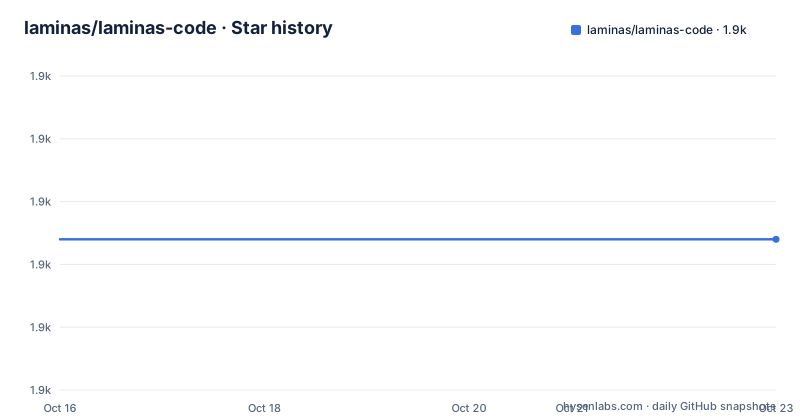
- laminas/laminas-code1,904 ★ · +0
| Repository | 2026-10-16 | 2026-10-23 |
|---|---|---|
| laminas/laminas-code | 1.9k | 1.9k |
0 Stars in the last 7 days, measured from the daily GitHub snapshot. Compare with other projects
Editorial analysis
The PHP generation problem laminas-code addresses
laminas-code addresses a narrow but recurring PHP engineering problem: producing or changing source code without building every declaration through direct string concatenation. Its `Laminas\Code\Generator` facilities expose an object-oriented interface for creating new code and updating existing code. This is relevant to library maintainers, framework developers, and build-tool authors who need repeatable PHP artifacts for scaffolding, testing, or project automation.
The distinction matters. A template is sufficient for a fixed class definition, but it becomes awkward when optional methods, properties, namespaces, or modifications are assembled dynamically. laminas-code models those parts as code constructs before producing PHP output. It does not decide which architecture a generated class should have, whether its dependencies are appropriate, or whether the result satisfies a project's coding conventions. Those remain application decisions.
The README limits the current implementation to PHP generation. It also says that developers can extend the base class for tasks such as generating JavaScript, configuration files, or Apache virtual hosts. That is an extension mechanism, not a claim that the repository includes production-ready generators for those formats. A custom extension would carry its own formatting, validation, and maintenance work.
Generator structure and reflection-oriented data flow
The documented center of the generation API is `Laminas\Code\Generator`. A caller creates or configures generator objects for PHP constructs, then asks the relevant component to produce source text. The object-oriented layer separates the description of the intended program structure from the mechanics of assembling a PHP file. That avoids requiring the caller to treat an entire class as one concatenated string.
The repository description also identifies extensions to PHP’s Reflection API. A tool built with these facilities can work with runtime class metadata, while the generator side turns selected structures into source. Static code scanning covers a different stage because it examines source rather than executing the target class through Reflection. The exact scanner classes, configuration keys, accepted inputs, and diagnostic output are not described in the README, so its parsing coverage and reporting model require confirmation in the documentation before selection.
Based on the repository layout, this is a library with implementations under `src/` and tests under `test/`. It is not presented as a standalone command-line scanner. Consumers should therefore expect to call its PHP interfaces from a build tool, application, or plugin. It may form part of a larger analysis or generation pipeline, but the project description does not establish that it can replace a general parser, dependency resolver, or architecture analyser.
Installing laminas-code and starting a first generation task
The README does not contain an installation command or a first-use code example. It directs users to the official documentation and identifies the repository documentation directory and Composer metadata. This article does not invent an unsupported command or version constraint.
The documented starting point is the Laminas documentation page:
https://docs.laminas.dev/laminas-code/That page is the authoritative source for installation steps compatible with the selected release. After installation, a sensible first task is to create one small PHP construct through `Laminas\Code\Generator`, render it, and inspect whether the generated declaration matches the intended namespace, members, and formatting. The README confirms that the interface can create new code, but it does not publish the method names needed to provide a complete example.
The repository’s Composer configuration is available in `composer.json`, while `composer.lock` records the dependency resolution used by the repository itself. A consumer should review the package requirements in `composer.json` rather than assume compatibility with every PHP version. Before relying on generated files, also run the consuming project’s own tests and coding checks. The library can produce source, but it cannot establish that the source is correct for the target codebase.
Benefits and boundaries of structured PHP generation
The main benefit is a structured interface for code creation. Instead of scattering declarations across string fragments, a tool can represent classes, methods, properties, and related constructs through dedicated objects. That can make conditional generation easier to follow and gives tooling a reusable model for repeated artifacts.
The extension point is also meaningful. The README explicitly says that the base class can be extended beyond PHP. However, extending it does not remove the need to define syntax rules, escaping behavior, formatting policy, or validation for another output language. A JavaScript or configuration generator created this way would be project code with project-specific maintenance costs. The repository does not advertise bundled support for every example named in the README.
Generated output has a distinct quality problem. Syntactically valid PHP can still be semantically wrong. It can reference an absent interface, use an unsupported language feature, conflict with a namespace, or violate project naming rules. Generated code should therefore be treated as source code subject to review, tests, static checks, and version-control policy. If a workflow requires only one fixed text file, a plain template may be simpler and easier to audit.
Scanning limits and concrete failure modes
The project description identifies static code scanning, but the README does not document syntax coverage, scanner configuration, diagnostics, ignore handling, or report formats. Those omissions prevent a confident claim that laminas-code is a complete static analyser. A failed analysis can also arise before the scanner reaches application logic if a target file cannot be parsed or a required class is unavailable.
Reflection introduces another boundary. Reflection operates inside a PHP process and depends on loadable code and its runtime context. Static inspection can avoid loading classes, but it still needs a defined syntax model. The available documentation excerpt does not say how laminas-code coordinates these two modes, so projects with conditional definitions, generated autoload files, or unusual bootstrap requirements should verify that behavior directly.
Code generation has corresponding failure modes. Re-running a generator may overwrite manual edits, while output can drift after a PHP or library upgrade. The README does not document rollback or a project-wide regeneration command. Consumers need to decide whether generated artifacts are committed or built in continuous integration. They should also ensure their workflow preserves intentional changes and detects when a generator produces output that no longer compiles under the application’s supported PHP version.
Maintenance signals, licensing, and upgrade cost
The repository is not archived, and its last push was on 2026-10-12. The release list includes `4.17.0` on 2025-11-01, `4.16.0` on 2024-11-20, and `4.15.1` on 2024-10-25. The default branch is `4.18.x`, although the listed releases do not include a `4.18.0` entry. That difference should be considered when selecting a production version rather than assuming the branch name represents a published release.
The declared license is `BSD-3-Clause`. The repository contains `LICENSE.md` and `COPYRIGHT.md`, which are the appropriate files to consult for the exact terms. This review does not interpret those terms or provide legal advice.
Upgrade cost depends on usage. A project using only the documented Generator interface may need dependency checks, regenerated output review, and regression tests. A project extending the base class can face greater work if parent APIs or generated formatting change. A consumer of reflection or scanning functionality must verify those documented interfaces because the README does not promise compatibility for every API. Locked Composer dependencies can make adoption more predictable, but upgrades still require reviewing `composer.lock` and exercising affected generation paths before release.
Choosing laminas-code instead of a parser, analyser, or template
Choose laminas-code when the primary task is to construct or modify PHP through an object-oriented interface. It is also relevant when a tool combines reflection metadata with generated source or scans PHP structures as part of a larger workflow. The documented extension model can support a custom generator for another syntax, provided the consuming project accepts responsibility for that format.
A general-purpose parser is a different choice. Parsers usually center on syntax trees, source positions, error recovery, and language grammar coverage, none of which are documented as the primary purpose of laminas-code. A static analyser is preferable when the goal is a broad diagnostic set, rule configuration, or reports across a codebase. A plain template is simpler for one fixed output with few variations.
These approaches overlap around PHP source, so the deciding question is the required output and control model. If the tool needs structured PHP declaration objects, laminas-code fits that model directly. If it needs comprehensive syntax intelligence or diagnostics, the README provides too little evidence to justify replacing a dedicated parser or analyser. Confirming the exact class and scanner contracts in the official documentation is the first technical filter.
Editorial conclusion
Adopt laminas-code when a PHP project needs structured source generation or reflection-oriented code handling. Do not choose it as a replacement for a full parser or static analyser. First verify the documented API for your intended use, confirm compatibility with the project’s PHP and dependency constraints, and review generated files before integrating them into a release workflow.
Frequently asked questions
What problem does laminas-code solve?
It provides an object-oriented interface for generating new PHP code and updating existing code. The repository description also identifies Reflection API extensions and static code scanning.
Does laminas-code generate code for languages other than PHP?
The current implementation is limited to PHP code generation according to the README. It says that the base class can be extended for tasks such as JavaScript, configuration files, and Apache virtual hosts, but it does not identify bundled generators for those formats.
How do I install laminas-code?
The README does not include installation commands. It directs users to `https://docs.laminas.dev/laminas-code/`, and the repository includes `composer.json` with package metadata.
Is laminas-code a complete static analyser?
The repository description calls static code scanning a capability, but the README does not document syntax coverage, diagnostics, configuration, or report formats. The repository should not be treated as a complete analyser without checking those contracts in its documentation.
What license does laminas-code use?
The project uses the `BSD-3-Clause` license. Its exact terms and notices are recorded in `LICENSE.md` and `COPYRIGHT.md`.
Official sources
Add this badge to your README
If you maintain this project, the badge below links readers to this analysis and shows its maintenance status from the daily GitHub snapshot. Paste the markdown into your README; add ?metric=license or ?metric=stars to the image URL for a different field.

[](https://hysenlabs.com/projects/laminas-laminas-code)Star history chart for your README
[](https://hysenlabs.com/projects/laminas-laminas-code)Was this useful?