latexstudio/CUMCMThesis for 2026 Math Modeling Papers
全国大学生数学建模竞赛LaTeX论文模板 已经适配到 2026 年格式
At a glance
- What is it?
- latexstudio/CUMCMThesis is a LaTeX class and package set for the Chinese Undergraduate Mathematical Contest in Modeling. It supplies competition-specific document structure and declares an AI-use statement update, but its documentation assumes some familiarity with ctex and does not give installation or compilation commands.
- Who is it for?
- Contestants who already work comfortably with ctex and need the 2026 CUMCM document structure should use CUMCMThesis, while newcomers should first confirm that their local TeX distribution can compile the class and sample file. Buyers or institutions should verify the repository's license before redistribution.
- Can I use it commercially?
- Not without permission. GitHub finds no licence file in the repository, and without a licence all rights are reserved by default: you may read the code but not reuse it. Check the README, or ask the authors, before using it.
- Is it still maintained?
- Yes. The repository last received commits 74 days ago.
- What is it written in?
- Mainly TeX, according to GitHub's language statistics.
Answers come from the project's GitHub data, last synced on November 6, 2026, and from our analysis. They are not legal advice.
Star history
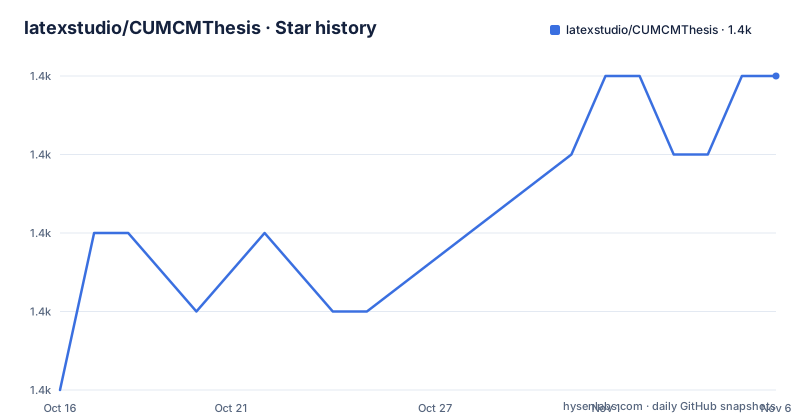
- latexstudio/CUMCMThesis1,439 ★ · +4
| Repository | 2026-10-16 | 2026-11-06 |
|---|---|---|
| latexstudio/CUMCMThesis | 1.4k | 1.4k |
4 Stars in the last 21 days, measured from the daily GitHub snapshot. Compare with other projects
Editorial analysis
Why CUMCMThesis Exists
CUMCMThesis targets a specific writing task: producing a LaTeX paper for the Chinese Undergraduate Mathematical Contest in Modeling. Its purpose is not to generate analysis, solve an optimization problem, or structure a research argument. Instead, it moves the document-format work out of the contestant's editing process so that attention can remain on the paper's content. That distinction matters for mathematical modeling submissions, where the same research may need to fit a prescribed cover, summary, numbered pages, declarations, and appendices.
The intended user is therefore a contest participant who already understands the content of a modeling paper but does not want to repeatedly adjust LaTeX settings for the competition format. The README also identifies a second requirement: the user should have some LaTeX experience, including familiarity with features of the `ctex` package such as changing character spacing or modifying font size. The project is consequently closer to a specialized starting document than to a fully isolated authoring application.
The repository includes `cumcmthesis.cls`, `cumcm2026.sty`, `example.tex`, an `example.pdf`, and supporting figures. The separate `.cls` and `.sty` entries indicate that the class provides the main document environment while the package contains supporting definitions or changes. The README states that the template has been adapted to the 2026 format. Its update record also says that an AI-use statement was updated in August 2026, making that document-level requirement part of the current template scope rather than an unrelated feature.
CUMCMThesis Document Structure and Package Mechanism
Based on the repository layout, `cumcmthesis.cls` is the entry point declared by a contest paper, while `cumcm2026.sty` is the year-specific style package named in the repository. The README presents the options used when loading the class, so the documented mechanism is class-option driven rather than a separate command-line conversion workflow. The visible options control whether the preface is included and whether the document is set for black-and-white printing.
The documented class loading forms are:
\documentclass[withoutpreface,bwprint]{cumcmthesis}The README says this form removes the cover while retaining the paper title above the abstract. That is a document-layout choice, not a content deletion mechanism. The alternative keeps the cover and follows the original behavior:
\documentclass[bwprint]{cumcmthesis}The README also records structural work on the commitment page, title layout, numbering pages, and appendix input style across earlier updates. The 2020 entry says that the cover and numbering page were adapted to a new official format, and the 2019 entry records another official-format adaptation. Those are concrete signs that the template carries contest-specific document machinery rather than merely providing a generic article class.
The example file is important because it is the only concrete paper entry point shown by the repository. The README links to `example.pdf` and `example.tex`, which gives users a reference document without requiring them to infer the intended structure from the class source. However, the README does not document the complete set of environments, commands, package dependencies, or generated-page behavior, so the example is the practical reference for details not explained in the manual.
First Use with the Documented Class Options
The repository does not provide installation steps for a TeX distribution, a package-manager command, or a compilation command. It does point users to a TeX software page and, in the update history, tells them to use a newer LaTeX distribution rather than the older `CTeX` suite.
The first documented use is to start a `.tex` document with `cumcmthesis.cls`. A contestant who does not want a cover can use the following declaration. The README says the title should then remain above the abstract:
\documentclass[withoutpreface,bwprint]{cumcmthesis}A contestant who needs the cover should retain the original class declaration. The `bwprint` option is present in both documented examples, so it should not be silently removed when copying the README's configurations:
\documentclass[bwprint]{cumcmthesis}The reader should then use `example.tex` as the project-specific starting point and compare the generated document with `example.pdf`. The repository contains no documented command that installs `cumcmthesis.cls` into a TeX search path, so the operational requirement is to make the class and its related package available to the local TeX environment by the user's existing TeX workflow. The README's linked example and tutorial material are the documented references for first use.
Where CUMCMThesis Is the Wrong Level of Abstraction
CUMCMThesis is the wrong choice for someone who wants a general-purpose thesis class, a journal paper template, or a tool that can choose fonts and packages automatically. Its ctex assumption is also a real barrier for a complete beginner. The README explicitly requires familiarity with ctex features, including font-size and character-spacing changes. A user who only knows basic document writing may still need to resolve TeX dependencies, class availability, and compilation errors independently.
The documentation does not state the supported operating systems, TeX distributions, package versions, or a reproducible build environment. It also does not provide a rollback procedure, a CI configuration, or a migration guide for contest years. That makes upgrades less predictable than a package with a pinned dependency set. The presence of `cumcm2026.sty` does not, by itself, establish compatibility with earlier contest formats.
The format itself is a recurring constraint rather than a permanent guarantee. The update history records changes for 2016, 2019, 2020, 2023, and 2026, including changes to the cover, numbering pages, commitment page, and AI-use statement. Contestants still need to check the current official requirements against the produced PDF. The template reduces repeated formatting work, but it cannot establish that an institution or competition will accept every local modification.
CUMCMThesis Versus a Manual ctex Paper Setup
The real alternative is a manually assembled ctex-based paper. That approach starts from a general ctex document configuration and adds the competition's cover, numbering, declarations, appendix structure, and formatting rules by hand or through separate local files. Its advantage is control: a contestant can change the preamble without depending on the options exposed by `cumcmthesis.cls`, and can keep every formatting decision in files under their own control.
CUMCMThesis takes the opposite approach. Its class and year-specific style encode the competition conventions in a reusable document class, and the README supplies two concrete class-loading modes for the preface and printing behavior. That reduces the number of formatting decisions that must be recreated for each paper. The trade-off is that the class becomes a compatibility dependency. A contestant who needs a layout outside the class model must either edit the class, override its behavior, or return to a manual ctex setup.
The example PDF and `.tex` file also affect the comparison. CUMCMThesis gives a visible reference for the intended result, while a manual setup starts with more open-ended construction. Neither the README nor the repository listing documents a comparison of feature coverage, exact overrides, or a test suite covering arbitrary modifications. The choice should therefore be based on whether the competition format is the main requirement or whether the paper needs extensive customization.
CUMCMThesis Maintenance, Releases, and License Boundaries
The repository is not archived, and its last push was on 2026-08-26. That is the most recent maintenance fact available here. The README's update record says that the AI-use statement was updated in August 2026. It also records a September 2023 commitment-page layout update, an August 2020 cover and numbering-page adaptation, and a September 2019 official-format adaptation.
Named releases are `2020`, described as a 2020-format adaptation, and `2019`, described as the 2019 official-site format. The repository data does not establish a separate release for the 2026 class file. The presence of `cumcm2026.sty` and the README's 2026 statement should therefore be treated as repository-level format updates, not as proof of a published 2026 release.
The license field is unknown. No licensing terms are shown in the repository information, so the template should not be assumed to permit redistribution, modification, or institutional packaging. Users who need to include it in a public thesis repository, distribute it as part of teaching materials, or embed it in another project need to establish the license with the repository owner first. This is a licensing-status check, not legal advice.
Editorial conclusion
Contestants who already work comfortably with ctex and need the 2026 CUMCM document structure should use CUMCMThesis, while newcomers should first confirm that their local TeX distribution can compile the class and sample file. Buyers or institutions should verify the repository's license before redistribution. Before adoption, check that the generated title, abstract, numbering, commitment pages, appendices, and AI-use statement match the current competition requirements in a local PDF.
Frequently asked questions
What is latexstudio/CUMCMThesis used for?
It is a LaTeX template for papers submitted to the Chinese Undergraduate Mathematical Contest in Modeling. It supplies contest-specific document formatting so contestants can focus more on the paper's content.
How do I start a CUMCMThesis document?
The README documents `\documentclass[bwprint]{cumcmthesis}` for a document with the cover and `\documentclass[withoutpreface,bwprint]{cumcmthesis}` when the cover is removed. It also points users to `example.tex` and `example.pdf` as references.
Does CUMCMThesis include 2026 formatting?
The README states that the template has been adapted to the 2026 format, and the repository contains `cumcm2026.sty`. The listed releases include `2020` and `2019`, but not a separately named 2026 release.
Do I need to know ctex to use CUMCMThesis?
The README says users should have some LaTeX experience and at least know how to use some `ctex` features, such as adjusting character spacing or changing font size.
Official sources
Add this badge to your README
If you maintain this project, the badge below links readers to this analysis and shows its maintenance status from the daily GitHub snapshot. Paste the markdown into your README; add ?metric=license or ?metric=stars to the image URL for a different field.

[](https://hysenlabs.com/projects/latexstudio-cumcmthesis)Star history chart for your README
[](https://hysenlabs.com/projects/latexstudio-cumcmthesis)Was this useful?