Official Document Skill: forcing an AI to write Chinese public documents with facts instead of slogans
A skill for official-document writing, distilled from hundreds of articles in People's Daily and other publications. Generates well-structured, appropriately worded, concrete official documents tailored to document type, scenario, and source material, with the 'AI smell' removed.
At a glance
- What is it?
- Official Document Skill is an MIT Codex/Claude skill distilled from official Chinese-language articles and document standards. Its goal is documents that are structurally correct and concrete, with a built-in scoring pass that strips AI filler before delivery.
- Who is it for?
- Adopt Official Document Skill if you write Chinese official or government documents and want a tool that picks the correct document type, enforces the statutory structure and formatting, and runs a six-dimension scoring plus humanizer pass to strip AI filler before delivery: that quality gate, which rewrites low-scoring drafts rather than returning them, is the reason to choose it over a generic assistant.
- Can I use it commercially?
- Yes. MIT is a permissive licence: you can use, modify and sell software built on it, as long as you keep its copyright and licence notices.
- Is it still maintained?
- Yes. The repository last received commits 133 days ago.
- What is it written in?
- GitHub does not report a main language for this repository.
Answers come from the project's GitHub data, last synced on October 23, 2026, and from our analysis. They are not legal advice.
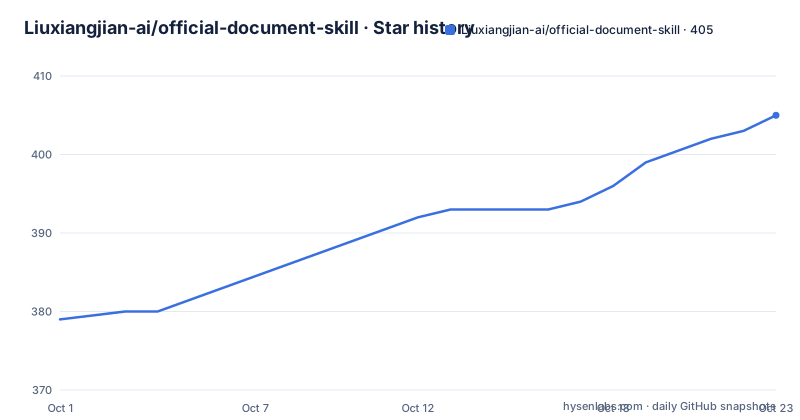
Star history
- Liuxiangjian-ai/official-document-skill405 ★ · +26
| Repository | 2026-10-01 | 2026-10-23 |
|---|---|---|
| Liuxiangjian-ai/official-document-skill | 379 | 405 |
26 Stars in the last 22 days, measured from the daily GitHub snapshot. Compare with other projects
Editorial analysis
The problem: AI public documents that are correct but empty
Official Document Skill targets a specific failure of AI writing in Chinese official and government documents. The README shows the typical output: text full of abstract slogans that reads as formal but, on inspection, never says who is responsible, what was done, through what mechanism, by when, or with what result. The README names this the AI flavor, plenty of abstract words, very little work information.
The user is someone inside an organization who has to produce official documents, notices, requests, reports, meeting minutes and the like, and wants AI help that produces deliverable text rather than empty formality. The skill is built for the conventions of Chinese public administrative writing specifically.
What makes it more than a prompt is its sourcing. The README says it is distilled from hundreds of articles in official publications plus public-document standards and formal formatting rules, and that version 1.3 additionally absorbs a humanizer review pass. The stated aim is to turn correct-but-empty text into specific, appropriate, deliverable documents. It is MIT licensed and packaged as a single-file skill.
A full document pipeline, not just polishing
The distinguishing design is that the skill runs a full pipeline rather than only editing sentences. The README describes the flow as recognize the scenario, judge the document type, extract facts, match the structure, generate the body, reduce AI flavor, score the quality, and deliver. That means it first decides what a piece should be, a notice, a request, a report, or a letter, before writing it, because in Chinese official writing choosing the wrong document type is a substantive error, not a style one.
Version 1.3 expands the covered document types from around eleven to more than twenty, spanning statutory documents, administrative writing, meeting materials and public-facing pieces, and it distills formatting constraints like titles, main recipients, attachments and signatures, plus the distinctions between easily-confused types such as a request versus a report.
The README is careful about how it uses its sources: it keeps only the transferable expression patterns from the official-publication corpus, not copyable stock phrases, so it will not turn a grassroots notice into an editorial. That restraint, using the corpus for structure and judgment rather than as a phrase bank, is what separates it from a template filler.
Using the skill
As a Codex and Claude skill, it is invoked in natural language with a `$official-document-skill` reference, and the README gives a concrete example of generating a notice from a plain request:
用 $official-document-skill 写一份通知:区教育局通知各学校开展暑期校园安全排查,The README explains the skill will recognize this as a notice and focus on the recipients, the matter, the requirements and the deadline, rather than writing it as promotional copy. Beyond generating from scratch, it can also turn spoken or scattered material, meeting notes or working points, into a properly structured document, and it can check an existing document's type and formatting for common errors such as a report that smuggles in a request, or a title whose document type does not match the body's purpose.
The skill is distributed as a single `SKILL.md` file containing the version 1.3 rules, with `README.md`, `examples.md` and `tests.md` alongside. Because the whole ruleset is consolidated into one file, adopting it is a matter of making that skill available to your agent, after which the natural-language invocations drive it.
The built-in scoring pass is the real safeguard
The feature that makes this more than instructions is a self-scoring step before delivery. The README describes a six-dimension check after generation: fact density, document-type fit, restraint of tone, natural sentence variation, control of abstract words, and structural clarity, each weighted, with an additional humanizer check for the specific tics of AI writing, meaning inflation, false profundity, vague subjects, forced rule-of-three parallelism, synonym cycling, meta-discourse and all-purpose conclusions.
The scoring drives action rather than just reporting a number. The README's handling rules say text above 90 can be delivered, 80 to 89 gets local tightening of filler, 70 to 79 has problem paragraphs rewritten, and below 70 is restructured entirely by document type. That is a real quality gate: the skill is instructed to fix low-scoring output before returning it, not to hand back the first draft.
The humanizer pass in version 1.3 is aimed precisely at documents that look tidy but still read as machine-written, the case where surface formality hides the absence of concrete content. Targeting that specific failure, rather than generic grammar, is what the whole skill is organized around.
The limitations: one language, one domain, and judgement it cannot supply
The honest limitations are scope. This is built for Chinese public administrative and government writing, and its value is entirely within that domain. It encodes the conventions, document types and formatting rules of that context, so it does not transfer to other languages or to non-official writing, and it is not meant to.
The deeper limitation is that the skill improves expression and structure but cannot supply facts or judgment it is not given. Its whole premise is replacing abstract slogans with concrete specifics, responsible parties, mechanisms, deadlines, results, but those specifics have to come from the user's material. If the input is vague, the skill can enforce the right structure and flag missing subjects, but it cannot invent the actual responsible unit or the real deadline. Its scoring rewards fact density; it cannot manufacture facts.
There is also an inherent tension in an AI tool whose job is to remove AI flavor: the humanizer pass is itself a model judging what looks machine-written, and its judgment is only as good as the model running it. The scoring is a strong safeguard, but it is a self-check, and a user delivering official documents should still read the result rather than trust the score alone.
Against a generic AI writing assistant or a document template
The alternatives are a generic AI writing assistant and a static document template. A generic assistant will happily produce the exact abstract, empty text the README complains about, because it optimizes for fluent formality rather than the fact density and document-type correctness official writing demands. A static template gives the right structure but does nothing about content or AI filler, and cannot judge which document type a situation calls for.
Official Document Skill's difference is the combination: it selects the document type, enforces the statutory structure and formatting, and runs a scoring and humanizer pass tuned to the specific failures of official writing, filler, vague subjects, all-purpose conclusions. The cost is that it is narrow, one language and one domain, and that its quality gate is a self-check. Choose a generic assistant if you want broad, casual help and will edit heavily. Choose a template if you only need the shell. Choose Official Document Skill when you specifically write Chinese official documents and want a tool that picks the right type, enforces the conventions, and actively strips the AI flavor before handing you a draft.
MIT, single-file rules, and where to start
Official Document Skill is MIT, so its rules can be read, forked and adapted with attribution, and because version 1.3 consolidates everything into one `SKILL.md`, the entire logic is inspectable in a single file rather than scattered across a codebase. That transparency matters for a writing tool whose value is its embedded standards: you can read exactly what conventions and checks it applies.
Maintenance is version-driven, and the README documents the progression through 1.3, which added the full pipeline, the expanded document-type coverage and the humanizer pass, so updates arrive as new consolidated rule versions rather than a service.
The concrete first step is to test it on a real document you know well: invoke it with `$official-document-skill` to generate a specific notice or report from actual material, then read the result against the README's six scoring dimensions, checking that it named the responsible party, the mechanism and the deadline rather than falling back on slogans. Feed it a deliberately vague brief too, to see that it flags the missing subject rather than inventing one, since that boundary, structure it can enforce but facts it cannot supply, is the thing to understand before relying on it.
Editorial conclusion
Adopt Official Document Skill if you write Chinese official or government documents and want a tool that picks the correct document type, enforces the statutory structure and formatting, and runs a six-dimension scoring plus humanizer pass to strip AI filler before delivery: that quality gate, which rewrites low-scoring drafts rather than returning them, is the reason to choose it over a generic assistant. It is irrelevant outside Chinese public administrative writing, and it cannot supply the facts, responsible parties, mechanisms and deadlines, that its whole method depends on. Start by generating a real notice or report from actual material with $official-document-skill, then check the output against the README's scoring dimensions, and feed it a vague brief to confirm it flags missing subjects rather than inventing them.
Frequently asked questions
What is Official Document Skill for?
It is a skill for writing Chinese official, government and administrative documents. The README says it is distilled from hundreds of official-publication articles and document standards to produce structurally correct, concrete, low-AI-flavor text that is ready to deliver.
How does it avoid generic AI-sounding text?
After generating, it self-scores on six dimensions including fact density and document-type fit, plus a humanizer check for meaning inflation, vague subjects, rule-of-three padding and all-purpose conclusions. The README's rules rewrite drafts scoring below set thresholds before delivery.
How many document types does Official Document Skill support?
The README says version 1.3 expanded coverage from around eleven to more than twenty, spanning statutory documents, administrative writing, meeting materials and public-facing pieces, and it first judges which type a given situation calls for.
Official sources
Add this badge to your README
If you maintain this project, the badge below links readers to this analysis and shows its maintenance status from the daily GitHub snapshot. Paste the markdown into your README; add ?metric=license or ?metric=stars to the image URL for a different field.

[](https://hysenlabs.com/projects/liuxiangjian-ai-official-document-skill)Star history chart for your README
[](https://hysenlabs.com/projects/liuxiangjian-ai-official-document-skill)Was this useful?