Dive into LLMs: A Course-Style Jupyter Notebook Series for Hands-On LLM Practice
GitHub describes it as Dive into LLMs: a hands-on series of programming tutorials on large language models. The repository metadata lists Jupyter Notebook as its primary language. This article stays within the project description and details documented in the GitHub repository README.
At a glance
- What is it?
- This repository from Shanghai Jiao Tong University offers a free, chapter-based set of Jupyter notebooks covering fine-tuning, prompting, knowledge editing, and security topics. It is a practical companion for students and researchers, not a production toolkit.
- Who is it for?
- Adopt dive-into-llms if you are a student, educator, or researcher who wants a free, structured, hands-on introduction to LLM techniques, especially in security and alignment, and you are comfortable with Chinese-language materials. Do not use it as a production deployment guide or as a reference for best practices in a commercial setting, because the README explicitly disclaims correctness and the content is course-oriented.
- Can I use it commercially?
- Not without permission. GitHub finds no licence file in the repository, and without a licence all rights are reserved by default: you may read the code but not reuse it. Check the README, or ask the authors, before using it.
- Is it still maintained?
- Probably not. The repository last received commits 13 months ago, on October 10, 2025.
- What is it written in?
- Mainly Jupyter Notebook, according to GitHub's language statistics.
Answers come from the project's GitHub data, last synced on November 15, 2026, and from our analysis. They are not legal advice.
Star history
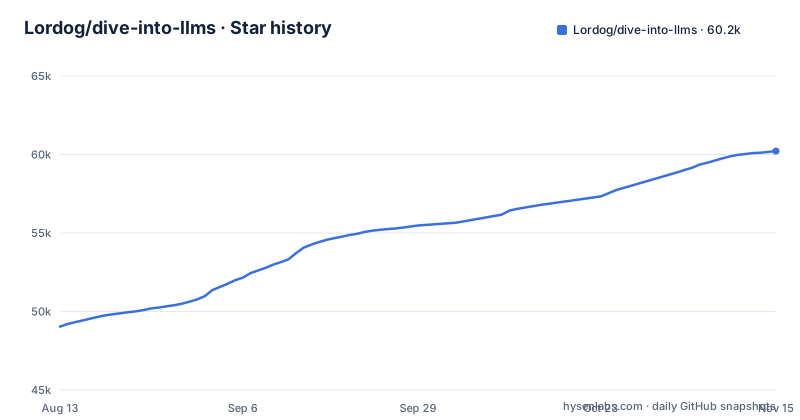
- Lordog/dive-into-llms60,215 ★ · +11,178
| Repository | 2026-08-13 | 2026-11-15 |
|---|---|---|
| Lordog/dive-into-llms | 49k | 60.2k |
11,178 Stars in the last 94 days, measured from the daily GitHub snapshot. Compare with other projects
Editorial analysis
What This Repository Actually Provides
dive-into-llms is a collection of Jupyter notebooks and lecture PDFs that grew out of two courses at Shanghai Jiao Tong University: Natural Language Processing Frontier Technology (NIS8021) and AI Security Technology (NIS3353). The README describes it as a free, public-interest programming reference for LLM beginners. The intended audience is students who need to complete course projects or start academic research. Each chapter pairs a PDF slide deck with a README and an .ipynb script. The topics range from fine-tuning and deployment to prompt learning, chain-of-thought, knowledge editing, mathematical reasoning, watermarking, jailbreak attacks, steganography, multimodal models, GUI agents, agent safety, and RLHF safety alignment. There is also a separate, newer track developed with Huawei Ascend, called the Full Process of LLM Development, which is hosted on the Ascend community site rather than in this repository.
How the Chapters Are Structured for Learning
The repository is organized by chapters, and each chapter follows a consistent pattern: a PDF lecture, a README that explains the concept, and a Jupyter notebook that implements it. For example, chapter 1 covers fine-tuning and deployment, with a notebook named dive-tuning.ipynb. Chapter 2 focuses on prompting and chain-of-thought, with dive-prompting.ipynb. The structure is intentionally pedagogical: you read the slides, then you run the code. Each chapter's tutorial README sits next to its notebook, so check it for the dependencies and environment that chapter needs.
Getting It Running: What the README Does and Does Not Tell You
The repository root holds only README.md, documents/ and pics/, with no requirements file at the top level. The README links each chapter's slide deck, tutorial README and notebook on GitHub, so check each chapter's tutorial README for setup steps. Chapter 1 covers fine-tuning a pretrained model and chapter 11 covers PPO-based RLHF, so a GPU is likely to be needed for both.
The Security-Focused Chapters Are the Standout Feature
What distinguishes this repository from generic LLM tutorials is the heavy emphasis on security and safety. Chapters 5 through 7 and 10 through 11 cover watermarking, jailbreak attacks, steganography, agent safety, and RLHF alignment. The README even warns that the RLHF chapter is 'dangerous' and tells you to check whether your model is 'sneering' after reading it. This is a refreshing angle: instead of only teaching how to build models, it teaches how to attack and defend them. For a researcher or student interested in AI security, this is a valuable starting point. The jailbreak chapter, for instance, likely demonstrates how to craft prompts that bypass safety filters, which is a practical skill for understanding model vulnerabilities. The watermarking chapter shows how to embed invisible markers in generated text, which is relevant for provenance and copyright. These topics are rarely covered in free, hands-on tutorials, so this repository fills a specific niche.
A Real Limitation: The Language Barrier and the Disclaimer
The entire README and presumably the notebooks are written in Chinese. The chapter titles and descriptions are in Chinese.. This limits the audience to Chinese-speaking users or those willing to work with machine translation. The README also includes a disclaimer that all content comes from personal experience and internet data, and that the techniques are not guaranteed to be correct. This is honest but also a warning: the code may contain errors, and the methods may not be state-of-the-art. For an engineer evaluating this for adoption, this means you cannot treat the notebooks as authoritative. You would need to verify each implementation against the official documentation of the libraries used. The repository is also a work in progress, as the README says, so you should expect occasional bugs and incomplete sections.
Comparing with Hugging Face Courses and Other Tutorials
The closest alternative is the Hugging Face course, which also offers free Jupyter notebooks and covers fine-tuning, prompting, and deployment. The key difference is that the Hugging Face course is framework-centric: it teaches you to use the transformers library in depth, with a focus on production-ready practices. Dive into LLMs, in contrast, is research-oriented and security-focused. It includes topics like knowledge editing and steganography that are not part of the Hugging Face curriculum. Another alternative is the book 'Hands-On Large Language Models' by Jay Alammar and Maarten Grootendorst, which covers similar ground but in a more polished format. However, that book is not free and does not include hands-on security experiments. For a student who wants to learn about LLM security specifically, dive-into-llms has no direct free equivalent. For a developer who wants to learn how to fine-tune a model for a business use case, the Hugging Face course is a more reliable choice because it is maintained by the library creators and includes up-to-date API usage.
Maintenance, Licensing, and Upgrade Costs
The repository was last pushed on October 10, 2025, and the only release, v1, is dated June 12, 2025. The README's update note is dated June 6, 2025. However, the license is listed as unknown, which is a significant issue for reuse. Without a license, you cannot legally copy, modify, or distribute the code without permission from the authors. This is a common problem with academic repositories, but it means you should treat the notebooks as reference material rather than as a codebase to integrate into your own projects. The maintenance cost for you is moderate: you need to keep up with changes in the underlying libraries, because the notebooks may break when transformers or other dependencies update. The upgrade cost is low if you only read the tutorials, but high if you want to adapt the code, because you would need to rewrite parts to match your environment. The README encourages contributions via issues and pull requests, so the project is open to community improvements, but the lack of a license creates uncertainty about how those contributions can be used.
Editorial conclusion
Adopt dive-into-llms if you are a student, educator, or researcher who wants a free, structured, hands-on introduction to LLM techniques, especially in security and alignment, and you are comfortable with Chinese-language materials. Do not use it as a production deployment guide or as a reference for best practices in a commercial setting, because the README explicitly disclaims correctness and the content is course-oriented. Before relying on it, verify that the notebooks match your target framework versions (e.g., PyTorch, transformers) and that your hardware meets the requirements for fine-tuning or RLHF experiments, as those can be resource-intensive. Also, check the license status, since the repository does not state a license, which may restrict how you can reuse the code in your own projects.
Frequently asked questions
What does the dive-into-llms tutorial cover?
Eleven chapters spanning fine-tuning and deployment, prompting and chain of thought, knowledge editing, mathematical reasoning, watermarking, jailbreak attacks, steganography, multimodal models, GUI agents, agent security and PPO-based RLHF alignment. It grew out of two Shanghai Jiao Tong University courses and is free.
How is each chapter in dive-into-llms organised?
Each chapter links to three things, a slide deck as a PDF, a tutorial README, and a script which is a Jupyter notebook. The files sit under a per-chapter directory in the documents folder.
Is the full-process LLM development course part of this repository?
No. The Ascend-based full-process course was built with Huawei and is hosted on the Ascend community learning area, and the repository only links out to it. The eleven chapters are the whole of what is present locally.
Can I reuse the dive-into-llms notebooks commercially?
Nothing in the repository grants that. The licence is recorded as unknown and there is no licence file, so the project states no permission to copy, adapt or redistribute the material, and the authors describe it as free and non-commercial in intent.
Official sources
Add this badge to your README
If you maintain this project, the badge below links readers to this analysis and shows its maintenance status from the daily GitHub snapshot. Paste the markdown into your README; add ?metric=license or ?metric=stars to the image URL for a different field.

[](https://hysenlabs.com/projects/lordog-dive-into-llms)Star history chart for your README
[](https://hysenlabs.com/projects/lordog-dive-into-llms)Was this useful?