LSPromise: a two-CVE root chain for Android 17 Pixels, published in the open
Android complete exploit chain that enables privilege escalation from a local untrusted app to root/kernel, combination of CVE-2026-49881 and CVE-2026-43284
At a glance
- What is it?
- The LSPosed team's public exploit chain, a Telecom logic flaw plus a known kernel bug, escalates a local app to root and loads KernelSU on vulnerable Android 17 builds. Research artifact, not a tool for strangers' phones.
- Who is it for?
- LSPromise is a legitimate research release for the rooting community: owners of vulnerable Pixel devices on initial Android 17 builds who understand that root weakens their security and that the September 2026 bulletin closes the userspace half. Skip it for any device you do not own, for patched builds where it should fail, or as a daily-driver root solution if banking and attestation apps matter to you.
- Can I use it commercially?
- The repository metadata does not identify a licence. Check the project’s published terms and any component-specific licences before reuse.
- Is it still maintained?
- Yes. The repository last received commits 78 days ago.
- What is it written in?
- Mainly C, according to GitHub's language statistics.
Answers come from the project's GitHub data, last synced on November 25, 2026, and from our analysis. They are not legal advice.
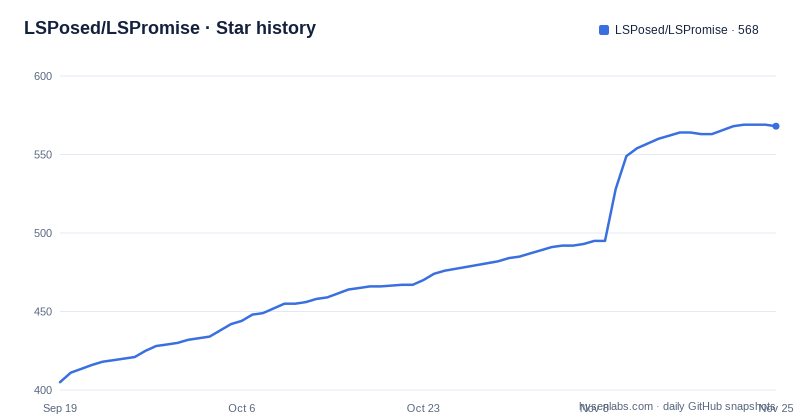
Star history
- LSPosed/LSPromise568 ★ · +163
| Repository | 2026-09-19 | 2026-11-25 |
|---|---|---|
| LSPosed/LSPromise | 405 | 568 |
163 Stars in the last 67 days, measured from the daily GitHub snapshot. Compare with other projects
Editorial analysis
A root chain published the open-source way
LSPromise, published by the LSPosed team, is a complete privilege escalation chain for Android: it takes a local, untrusted app from zero to root and kernel code execution on vulnerable devices, and ends by loading KernelSU, the community root solution, on the machine you are holding. The README opens with a technical characterization that doubles as a warning to defenders: the chain uses no memory corruption and no race conditions, so no heap spraying and no bypass of mitigations such as KASLR, MTE or CFI is involved, which is why the author describes a 100 percent success rate on vulnerable builds.
Provenance matters for judging a release like this. LSPosed is a long-standing name in the Android modification community, and the publication follows the norms of responsible research: the userspace bug was reported to the Android Security Team with a writeup, it received CVE assignments, and one of the two flaws is already covered by a published Google fix. The README even includes a screen recording of the chain landing. This is a research artifact aimed at device owners and defenders, and it should stay that way: privilege escalation on a device you do not own is illegal in most jurisdictions regardless of how public the code is.
Bug one: a logic flaw in the Telecom service
The userspace half is CVE-2026-49881, and the README walks the code because the bug is unusual. A change in Android 17's Telecomm service added a class-existence check for InCallService entries, and that check loaded code from an arbitrary app using a context combination that includes the app's code while ignoring security, with only a guard against static initialization. As the writeup notes, an app can still declare a custom AppComponentFactory, which the system invokes when the class loader is created, executing the app's code.
The vulnerable code lives in the Telecom package, which runs inside system_server as the system identity, one of the most privileged userspace processes on Android, so the bug yields arbitrary Java execution there. The disclosure story is part of the record: reported to the Android Security Team on 2026-07-23, told it was a duplicate, and fixed in the September 2026 security bulletin by removing the check entirely. The README also voices a policy observation, that Google's move to quarterly security bulletins may explain a three-month window on a freshly released Android version, and that AOSP and Pixel devices outside beta QPR builds remained vulnerable at writing time.
Bug two, and the chain between them
Root needs more than system-server code, and the second half is a kernel one-day the README credits to prior public work: the DirtyFrag family of page-cache write bugs, using the xfrm-ESP variant assigned CVE-2026-43284, the variant reachable on Android kernels. SELinux blocks untrusted apps from the required sockets and also stops system_server from loading native code from data or mapping anonymous executable memory, which is where the chaining logic earns its keep.
The writeup describes the route at the level of mechanism: system_server runs ActivityManager, which keeps application-thread handles for every app process, and Java reflection retrieves those handles so code in system_server can direct the network-stack process to load attacker-supplied code, a process with the native-code rights and privileges the kernel bug needs. The README quotes the exact code that opens the door, the class-existence check Android 17 added to InCallController:
        PackageManager packageManager = mContext.getPackageManager();
        Context userContext = mContext.createContextAsUser(userHandle,
                0 /* flags */);
        PackageManager userPackageManager = userContext != null ?
                userContext.getPackageManager() : packageManager;

        List<ResolveInfo> entries;
        entries = userPackageManager.queryIntentServices(
                serviceIntent,
                PackageManager.GET_META_DATA | PackageManager.MATCH_DISABLED_COMPONENTS);
        for (ResolveInfo entry : entries) {
            ServiceInfo serviceInfo = entry.serviceInfo;

            if (serviceInfo != null) {
                boolean isMetaFlag = serviceInfo.metaData != null &&
                        serviceInfo.metaData.getBoolean(
                                "android.telecom.CLASS_EXISTENCE_CHECK", false);
                if (isMetaFlag && !serviceClassExists(serviceInfo, userHandle)) {
                    continue;
                }
            }
        }
From there the chain follows the published DirtyPipe-style pattern: patch system libraries through the page-cache primitive, step through process transitions into more privileged SELinux domains, load a kernel module disguised with a vendor file label, and relax SELinux before launching KernelSU. Every step is already documented in the linked public writeups; the README's contribution is assembling and testing them into one deterministic chain.
Using it, and what root costs you
The operational surface is small by design: install the KernelSU app, open LSPromise, run its userspace step, then its kernel step, and KernelSU takes over the management of root grants. One quirk is documented: rerunning the kernel exploit after a success requires a reboot first. Tested hardware is the Pixel 10 on the initial Android 17 release, and the README reports the chain failing on the Pixel 6a, with a note that devices on related 6.1-series kernel trees may carry a different bug.
The cost side deserves equal weight. Root changes the security posture of the device fundamentally: the exploitation path sets SELinux to permissive, KernelSU then manages which apps receive root, and a rooted device is a weaker device against any subsequent attacker. Integrity-checked apps, banking software and attestation-dependent services commonly refuse rooted devices. And the determinism claim cuts defensively too: any local app on an unpatched, vulnerable build has a reliable escalation path, which is precisely why owners of affected devices should treat the September bulletin as urgent.
Why publish this, and who should not touch it
The publication logic is visible in the artifact itself. The userspace bug was reported, assigned and patched; the kernel bug was already public from another researcher's writeup; and the audience for the release is the rooting and research community that LSPosed has served for years. Publishing the assembled chain with a writeup gives defenders a working reproduction, gives Google a concrete demonstration of the quarterly-bulletin gap the author critiques, and gives device owners of vulnerable builds a root path that involves no bootloader reflash.
Who should stay away is a longer list than usual. Not for devices you do not own or are authorized to test, full stop. Not for a daily phone whose banking and attestation-dependent apps matter more than root. Not for Pixel owners who have installed the September 2026 bulletin or later, where the userspace bug is closed and the chain should fail. And not for anyone expecting support: the repository carries no licence file, no releases, and a last push of 2026-09-09, the profile of a research drop rather than a maintained tool.
Against bootloader routes and staying stock
The standard route to root on a Pixel is the sanctioned one: enable the OEM flashing setting, patch a boot image, and flash it, the path Magisk and KernelSU's own installation instructions describe. That route wipes the device when the bootloader opens and sets a persistent bootloader-open flag, but it survives system updates through re-flashing and is documented by the vendors themselves. The exploit route trades that permanence and sanction for immediacy: no bootloader reflash, root on the current build, for as long as the bugs remain unpatched on the device.
The third option is the one most people should pick: staying stock, and installing the September 2026 bulletin that closes the userspace bug. LSPromise is best read in two registers. For owners of freshly shipped Android 17 devices, it is evidence of why the first bulletin matters. For the security community, it is a cleanly documented case study in chaining a carelessness bug with a known kernel primitive, written by researchers who reported what they found and published after the fix landed.
Editorial conclusion
LSPromise is a legitimate research release for the rooting community: owners of vulnerable Pixel devices on initial Android 17 builds who understand that root weakens their security and that the September 2026 bulletin closes the userspace half. Skip it for any device you do not own, for patched builds where it should fail, or as a daily-driver root solution if banking and attestation apps matter to you. Verify before anything else: confirm your device model, Android build and bulletin level against the README, and treat the September patch as the real fix rather than treating the exploit as a feature.
Frequently asked questions
What is LSPromise?
It is an exploit chain published by the LSPosed team that escalates from a local untrusted app to root and kernel code execution on vulnerable Android 17 devices by combining CVE-2026-49881, a Telecom logic bug, with CVE-2026-43284, a kernel page-cache write bug, and then loads KernelSU.
Which devices does LSPromise work on?
The README reports testing on the Pixel 10 running the initial Android 17 official release, and states it does not work on the Pixel 6a. Devices that installed the September 2026 security bulletin are fixed against the userspace bug, and some other 6.1-series kernel trees are affected by a separate bug.
Is rooting with LSPromise safe?
Root is a security downgrade by definition: the chain ends with SELinux set permissive before KernelSU takes over, and a rooted device is more exposed to any subsequent attacker and often rejected by banking and attestation-checked apps. Use it only on a device you own, with backups, and install the September 2026 bulletin if you choose not to root.
Official sources
Add this badge to your README
If you maintain this project, the badge below links readers to this analysis and shows its maintenance status from the daily GitHub snapshot. Paste the markdown into your README; add ?metric=license or ?metric=stars to the image URL for a different field.

[](https://hysenlabs.com/projects/lsposed-lspromise)Star history chart for your README
[](https://hysenlabs.com/projects/lsposed-lspromise)Was this useful?