Kose Font: a Chinese handwriting face patched onto a 2014 Japanese original
A Chinese handwriting font derived from SetoFont.
At a glance
- What is it?
- A derived open font that fills the simplified Chinese gaps in SetoFont by reusing the original's own radicals. The release notes are a ledger of individual characters, which tells you what kind of project this is.
- Who is it for?
- Kose Font is best understood as a maintenance project rather than a design one. Nobody is drawing new glyphs at this stage; the work is deciding which characters to add, finding the radical combinations that work inside an existing handwriting style, and getting the codepoints right, which the last few releases show is not always straightforward.
- Can I use it commercially?
- Check first. The repository uses a licence we do not classify automatically, so read its LICENSE file before any commercial use.
- Is it still maintained?
- Yes. The repository last received commits 17 days ago.
- What is it written in?
- GitHub does not report a main language for this repository.
Answers come from the project's GitHub data, last synced on November 7, 2026, and from our analysis. They are not legal advice.
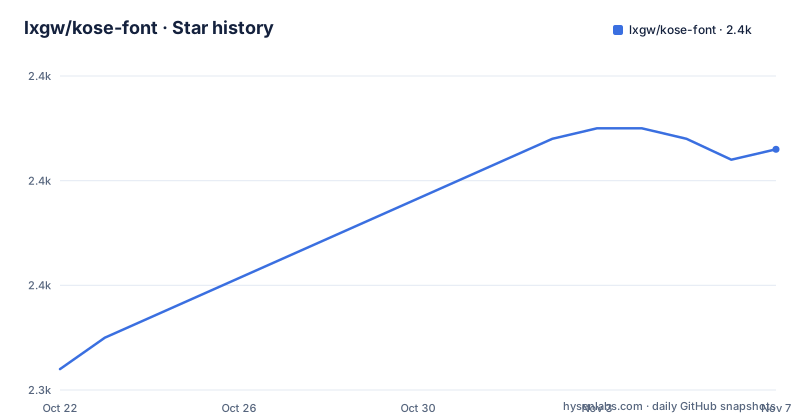
Star history
- lxgw/kose-font2,363 ★ · +21
| Repository | 2026-10-22 | 2026-11-07 |
|---|---|---|
| lxgw/kose-font | 2.3k | 2.4k |
21 Stars in the last 16 days, measured from the daily GitHub snapshot. Compare with other projects
Editorial analysis
A font project where the commits are individual characters
The repository's release history is the fastest way to understand what kind of project this is. The three most recent releases each list a handful of characters and nothing else. v3.124 added characters from extension C, E and J blocks, including a run of rare extension J ideographs, with a link to a dictionary so a reader can look them up. Two days later v3.125 disambiguated two characters by distinguishing their internal forms, and added two special symbols. Six days after that, v3.126 corrected the codepoints of eight of the extension J characters that v3.124 had just added.
That sequence is the whole project in miniature. Add characters, discover that two of them render as the same shape, fix them, then discover that some of the new ones were mapped to the wrong codepoints. There is no version with a feature list because there are no features. Coverage is the product.
The scale is large. The font carries the full CJK unified ideographs basic block at 20,992 characters, 6,592 from extension A, and scattered coverage across extensions B through I. The stated goal is to cover everything within implementation level 2 of GB 18030-2022 and all 8,105 characters in the standard table of generally used characters of the Chinese language, which is the practical target for mainland users. Kana and Hangul syllables are also displayable, along with special symbols taken from Source Han Sans.
The repository has 2,313 stars, 34 forks and only 6 open issues, with the last push on 2026-06-29. The language field is empty, which is what you would expect for a repository whose contents are font binaries.
The lineage runs through three upstream fonts
Kose Font is derived, and the README is careful to name every ancestor. The base is SetoFont, made by the Japanese amateur font designer Seto Nozomi, which covers JIS levels one through four along with traditional and some simplified Chinese. Its most recent version is 6.20, dated 2014-09-24, and the original author has not updated it in a long time. That date is the reason this project exists: a beautiful open font frozen more than a decade ago.
The second ancestor is naikaifont, released by Max, which filled in the 4,808 common characters listed by Taiwan's education authorities and added commonly used Minnan and Cantonese characters, addressing the gaps in traditional Chinese regions.
The third is cjkFonts Quan Seto, published by cjkFonts, which supplied the remaining characters, Hangul and special symbols.
The README also credits contributions from users of the Maoken font site, specifically a user credited as a newcomer whose corrections and improvements are described in detail on that site's page for the font.
So the derivation chain is not a single upstream. Anyone auditing this font for compatibility or provenance needs to look at all three, because a licence question about the result is a question about the least restrictive term across SetoFont, naikaifont and cjkFonts Quan Seto, and about the fourth ancestor the README names under the licence section, a font called Tanugo Kaku published by a user handle given as twinklem_seto. That last one is easy to miss because it appears in the licensing paragraph rather than in the project history.
Reusing the original's own components instead of drawing new glyphs
The technique matters more than the coverage numbers. The README states that the supplementary characters are built using components already present inside SetoFont, rather than being drawn from scratch. That is a difficult constraint, and it explains both the unevenness and the honesty about that unevenness.
A character missing from a font but needed for simplified Chinese must be assembled from strokes and radicals that the designer already drew. If the original font has no suitable component, the new glyph will look like it came from somewhere else, because it did. The author says this plainly: the person behind the project is not a professional designer, aesthetic considerations were not the priority, and the added characters may clash slightly with the original. The phrasing is that they are better than nothing.
Given that, the coverage claim and the quality caveat are not in conflict. Both are true, and the README presents them as a pair. You can display the character, and it may not look like its neighbours.
The same caution appears alongside the GB 18030-2022 claim, with a note that the work was done quickly and that not every glyph is guaranteed to be the normative Mainland Chinese form, with feedback invited through issues. That is a specific and credible admission, since wrong-form glyphs in a CJK font are exactly the kind of defect that is invisible to anyone who does not read the language.
One naming detail is worth noting because it explains a repository name that does not match the current project name. The font was originally called Kose Font, and was renamed Xiaolai Font, because many people mistyped one character of the original name for another. The repository kept its original URL while the project name changed.
Two variants, and one of them is frozen
The download instructions distinguish a monospaced variant from a proportional one, and the README flags this as the first thing to get right: one file name is the monospaced version and the other is the proportional version, so choose according to need.
There is also a Japanese variant, and it is in a different state. The README states that the Japanese version keeps the original Kosefont-JP name and is no longer updated or maintained, and that it can be downloaded from a directory named TTF (Japanese) inside the repository. The Simplified Chinese line continues to receive releases; the Japanese line has stopped.
The release history makes the asymmetry concrete. All three recent releases are dated September 2025, at versions v3.124, v3.125 and v3.126, and the most recent is v3.126 on 2025-09-10. The last push to the repository is 2026-06-29, months after that. Both facts come from the project's own records, and together they suggest a line where commits and releases are not in lockstep.
Distribution runs through several channels rather than one. Releases on GitHub is the primary route, with mirrors on the Maoken font site and Zijia. For anyone replacing a system font on a rooted Android device, the README points to a Magisk font replacement module, hosted on a Chinese file service with a password given in the README, providing a single weight.
Beyond the binaries, the repository carries documentation worth reading: a file describing the OpenType features the font supports, a history file with older changelog entries, a licence file, and a documentation directory.
Licensing that permits embedding and prohibits selling the file
The font is released under SIL Open Font License 1.1, and the README restates the licence in its own terms rather than leaving it to the OFL text. It states that the font can be used freely by individuals and companies, including commercially, without payment or notifying the author. It can be redistributed, shared, installed on a system, embedded in software or an application, bundled with other software, redistributed or sold as part of that bundle. Derivative works are permitted and must also comply with OFL 1.1.
Two restrictions are called out, and both matter more than the permissions. Clause 1 of the licence means the font file may not be sold on its own, in OTF or TTF format. Clause 5 means the font may not be distributed under a licence other than OFL 1.1, and may not be merged into a single font file with fonts under licences that would conflict, such as GNU GPL or IPA.
Those restrictions are the reason the README opens with a caution. It reports that this font, along with many other open source fonts, is being resold by unscrupulous merchants on platforms such as Taobao and Xiaohongshu, in violation of the OFL 1.1 term forbidding the sale of font files alone. The README asks readers not to buy from such shops, noting that the money does not reach the author and that a buyer gets no updates or support.
That is a rare and useful thing to find at the top of a font repository: an acknowledgement that the licence has real enforcement problems in practice, and a request for the behaviour that reduces the incentive. Redistribution requires including the full OFL text, which the README notes explicitly.
One derived font is credited, a pinyin handwriting face, and the README invites further derivatives.
A wider family, and what this repository is not
The README closes with a list of related projects under the same author's banner, which is worth reading to understand where this font sits. There is a WenKai series in several regional variants, some with Lite versions, a set of sans and serif faces including XiHei and ZhiSong, a marker gothic, a zhinkai face, and this Xiaolai font, plus another font of the same family listed separately.
Two of the listed families are explicitly marked as no longer maintained, which is the same treatment the Japanese variant of this font received. The pattern across the list suggests a maintainer who marks retirement rather than letting projects quietly rot, which is a better outcome for anyone depending on them.
What this repository is not is a font design project in the ordinary sense. There is no source in the repository in the sense a designer would recognise, no build system for glyph outlines, and no way to contribute a character design in the way you would contribute to a typeface project. The tree is short: the licence file, a README, the OpenType features document, a history file, a documentation directory, and the frozen Japanese TTF directory. Everything else ships through Releases.
For a reader deciding whether to use it, the practical questions are therefore about fit rather than about capability. Does a handwritten style suit the material? Is uneven glyph quality acceptable for the audience? And for anyone redistributing, is the OFL 1.1 restriction on selling the file alone understood and respected? The README answers all three, in that order, and the licence file answers the last one formally.
Editorial conclusion
Kose Font is best understood as a maintenance project rather than a design one. Nobody is drawing new glyphs at this stage; the work is deciding which characters to add, finding the radical combinations that work inside an existing handwriting style, and getting the codepoints right, which the last few releases show is not always straightforward. For a user, the decision is simple: if you want a warm handwritten Chinese face and you are willing to accept uneven coverage on rarer characters, download the proportional or monospaced variant from Releases. Read the OFL 1.1 restrictions before redistributing it, particularly the clause about not selling the font file on its own.
Frequently asked questions
What is Kose Font based on?
It is derived from SetoFont, an open handwriting font by the Japanese designer Seto Nozomi whose last version 6.20 dates from 2014-09-24. Characters missing for simplified Chinese were built using components already present in that original font, with naikaifont and cjkFonts Quan Seto supplying further coverage.
How many characters does the font cover?
The full CJK unified ideographs basic block at 20,992 characters, plus 6,592 from extension A and scattered coverage across extensions B through I. The stated target is everything within implementation level 2 of GB 18030-2022 and all 8,105 characters in the standard table of generally used characters.
Can I use Kose Font commercially?
Yes. The README states the font may be used by individuals and companies, including commercially, without payment or notifying the author, and may be embedded in software or bundled with other software. Two restrictions apply: the font file may not be sold on its own, and it may not be distributed under a licence other than OFL 1.1.
What is the difference between the monospaced and proportional files?
Two files are published for the Simplified Chinese line, one monospaced and one proportional, and the README asks you to download the right one for your use. A separate Japanese variant exists in a directory inside the repository, keeps the older Kosefont-JP name and is no longer maintained.
Is the Japanese version of the font still updated?
No. The README states the Japanese version retains the original Kosefont-JP name, is no longer updated or maintained, and can be downloaded from the TTF (Japanese) directory in the repository. Simplified Chinese releases such as v3.126 continue separately.
Official sources
Add this badge to your README
If you maintain this project, the badge below links readers to this analysis and shows its maintenance status from the daily GitHub snapshot. Paste the markdown into your README; add ?metric=license or ?metric=stars to the image URL for a different field.

[](https://hysenlabs.com/projects/lxgw-kose-font)Star history chart for your README
[](https://hysenlabs.com/projects/lxgw-kose-font)Was this useful?