OEIS_03: A Gnuplot-Tagged Archive of OEIS Sequence Scripts for the A300000 Range
🤗 implementation of OEIS sequences (A300000-)
At a glance
- What is it?
- manman4/OEIS_03 is a niche repository of PARI/GP scripts and notes for OEIS sequences from A300000 to A399999, aimed at editors and researchers who need reproducible data generation. Its practical value is limited by sparse documentation and a specific gap in sequence coverage.
- Who is it for?
- Adopt OEIS_03 if you are an OEIS editor or a number theory researcher who needs reproducible PARI/GP scripts for sequences in the A300000 to A399999 range, especially those that manman4 has edited. Do not use it as a general reference for that range, because sequences A310xxx to A315xxx are missing as of February 2021, and the repository excludes b-files and text files.
- Can I use it commercially?
- Yes. MIT is a permissive licence: you can use, modify and sell software built on it, as long as you keep its copyright and licence notices.
- Is it still maintained?
- Yes. The repository last received commits 2 days ago.
- What is it written in?
- Mainly Gnuplot, according to GitHub's language statistics.
Answers come from the project's GitHub data, last synced on October 21, 2026, and from our analysis. They are not legal advice.
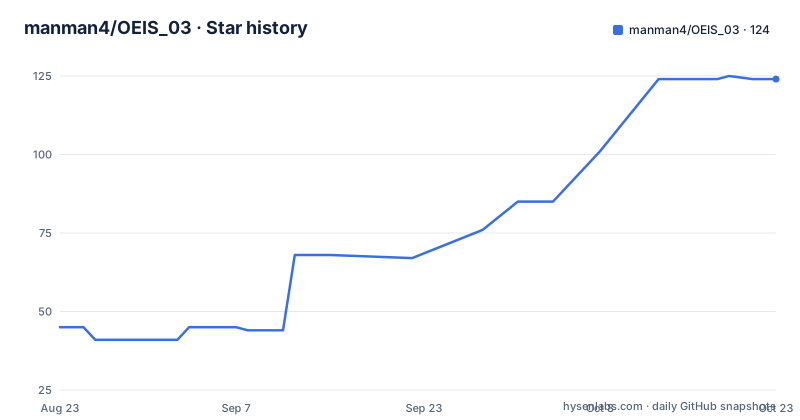
Star history
- manman4/OEIS_03124 ★ · +79
| Repository | 2026-08-23 | 2026-10-21 |
|---|---|---|
| manman4/OEIS_03 | 45 | 124 |
79 Stars in the last 59 days, measured from the daily GitHub snapshot. Compare with other projects
Editorial analysis
What This Repository Actually Provides
OEIS_03 is a personal archive, not a polished library. The author, manman4, has edited OEIS sequences since 2016 and is releasing scripts and tools in a series of repositories, each covering a block of 100,000 sequence numbers. This one covers A300000 through A399999. The README is explicit about what is not here: b-files and corresponding text files are excluded because of their size, and the numerical data is limited to 1000 digits including the sign. The primary content is PARI/GP scripts, saved as .gp files, that generate sequence terms. The repository is tagged as Gnuplot in the metadata, but the README does not mention Gnuplot at all, so the tag is either a metadata error or reflects a secondary tool that is not documented. That mismatch is a warning: the repository's organization is loose, and you should not assume the tag tells you much about the contents.
The Mechanism: PARI/GP Scripts and the 1000-Digit Constraint
The core mechanism is a PARI/GP script that computes a sequence up to a specified index and writes the terms to a text file. The README gives a concrete example for A336975. It defines a function v(n) that uses a generating function, specifically a product over k from 1 to n of 1/(1 - x^k*(k+x)), then sets M=1000, computes the series to order n+10, and loops from n=0 to M, extracting the coefficient with polcoef. The script checks if the coefficient is negative and if the number of digits exceeds 1000; if either condition fails, it breaks the loop. Then it writes the index and the value to a file. The note explains that the calculation range is slightly larger than the display range, for example computing 10,100 terms but showing only 10,000, to ensure accuracy at the boundary. This is a practical detail for OEIS b-file generation, where each line is 'n a(n)' and the file must be exact. The 1000-digit limit is a hard constraint that will truncate sequences with astronomically large terms, which is a real limitation for some integer sequences.
Getting It Running: Commands and Configuration
To use the scripts, you need PARI/GP, which is not distributed with this repository. The README does not provide a setup guide for PARI/GP itself; it assumes you have it. The example script is self-contained: copy the function definition, set M, call v, and loop. The write path is a hardcoded '/Users/xxx/Desktop/b336975_gp_test.txt', so you must change that to a local path. For C and C++ programs that use OpenMP, such as A299706, the README provides aliases for Apple Silicon Macs with Homebrew. These aliases invoke clang with flags like -Xpreprocessor -fopenmp and link against libomp from /opt/homebrew/opt/libomp. You add the aliases to ~/.zshrc and run source ~/.zshrc. Then you can compile with short commands like gcc-omp a299706.c -o a299706. That is the only concrete setup advice in the material, and it is specific to one platform. On Linux or Windows, you would need to find equivalent flags yourself.
A Real Gap: Missing Sequences and Encoding Issues
The README states a specific and significant gap: sequences from A310xxx to A315xxx are not included, as of February 15, 2021. The author notes that among the edited sequences, A309990 is immediately followed by A316083. That means if you are looking for a script for a sequence in that range, this repository will not have it. The gap is not a small omission; it covers thousands of sequence numbers. Additionally, the README warns that some text files or documents may contain garbled characters due to encoding issues. That is a practical hazard: you might open a .gp file and find corrupted comments or strings. The scripts themselves may still run, but you cannot trust the documentation without inspection. This makes the repository a source of raw material, not a reliable reference. You should always cross-check any output against the official OEIS data repository, which is linked in the README: https://github.com/oeis/oeisdata/.
Maintenance and Upgrade Cost
The repository has no releases and the last push date is unknown. The README has a date of 2021/02/15 for the gap note, which suggests the content may be stale. There is no versioning or changelog, so you cannot track updates. The scripts depend on PARI/GP functions like polcoef, which have been stable for years, but if PARI/GP changes its API, these scripts may break. The author mentions a separate series of repositories, OEIS_00 through OEIS_04, and a dedicated repository for b-files, but this one does not link to that b-file repository, so you cannot easily find updates. The maintenance cost is low because the scripts are small, but the upgrade cost is hidden: you must manually verify each script against the current OEIS data. The license is MIT, which gives you freedom to modify and redistribute, but the README does not provide any warranty or support. You are on your own.
Alternatives: The Official Data Repository and study_OEIS
The README itself points to two alternatives. The first is the official OEIS data repository at https://github.com/oeis/oeisdata/, which is the authoritative source for b-files and sequence data. That repository is comprehensive and maintained by the OEIS foundation, so it is the right choice if you need complete and current data, not just scripts. The second alternative is manman4's own study_OEIS repository, which contains thematic resources and the OpenMP aliases mentioned earlier. That repository has a src directory with the aliases, and it is likely where the author keeps more general tools. The difference in approach: OEIS_03 is a raw dump of scripts tied to specific sequence numbers, while oeisdata is a structured, versioned dataset, and study_OEIS is a curated collection of tools. If you want to generate a specific sequence from scratch, OEIS_03 gives you a starting point, but if you want reliable data without running code, oeisdata is more direct. The trade-off is control versus convenience.
Who Should Use This and What to Verify First
This repository is for OEIS editors who need a reference implementation for a specific sequence they are working on, or for researchers who want to see how a sequence's generating function is implemented in PARI/GP. It is not for someone who wants a comprehensive database or a polished tool. Before using any script, verify that the sequence number is in the A300000 to A399999 range and not in the A310xxx to A315xxx gap. Open the .gp file and check for garbled characters, which the README warns about. Run the script with a small M first, like M=10, to see if it produces sane output. Compare the output against the official OEIS data for the first few terms. Also check the PARI/GP version; the script uses polcoef, which is standard, but if you have an older version, you may need to adjust. The 1000-digit limit is a hard stop, so if the sequence grows faster than that, the script will break early. That is not a bug; it is a design choice for file size, but you should know it before relying on the output.
Editorial conclusion
Adopt OEIS_03 if you are an OEIS editor or a number theory researcher who needs reproducible PARI/GP scripts for sequences in the A300000 to A399999 range, especially those that manman4 has edited. Do not use it as a general reference for that range, because sequences A310xxx to A315xxx are missing as of February 2021, and the repository excludes b-files and text files. Before relying on any script, verify that the sequence number is present, check the script for encoding issues, and test the output against the official OEIS data at https://github.com/oeis/oeisdata/. Also confirm that the PARI/GP version you use supports the functions in the script, such as polcoef, and note that the 1000-digit limit may truncate sequences with larger terms.
Frequently asked questions
What is an OEIS sequence?
An entry in the OEIS, the Online Encyclopedia of Integer Sequences, which the author of this repository has been editing since 2016. This repository holds implementations for the A300000 block onward, saved as PARI/GP files under one directory per sequence-number prefix.
Which sequence ranges does manman4/OEIS_03 cover?
A300000 through A399999. The sibling repositories take the other blocks: OEIS_00 covers A000001 to A099999, OEIS_01 covers A100000 to A199999, OEIS_02 covers A200000 to A299999, and OEIS_04 covers A400000 to A499999.
Why are there no b-files in manman4/OEIS_03?
They are excluded because of their large size, and they are managed separately in a dedicated repository. The numerical data in the scripts is limited to 1000 digits, including the sign, to keep file sizes manageable.
Which sequences are missing from manman4/OEIS_03?
Sequences numbered A310xxx through A315xxx are not included, which is recorded as of 2021/02/15. Among the edited sequences, A309990 is immediately followed by A316083, so the numbering shows the same gap.
What file format does manman4/OEIS_03 use for its scripts?
PARI/GP. The README states that the scripts are saved as PARI/GP, and the example generator is a PARI/GP snippet whose output loop breaks when a term turns negative or exceeds 1000 digits.
Official sources
Add this badge to your README
If you maintain this project, the badge below links readers to this analysis and shows its maintenance status from the daily GitHub snapshot. Paste the markdown into your README; add ?metric=license or ?metric=stars to the image URL for a different field.

[](https://hysenlabs.com/projects/manman4-oeis-03)Star history chart for your README
[](https://hysenlabs.com/projects/manman4-oeis-03)