dynamic-systems-DL is one README listing 59 papers, with five code links
Collection of resources that combine dynamic systems, control with deep learning.
At a glance
- What is it?
- A hand-maintained reading list where dynamical systems meet deep learning, organised by differential equation type, with venue tags running from 2018 to 2021, a handful of linked implementations, and no code, licence or build of its own.
- Who is it for?
- Treat dynamic-systems-DL as a starting index rather than a curriculum, and check publication years yourself before building a reading plan on it. The newest entries visible in the file are tagged 2021 while the repository was last pushed on 24 August 2026, so the list has not tracked the field for some years.
- Can I use it commercially?
- Not without permission. GitHub finds no licence file in the repository, and without a licence all rights are reserved by default: you may read the code but not reuse it. Check the README, or ask the authors, before using it.
- Is it still maintained?
- Yes. The repository last received commits 60 days ago.
- What is it written in?
- GitHub does not report a main language for this repository.
Answers come from the project's GitHub data, last synced on October 21, 2026, and from our analysis. They are not legal advice.
Star history
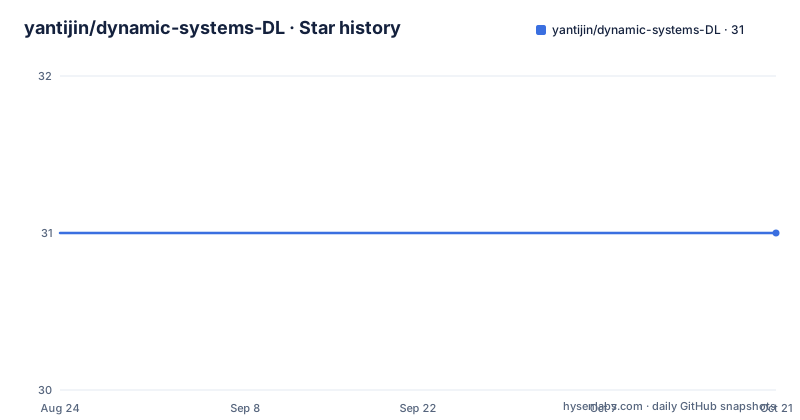
- yantijin/dynamic-systems-DL31 ★ · +0
| Repository | 2026-08-24 | 2026-10-21 |
|---|---|---|
| yantijin/dynamic-systems-DL | 31 | 31 |
0 Stars in the last 58 days, measured from the daily GitHub snapshot. Compare with other projects
Editorial analysis
The whole repository is a single README with no code attached
The top level of dynamic-systems-DL holds one file, `README.md`, and nothing else. There is no source directory, no `LICENSE`, no test suite and no build configuration, and GitHub records no primary language for the repository because there is no code to classify. There are no releases either. The project description calls it a collection of resources combining dynamical systems and control with deep learning, and that is exactly what it is: a reading list maintained by hand. The counters are 31 stars and 4 forks with no open issues, the default branch is `main`, and the last push landed on 24 August 2026. For a reader the practical consequence is that everything worth knowing sits in one scrolling document, and there is no tooling to run.
Venue tags stop at 2021 while the file was pushed in 2026
Every entry carries a bracketed venue tag, and those tags are the only date information in the file. The vocabulary covers `arXiv`, `NeurIPS`, `ICLR`, `ICML`, `AAAI`, `AISTATS` and one journal, `Scientific Reports`, with a two digit or four digit year suffix: `arXiv18`, `arXiv19`, `arXiv20`, `NeurIPS18` through `NeurIPS20`, `ICLR19`, `ICLR2020`, `ICLR21`, `ICML20`, `ICML2020`, `AAAI20`, `AAAI21` and `AISTATS20`. The newest year that appears anywhere is 21. Nothing in the file is tagged 2022 or later, even though the repository was pushed in August 2026. That gap is the single most useful thing to know before planning a reading order from this list: the spine of the collection is the 2018 to 2021 wave of neural differential equations.
Grouped by equation type rather than by problem domain
The organising principle is the kind of differential equation, not the application area. Under Differential Equations in Deep Learning there is General Architectures, then Neural ODEs as the large centrepiece, with a nested subsection on speeding up training, followed by Neural SDEs, Neural CSDEs, Neural CDEs, Normalizing Flows and a short Applications group. A second top-level heading, Energy based models, opens with Hamilton and its own Applications subsection. The sub-subsection on training speed is the sharpest one, holding work on spectral element acceleration, checkpoint adjoints, interpolation techniques for gradient propagation and hypersolvers, which is where the practical cost of solving an ODE at every training step is actually addressed. Grouping by equation type makes the list navigable for someone with a specific modelling question, and less so for someone who simply wants the best papers on system identification.
Five entries link to code and the rest link only to the paper
Implementation links are rare in this list, and the marker used for them is a literal `[code]` at the end of an entry. Counting the entries that carry one gives five out of the fifty-nine visible lines. Four of the repositories they point at are named: `jacobjinkelly/easy-neural-ode` alongside Learning Differential Equations that are Easy to Solve, `greydanus/hamiltonian-nn` alongside Hamiltonian Neural Networks, `gaspardbb/HamiltonianGenerativeNetworks` alongside Hamiltonian generative networks, and `dandip/ssinn` alongside Sparse Symplectically Integrated Neural Networks. The clustering is noticeable: three of the five sit in the Hamiltonian and symplectic material rather than in the neural ODE core. For anyone who wants to run something, the practical route is to follow those links or to search each title directly.
Control appears in titles rather than in any section heading
The project description promises a combination of dynamical systems, control and deep learning, but the visible headings are all about modelling families: ODEs, SDEs, CSDEs, CDEs and flows. Control shows up inside individual titles instead. Two are explicit about it. Symplectic ODE-Net: Learning Hamiltonian Dynamics with Control sits in the Hamilton group, and Go with the flow: Adaptive control for Neural ODEs sits in the ICLR21 material. Elsewhere the framing shifts towards forecasting and inference rather than feedback, with Forecasting Reservoir Inflow via Recurrent Neural ODEs as one example and the reservoir and manifold work sitting under Applications. Anyone arriving expecting a control theory reading list will find a deep learning reading list that contains some control papers.
One entry has an empty link and one has no link at all
The list has small gaps that matter if you are working straight from the file. One speed up entry, Hey, that's not an ODE: Faster ODE Adjoints with 12 Lines of Code, carries a tag of `arXiv20` and an empty link target, so clicking it goes nowhere and the title is the only handle you have. Forecasting Reservoir Inflow via Recurrent Neural ODEs is tagged `AAAI21` with no destination at all. Spacing and capitalisation also drift across the file: the same preprint source appears as `arXiv18`, `arxiV20` and `ArXiv2020`, and ICML appears both as `ICML20` and as `ICML2020`. None of that blocks reading, but it does mean the file is maintained by hand rather than generated, which is consistent with a project that asks for pull requests instead of automating its own catalogue.
Adding a paper means a pull request against one file
The contribution model is stated at the top of the document in a blockquote: feel free to submit a pull request if you want to add good papers, and there is an invitation to get in touch about cooperation where research interests overlap. That is the entire onboarding path, and it is a low barrier with no tooling attached, since the target is one Markdown file. What the file does not say is how an entry should be formatted beyond the existing pattern of a title, a venue tag and an optional code marker, or which venue tags are preferred when a paper appears at both a preprint and a conference. It also does not record a review policy or a licence, and the repository has no licence file, so a contributor adding a line is adding it into unclear terms.
Editorial conclusion
Treat dynamic-systems-DL as a starting index rather than a curriculum, and check publication years yourself before building a reading plan on it. The newest entries visible in the file are tagged 2021 while the repository was last pushed on 24 August 2026, so the list has not tracked the field for some years. Verify any paper you intend to build on, and note that the repository offers no licence and no code of its own, so treat the file as a pointer list rather than something you can reuse.
Frequently asked questions
What is the dynamic-systems-DL repository?
A curated reading list of papers combining dynamical systems and deep learning, grouped by differential equation type. The entire repository is one README.md file with no code attached.
How are the papers in dynamic-systems-DL organised?
By equation family rather than problem domain: General Architectures, Neural ODEs with a nested subsection on speeding up training, Neural SDEs, Neural CSDEs, Neural CDEs, Normalizing Flows and Applications, then Energy based models opening with Hamilton.
How current are the entries in dynamic-systems-DL?
The newest venue year visible in the file is 2021, with tags such as ICLR21 and AAAI21. The repository itself was last pushed on 24 August 2026, so the list has not been extended with newer work.
Does dynamic-systems-DL link to any implementations?
A handful of entries carry a code marker, including Hamiltonian Neural Networks, Hamiltonian generative networks, Sparse Symplectically Integrated Neural Networks and Learning Differential Equations that are Easy to Solve. Most entries link only to the paper.
How do I add a paper to dynamic-systems-DL?
Open a pull request against the README. The document asks contributors to submit good papers that way, and there is an invitation to make contact about cooperation where research interests overlap.
Official sources
Add this badge to your README
If you maintain this project, the badge below links readers to this analysis and shows its maintenance status from the daily GitHub snapshot. Paste the markdown into your README; add ?metric=license or ?metric=stars to the image URL for a different field.

[](https://hysenlabs.com/projects/yantijin-dynamic-systems-dl)Star history chart for your README
[](https://hysenlabs.com/projects/yantijin-dynamic-systems-dl)