Bifrost AI Gateway: A Fast Go-Based Proxy With an Enterprise Pitch
Fastest enterprise AI gateway (50x faster than LiteLLM) with adaptive load balancer, cluster mode, guardrails, 1000+ models support & <100 µs overhead at 5k RPS.
At a glance
- What is it?
- Bifrost is a Go-based AI gateway that unifies 23+ providers behind an OpenAI-compatible API. Its headline claim is low overhead at high request rates, but several enterprise features sit behind a commercial tier.
- Who is it for?
- Adopt Bifrost if you run production AI traffic in Go or need a single OpenAI-compatible endpoint across many providers and want sub-millisecond proxy overhead; the README's feature list outside the enterprise section includes the gateway, semantic caching, and governance. Do not adopt it if you require adaptive load balancing, clustering, guardrails, or MCP gateway features, because the README marks those as enterprise capabilities, likely paid.
- Can I use it commercially?
- Yes. Apache-2.0 is a permissive licence: you can use, modify and sell software built on it, as long as you keep its copyright and licence notices.
- Is it still maintained?
- Yes. The repository last received commits 1 day ago.
- What is it written in?
- Mainly Go, according to GitHub's language statistics.
Answers come from the project's GitHub data, last synced on November 13, 2026, and from our analysis. They are not legal advice.
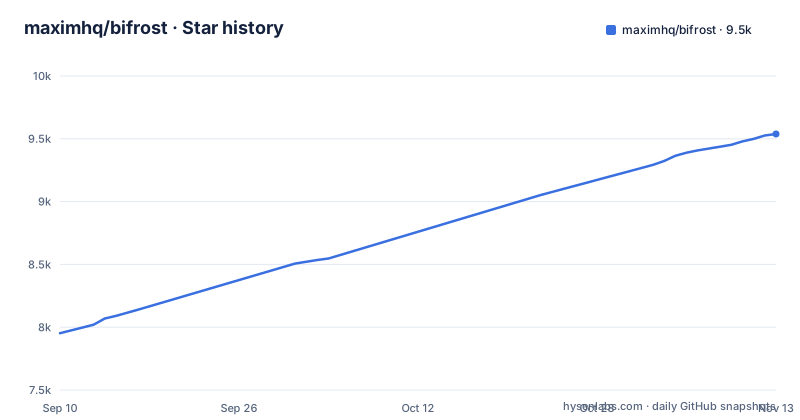
Star history
- maximhq/bifrost9,538 ★ · +1,586
| Repository | 2026-09-10 | 2026-11-13 |
|---|---|---|
| maximhq/bifrost | 8k | 9.5k |
1,586 Stars in the last 64 days, measured from the daily GitHub snapshot. Compare with other projects
Editorial analysis
What Bifrost Actually Solves
Bifrost is an AI gateway, a proxy that sits between your application and multiple large language model providers. The problem it targets is operational fragmentation: teams that call OpenAI, Anthropic, AWS Bedrock, and Google Vertex directly end up with provider-specific code, duplicated retry logic, and no central place to track cost or enforce limits. Bifrost unifies those providers behind a single OpenAI-compatible API, so a client that speaks the OpenAI chat completions format can reach any supported backend by changing the model string, for example openai/gpt-4o-mini. The intended user is a platform or backend engineer who wants one entry point for LLM traffic, with automatic failover and load balancing, without rewriting application code. The README also lists semantic caching, budget management, and observability as part of the feature set, which points to teams that care about cost control and monitoring, not just connectivity.
How the Gateway Is Put Together
The repository layout shows a modular Go project. There is a core directory that contains provider-specific implementations and shared schemas, plus a bifrost.go file that appears to be the main implementation. A framework directory holds configstore and other persistence components, which suggests the gateway keeps its configuration in a store rather than only in static files. The architecture is not described in detail in the README, but the separation of providers, schemas, and framework implies a plugin-oriented design. The gateway can be configured through a web UI, an API, or file-based configuration, so the control plane is flexible. The claim of under 100 microseconds overhead at 5,000 requests per second indicates that the proxy is designed to add minimal latency. Because the project is written in Go, it compiles to a single binary and handles concurrency well, which is a plausible basis for that performance claim.
Getting It Running: Commands and Configuration
The quick start is genuinely quick. You can run the gateway with npx, which is unusual for a Go project but convenient: npx -y @maximhq/bifrost. Alternatively, use Docker: docker run -p 8080:8080 maximhq/bifrost. After starting, open http://localhost:8080 to reach the built-in web UI. The README claims zero configuration startup, described as starting immediately with dynamic provider configuration. The first API call is a standard OpenAI-style POST to /v1/chat/completions with a model field like openai/gpt-4o-mini. Configuration can happen through the web UI, an API, or a config JSON file, and the deployment guide mentions environment variable references for secrets, so you can keep API keys out of files. For Go developers, there is a separate Go SDK setup guide, which implies a native client path beyond the HTTP API. The npx route is a nice touch for evaluation, but for production you would likely use the Docker image or build from source.
The Enterprise Feature Split Is the Real Story
The README lists adaptive load balancing, clustering, guardrails, and MCP gateway as enterprise capabilities, alongside private networking and custom security controls. The README's feature list, which does not mark tiers, includes automatic fallbacks, load balancing, semantic caching, and governance features like virtual keys and rate limiting. That split matters. The phrase 'enterprise-grade' appears frequently, and a demo link points to a Calendly booking page. So what you get from the Apache-2.0 codebase is not the full product described in the headline. The free tier covers unified access and basic resilience, but the adaptive load balancer and cluster mode, which are central to the 'never go down' promise, are not in the open core. This is a common pattern, but it means an engineer evaluating Bifrost must separate marketing from the actual repository. The codecov badge and other badges exist, but they do not tell you which features are usable without a commercial license.
Semantic Caching and MCP: Two Features With Different Maturity
Semantic caching is listed as a core feature, not an enterprise one. The idea is to cache responses based on semantic similarity, so a slightly rephrased question can hit the cache and avoid a paid API call. That is a cost-saving mechanism with real complexity: it requires an embedding model and a similarity threshold. On the other hand, MCP (Model Context Protocol) support is split. There is an MCP gateway feature under enterprise, but the README also lists Model Context Protocol under Advanced Features, the repository has an examples/mcps/ directory, and the README says MCP enables AI models to use external tools like filesystems and web search. So the open-source core may include MCP client or server functionality, but the gateway version that routes MCP traffic across providers is commercial. That distinction is easy to miss, and it changes the evaluation. If your use case is tool-using agents, you need to clarify which MCP component is free.
Limitations and Failure Modes
The most obvious limitation is the feature split: you cannot rely on adaptive load balancing or clustering unless you buy the enterprise tier. A second limitation is that the README's performance claim, 50x faster than LiteLLM and under 100 microseconds overhead at 5k RPS. For a gateway, proxy overhead is only one part of end-to-end latency; the provider call dominates. A third limitation is that zero-config startup may not fit strict security policies. The README mentions secrets management with environment variables, but the web UI configuration implies that provider keys are entered somewhere, and if that is the browser, it could be a risk in shared environments. Finally, the project's default branch is dev, not main, which suggests the project moves fast and may not always be stable. The latest release is from November 2026, so it is actively maintained, but that pace can mean breaking changes.
Alternatives and How They Differ
The README itself names LiteLLM as a comparison point, claiming Bifrost is 50x faster. LiteLLM is a Python-based AI gateway that also provides a unified API across many providers. The architectural difference is fundamental: LiteLLM runs on Python, which has higher per-request overhead and a larger memory footprint, while Bifrost is Go, which compiles to a native binary and handles thousands of concurrent connections with lower latency. That is why the speed claim is plausible, though not verified. Another alternative is Kong or Envoy with AI plugins, which are general-purpose API gateways extended for LLM traffic. Those take a different approach: they are not purpose-built for AI, but they integrate with existing service mesh infrastructure. If you already run Envoy, adding an AI plugin might be simpler than introducing a new gateway. Bifrost's advantage is that it is purpose-built, so features like fallbacks and caching are native, not bolted on.
Maintenance, License, and Upgrade Path
The project is licensed under Apache-2.0, which is permissive and allows commercial use, modification, and redistribution, with the condition that you preserve the license notice. That is favorable for adoption, but the README presents the enterprise features as part of separate enterprise deployments, so check their terms separately. The repository structure shows a modular design, with components released under their own tags (for example, transports/v2.4.0 and helm-chart-v2.1.47). That suggests you can upgrade components independently, which is good for maintenance. The default branch is dev, and the last push is recent, so development is active. The use of Go means deployment is a single binary or a container, which simplifies upgrades compared to Python gateways that require dependency management. However, because the enterprise tier is closed, you need to track which features you use from the open core and whether they remain free in future versions. Check the release notes before upgrading in production.
Editorial conclusion
Adopt Bifrost if you run production AI traffic in Go or need a single OpenAI-compatible endpoint across many providers and want sub-millisecond proxy overhead; the README's feature list outside the enterprise section includes the gateway, semantic caching, and governance. Do not adopt it if you require adaptive load balancing, clustering, guardrails, or MCP gateway features, because the README marks those as enterprise capabilities, likely paid. Before committing, verify the exact split between the Apache-2.0 core and the enterprise tier, check that the 50x speed claim matches your workload, and confirm that the zero-config startup covers your provider authentication needs.
Frequently asked questions
What does Bifrost do?
It is a high-performance AI gateway that unifies access to more than twenty-three providers, including OpenAI, Anthropic, AWS Bedrock, Google Vertex, Azure, Cerebras, Cohere, Mistral, Ollama and Groq, through a single OpenAI-compatible API. On top of that it provides automatic failover, load balancing, semantic caching, governance with virtual keys and rate limiting, and observability through Prometheus metrics, distributed tracing and logging.
How do I run Bifrost locally?
Run it with the package runner or as a container, which publishes port 8080, then open the built-in web interface at that address to configure providers visually. Your first call is a standard chat completions request to the same port, with the provider chosen by prefixing the model identifier.
Which Bifrost features are enterprise only?
The README lists adaptive load balancing, clustering, guardrails and the MCP gateway as advanced capabilities that enterprise deployments unlock, alongside private networking, custom security controls and governance. Core infrastructure features such as the unified interface, multi-provider support, automatic fallbacks and load balancing are listed separately under Core Infrastructure.
Is Bifrost open source and what does it ship?
It is Apache-2.0 licensed, with a third-party notices file, a security policy and a code of conduct in the tree. Alongside the Go source it ships Helm charts, Terraform, Nix configuration, and examples for Docker, Kubernetes, MCP, plugins, webhooks and configuration files.
Official sources
Where developers are discussing it
Posts on Hacker News, dev.to and Lobsters that link to this repository, found by our scan of those communities. 4 in the last 30 days; newest first.
- Bifrost vs LiteLLM Rust: Do the 7x Benchmark Claims Hold Up?dev.to · Nov 10, 2026 · 28 points · 2 comments
- 5 Best MCP Gateways in 2026: Bifrost, IBM ContextForge, Obot, Docker and Microsoft Compareddev.to · Nov 2, 2026 · 5 points · 0 comments
- 5 Best Open-source LLM Gateways 💎dev.to · Oct 27, 2026 · 5 points · 0 comments
- 5 Best LLM Gatewaysdev.to · Oct 21, 2026 · 2 points · 0 comments
- Top 5 Enterprise AI Gatewaysdev.to · Oct 14, 2026 · 10 points · 0 comments
- Show HN: Bifrost – High-performance AI gatewayHacker News · Oct 13, 2026 · 3 points · 0 comments
Add this badge to your README
If you maintain this project, the badge below links readers to this analysis and shows its maintenance status from the daily GitHub snapshot. Paste the markdown into your README; add ?metric=license or ?metric=stars to the image URL for a different field.

[](https://hysenlabs.com/projects/maximhq-bifrost)Star history chart for your README
[](https://hysenlabs.com/projects/maximhq-bifrost)Was this useful?