ScrewFast Astro website template review
Open-source Astro website template with sleek, customizable TailwindCSS components
At a glance
- What is it?
- ScrewFast is an Astro template for teams that need a multilingual marketing site, blog, product catalog, and documentation site in one codebase. It includes Tailwind CSS, Preline UI, SEO configuration, security headers, and deployment-oriented checks, but it is still a starter repository that requires content, branding, and deployment configuration.
- Who is it for?
- Adopt ScrewFast when you want a complete Astro site foundation rather than a single landing page theme. Do not adopt it if you require a finished brand, original visual identity, or production copy, because the repository provides a customizable starting point.
- Can I use it commercially?
- Yes. MIT is a permissive licence: you can use, modify and sell software built on it, as long as you keep its copyright and licence notices.
- Is it still maintained?
- Yes. The repository last received commits 6 days ago.
- What is it written in?
- Mainly Astro, according to GitHub's language statistics.
Answers come from the project's GitHub data, last synced on November 7, 2026, and from our analysis. They are not legal advice.
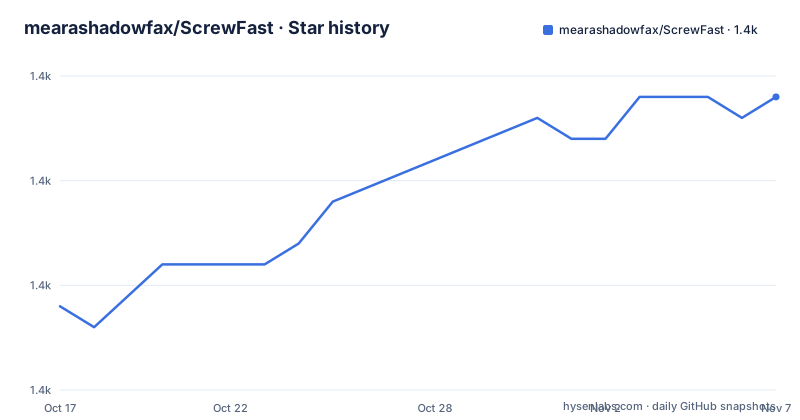
Star history
- mearashadowfax/ScrewFast1,434 ★ · +10
| Repository | 2026-10-17 | 2026-11-07 |
|---|---|---|
| mearashadowfax/ScrewFast | 1.4k | 1.4k |
10 Stars in the last 21 days, measured from the daily GitHub snapshot. Compare with other projects
Editorial analysis
What ScrewFast combines in one Astro repository
ScrewFast addresses the problem of assembling a complete public-facing website from separate templates. It provides a landing page, blog, product pages, product catalog, and a Starlight documentation site. These areas share a layout, navbar, footer, navigation data, localization structure, and design system rather than operating as unrelated page collections.
The intended audience is a developer or small team that wants a polished starting point for a company, product, or technical project. The repository is especially relevant when a single Astro project needs marketing content, editorial content, product information, and developer documentation. It is less suitable when the goal is to install a finished business site without changing the copy, imagery, navigation, or domain settings.
The stack is defined in `package.json`: Astro 7, Tailwind CSS 4, Preline 5, TypeScript 6, Astro MDX, Starlight, GSAP, Lenis, and Sharp. The README also identifies centralized SEO metadata, multilingual content, security headers, HTML minification, and a CI pipeline as part of the template. That breadth is the central trade-off. One repository covers more website types than a narrow landing-page theme, but adopting it also means accepting its architecture, conventions, and configuration model.
How ScrewFast organizes pages, sections, and content
A page route delegates to a view, and the view composes reusable section components. The README describes routes under `src/pages/` and `src/pages/fr/` as thin shells that render views. Those views live under `src/views/`, while page sections and interface pieces live under `src/components/sections/`. This keeps page composition visible without forcing each route to contain a large amount of markup.
Content is passed into components as props. The documented example imports `MainLayout` and `HeroSection`, places the hero inside the layout, and supplies the title, subtitle, button label, and destination. The layout supplies the surrounding page structure, while the section controls its own content.
Text and reusable data are separated from components. View copy is stored in `src/copy/`, with files such as `src/copy/en.ts` and `src/copy/fr.ts` for locale-specific content. Reusable data such as FAQs, features, and pricing tiers is described as JSON in `src/data_files/`. Global identity values, including `SITE` and `OG`, are in `src/data_files/constants.ts`. Navigation identifiers and paths are centralized in `src/data_files/navigation.ts`, while translated labels remain in the copy tables.
This arrangement means that changing a label or route does not require searching every page. It also means that contributors need to understand several conventions before making broad changes. `AI_GUIDE.md` documents the intended locations and conventions for coding assistants, but the repository still uses normal Astro and TypeScript structures.
Installing ScrewFast and making the first page edit
The README requires Node.js 22 and pnpm 9 or newer. It documents creating a repository from the GitHub template or cloning the project. The following commands clone the default repository, install dependencies, and start the development server:
git clone https://github.com/mearashadowfax/ScrewFast.git my-site
cd my-site
pnpm install
pnpm dev
After `pnpm dev` starts, the README directs the user to open `http://localhost:4321`. Edits to project files trigger page reloads. A first practical edit can be made in `src/data_files/constants.ts`, where the documented `SITE` object contains the title, tagline, description, URL, and author. The domain in `astro.config.mjs` must also be changed so generated sitemap and `robots.txt` references point to the deployed site.
For a production build, use:
pnpm build
pnpm preview
The `build` script runs `astro check`, builds the site into `dist/`, and then runs `node process-html.mjs` for post-build processing. `pnpm preview` serves the built project. The README also documents a separate smoke test:
pnpm test:smokeThat script serves `dist/` and checks key routes. The documented verification path is therefore type-check, production build, preview or smoke test, rather than relying only on the development server.
Multilingual marketing pages and Starlight documentation
ScrewFast includes English and French marketing pages, while the documentation site supports seven languages: `en`, `de`, `es`, `fa`, `fr`, `ja`, and `zh-CN`. The README states that RTL support is included. This is useful for teams publishing the same product or documentation across several language audiences, because the structure for translated routes and documentation is already present.
The `monolingual-site` branch removes the French pages and i18n plumbing. That is a concrete choice for projects that do not need localization, but it also means that the main branch is not the simplest possible single-language Astro setup. Projects with different language requirements will need to inspect the branch structure and decide whether to remove or extend the existing configuration.
The docs use Astro Starlight. The repository includes `@astrojs/starlight`, and the README describes a full documentation site sharing the template's general presentation. That combination is sensible for a developer product that needs both a marketing site and API or project documentation. It is less suitable for a team that only needs a blog and has no plans to publish technical documentation, because the extra site type adds configuration and content-management surface.
SEO, security headers, and production checks
SEO configuration is centralized rather than left to every page. The `SITE` and `OG` objects in `src/data_files/constants.ts` provide site-wide identity and social metadata. Locale-specific descriptions and Open Graph text live in the copy tables under `src/copy/`. The repository includes `@astrojs/sitemap`, and the README states that generated `sitemap` and `robots.txt` depend on the site configuration in `astro.config.mjs`.
The template also documents JSON-LD structured data. That can help pages expose machine-readable information, although the README excerpt does not enumerate every schema type or describe how to replace the demo data. Developers should inspect the relevant view and data files before assuming that product, article, organization, or breadcrumb metadata is already configured for their content.
Security-related configuration is associated with `vercel.json`, including a Content Security Policy and other security headers. That provides a Vercel-oriented baseline, not a guarantee that every deployment host will behave identically. The CI pipeline is described as type-checking, building, and smoke-testing every push, while Dependabot is listed as a dependency maintenance mechanism. The repository has no GitHub releases, so upgrade planning cannot rely on a documented release cadence. The last push was on 2026-10-11, and the repository is not archived.
The MIT license permits use under its terms, but license compliance remains the adopter's responsibility. There is no legal evaluation here of how the template's bundled dependencies or assets should be handled.
Where ScrewFast is a poor fit
The first limitation is customization cost. The repository provides a complete set of sections and UI components, but it does not eliminate the work of replacing the sample brand, product content, navigation, metadata, images, and localized copy. A team expecting a finished hardware-tools site will still need to edit the underlying Astro, TypeScript, and content files.
The second limitation is scope. The same architecture that supports landing pages, a blog, a catalog, and Starlight documentation can be excessive for a small campaign page. The project includes animation and presentation libraries such as GSAP and Lenis, as well as image-processing dependencies. The README does not provide a performance budget or a comparison showing whether those features are necessary for a particular deployment.
A real alternative is a minimal Astro site built directly with Astro and Tailwind CSS, without the catalog, multilingual pages, Starlight docs, mega menu, animation stack, and broader section library. That approach requires more page construction, but it gives a smaller maintenance surface and avoids adopting conventions that may not match the project.
Maintenance boundaries and upgrade work
The repository is not archived, and its last push was on 2026-10-11. That indicates recent repository activity, but the absence of GitHub releases means there is no documented versioned upgrade path or formal release history to compare. The package manifest uses caret ranges for Astro, Tailwind CSS, Preline, Starlight, TypeScript, and other packages, while `pnpm-lock.yaml` records the resolved dependency graph for the project.
Upgrades may involve more than changing one dependency. Astro integrations, content collections, Starlight configuration, Tailwind CSS 4 behavior, TypeScript checking, MDX, and the post-build HTML minification script are all connected to the build. The documented `pnpm build` and `pnpm test:smoke` scripts provide concrete checks for changes, and `pnpm format:check` or `pnpm format:fix` are also available in `package.json`.
The maintenance burden depends on how much of the template is retained. A project that keeps the full multilingual catalog and Starlight documentation has more files and routes to validate than a small marketing site. The repository's `AI_GUIDE.md` can help contributors locate conventions, but it does not replace reading the relevant view, copy, content, and configuration files.
Editorial conclusion
Adopt ScrewFast when you want a complete Astro site foundation rather than a single landing page theme. Do not adopt it if you require a finished brand, original visual identity, or production copy, because the repository provides a customizable starting point. Verify the content model, deployment target, locale configuration, and form behavior first.
Frequently asked questions
How do I install and run ScrewFast locally?
Install Node.js 22 and pnpm 9 or newer, clone the repository, run `pnpm install`, and start the development server with `pnpm dev`. The README directs users to open `http://localhost:4321`.
Does ScrewFast support multiple languages?
Yes. The README documents English and French marketing pages, plus Starlight documentation in `en`, `de`, `es`, `fa`, `fr`, `ja`, and `zh-CN`, with RTL support. A `monolingual-site` branch is available when localization is not needed.
What does `pnpm build` do in ScrewFast?
The `build` script runs `astro check`, builds the site into `dist/`, and runs `node process-html.mjs` for post-build processing. `pnpm test:smoke` can then serve `dist/` and verify key routes.
Where should I change the site title and production domain?
Change site-wide values such as `SITE` and `OG` in `src/data_files/constants.ts`. Update the `site` value in `astro.config.mjs` so the sitemap and `robots.txt` use the correct domain.
Official sources
Add this badge to your README
If you maintain this project, the badge below links readers to this analysis and shows its maintenance status from the daily GitHub snapshot. Paste the markdown into your README; add ?metric=license or ?metric=stars to the image URL for a different field.

[](https://hysenlabs.com/projects/mearashadowfax-screwfast)Star history chart for your README
[](https://hysenlabs.com/projects/mearashadowfax-screwfast)Was this useful?