Neural Style Transfer from GPU to iPhone: What This Repo Actually Teaches
A journey to explore neural style algorithm: From GPU to Mobile!
At a glance
- What is it?
- A hands-on exploration of the neural style algorithm using TensorFlow and Keras, with a full pipeline from training on GPU to deploying on iOS. The repo is a personal journey, not a polished framework, and that shapes its strengths and its rough edges.
- Who is it for?
- Adopt this repo if you are a developer or researcher who wants a concrete, step-by-step path from training a neural style model to deploying it on an iPhone, and you are comfortable reading raw scripts and adapting them. It is not for production use: the code is experimental, the documentation is sparse, and the performance numbers show mobile inference is still far from real-time.
- Can I use it commercially?
- Not without permission. GitHub finds no licence file in the repository, and without a licence all rights are reserved by default: you may read the code but not reuse it. Check the README, or ask the authors, before using it.
- Is it still maintained?
- Probably not. The repository last received commits 122 months ago, on October 10, 2016.
- What is it written in?
- Mainly Python, according to GitHub's language statistics.
Answers come from the project's GitHub data, last synced on October 23, 2026, and from our analysis. They are not legal advice.
Star history
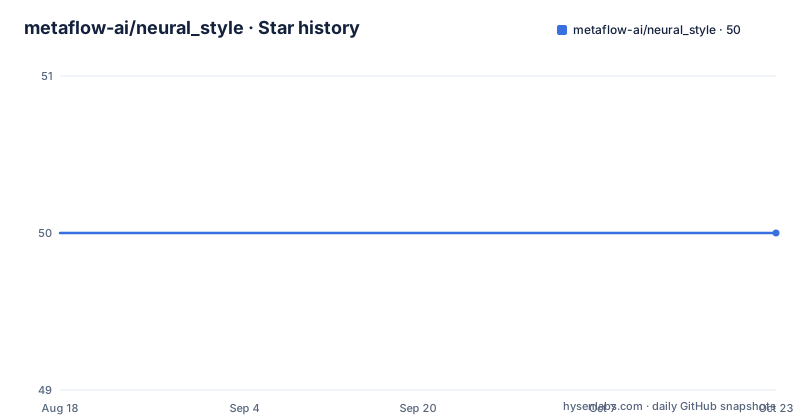
- metaflow-ai/neural_style50 ★ · +0
| Repository | 2026-08-18 | 2026-10-23 |
|---|---|---|
| metaflow-ai/neural_style | 50 | 50 |
0 Stars in the last 66 days, measured from the daily GitHub snapshot. Compare with other projects
Editorial analysis
What Problem This Repo Tackles and Who It Serves
The repo does not claim to be a framework. It is a set of scripts that the author used to understand the algorithm. The value is in the journey, not the destination. If you want to learn how neural style transfer works under the hood, this repo gives you a map. If you want to ship a product, look elsewhere.
The Training Pipeline: From Data Download to Deep Art
The pipeline is linear and scripted, which makes it reproducible if you follow the steps exactly. But the scripts are not parameterized for every case. For example, predict.sh takes a model path, but the image size is not configurable from the command line. The performance table uses a 600x600 image size, so that is likely hardcoded somewhere. If you want a different resolution, you will need to edit the scripts or the Python files. That is a limitation, but it also makes the code easier to read for learning purposes.
Custom Keras Layers and the Torch Importer
The existence of these custom layers is a sign that the author was pushing the boundaries of what Keras offered at the time. Today, many of these operations are built into Keras or TensorFlow, but the custom implementations here are still instructive. Reading them can teach you how to implement your own layers, which is a valuable skill.
Deploying to iPhone: Export and Mobile App
The mobile deployment path is real, but it is not turnkey. The export script is there, but you need to have a trained model first. The mobile README is separate, so you have to find it. The performance numbers suggest that real-time style transfer on an iPhone 6s is not achievable with this approach. The repo does not claim otherwise, but it gives you the data to make that conclusion yourself.
Performance Measurement: What the Numbers Actually Tell You
These performance numbers are from a specific time and hardware. The iPhone 6s is from 2015, and the AWS GPU is a K420, which is not a high-end card. The numbers are useful as a baseline, but they are not predictive of modern hardware. If you want to know how the algorithm performs on a modern iPhone, you would have to run the code yourself. The repo gives you the scripts to do that, but it does not update the numbers.
Docker Setup and Dependencies: The CUDA and cuDNN Constraint
For a modern user, the CUDA 7.5 requirement is a dealbreaker unless you are willing to work with old toolchains. This repo is from a time when TensorFlow 0.9 was current, and the README links to TensorFlow 0.9 documentation. That is a strong signal that the code is not compatible with TensorFlow 2.x without significant changes. If you are serious about using this repo, plan to use an older environment, possibly inside Docker, to avoid breaking your main system.
Limitations, Failure Modes, and When This Repo Is the Wrong Tool
Another limitation is the lack of documentation for the custom layers and the torch importer. If you want to understand how the algorithm works, you have to read the code. That is fine for an experienced developer, but it is a barrier for a beginner. The README gives you the commands, but not the theory. You have to go to the original papers, which are linked in the acknowledgment section, to understand the algorithm.
Alternatives and How They Differ
For mobile deployment, there are also specialized tools like TensorFlow Lite, which can optimize models for mobile hardware. This repo does not use TensorFlow Lite; it exports a .pb file and runs it on the iPhone's CPU. TensorFlow Lite would likely be faster, but it is a different workflow. The README's quantized experiment suggests the author tried quantization, but it did not work well. TensorFlow Lite has improved since then, so it might be worth exploring if you want to deploy style transfer on mobile.
Maintenance, Upgrade Cost, and License Implications
For a learning project, these costs are acceptable. You can run the code in a Docker container with the old versions and not worry about the future. But for a production system, the unknown license and the lack of maintenance make it a poor choice. You would be better off using a maintained library with a clear license, even if it means learning a different API.
Editorial conclusion
Adopt this repo if you are a developer or researcher who wants a concrete, step-by-step path from training a neural style model to deploying it on an iPhone, and you are comfortable reading raw scripts and adapting them. It is not for production use: the code is experimental, the documentation is sparse, and the performance numbers show mobile inference is still far from real-time. Avoid it if you need a maintained library, a clean API, or support for modern TensorFlow versions. Before you start, verify your CUDA and cuDNN versions (the repo expects CUDA 7.5 and cuDNN 5), check that the Keras layers still work with your TensorFlow version, and confirm the 20GB data download is acceptable. The repo is a valuable learning artifact, but treat it as a starting point, not a turnkey solution.
Frequently asked questions
What is neural style transfer in deep learning, according to metaflow-ai neural_style?
It is reconstructing an image so that its content matches one input and its style matches another, using a pretrained VGG as the feature extractor. This repository is a working implementation of that idea in TensorFlow and Keras, with scripts to inspect layer influence, layer reconstruction, the alpha parameter and the total variation loss.
How do I run the metaflow-ai neural_style training pipeline?
Six steps, each tied to a directory: run download_images.sh in the data directory for roughly 20GB of images, download_weights.sh in the vgg19 directory, build_overfit_folder.sh in data, pretrain_model.sh at the root, python train.py pointed at a model directory, then predict.sh with a model path. Setting the epoch count to zero initialises weights only.
How fast is neural_style across different hardware?
For 600 by 600 images the README records about 0.0329 seconds batching and 0.026 seconds looping on an AWS K420 GPU, 4.13 and 3.31 seconds on macOS, 5.86 seconds in float32 and 16.9 seconds quantized on the macOS simulator, and 18.30 seconds on an iPhone 6s CPU. The stated gap is x703 between CPU and GPU.
How does neural_style get a trained model onto an iPhone?
Run export_keras_model.py with a model directory, copy the resulting pb file into the mobile_app/data directory, then follow the mobile readme for the iOS side. The GPU container needs CUDA 7.5 and cuDNN 5, and the pinned stack is TensorFlow 0.10.0 with Keras 1.0.4.
Official sources
Add this badge to your README
If you maintain this project, the badge below links readers to this analysis and shows its maintenance status from the daily GitHub snapshot. Paste the markdown into your README; add ?metric=license or ?metric=stars to the image URL for a different field.

[](https://hysenlabs.com/projects/metaflow-ai-neural-style)Star history chart for your README
[](https://hysenlabs.com/projects/metaflow-ai-neural-style)Was this useful?