The Met Open Access CSV: 470,000 Artworks for Reuse
The Metropolitan Museum of Art's Open Access Initiative
At a glance
- What is it?
- The Met's openaccess repository publishes a UTF-8 CSV containing information on more than 470,000 artworks under CC0. It is useful for collection search and research, but it contains no artwork images and its documentation is incomplete.
- Who is it for?
- Developers, researchers, and cultural organizations should adopt this repository when a reusable, machine-readable index of The Met's collection is enough. Museums and publishers that require images, complete documentation, or a maintained data service should verify those requirements first.
- Can I use it commercially?
- Yes. CC0-1.0 is a permissive licence: you can use, modify and sell software built on it, as long as you keep its copyright and licence notices.
- Is it still maintained?
- Yes. The repository last received commits 5 days ago.
- What is it written in?
- GitHub does not report a main language for this repository.
Answers come from the project's GitHub data, last synced on November 7, 2026, and from our analysis. They are not legal advice.
Star history
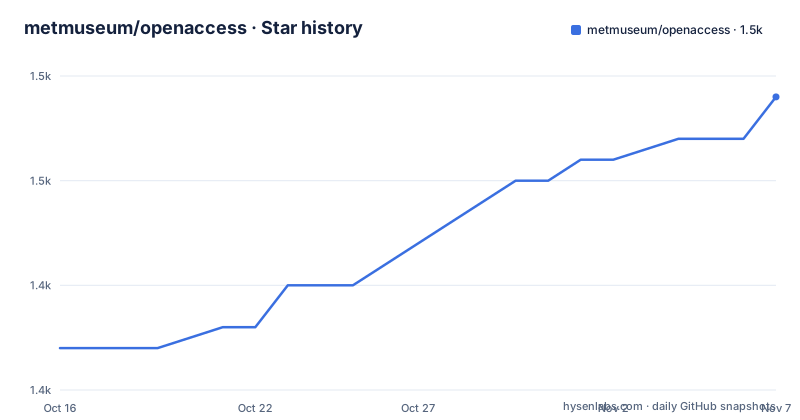
- metmuseum/openaccess1,454 ★ · +12
| Repository | 2026-10-16 | 2026-11-07 |
|---|---|---|
| metmuseum/openaccess | 1.4k | 1.5k |
12 Stars in the last 22 days, measured from the daily GitHub snapshot. Compare with other projects
Editorial analysis
What metmuseum/openaccess Provides
The metmuseum/openaccess repository addresses the need for a downloadable, reusable index of The Metropolitan Museum of Art's Collection. The README states that the CSV contains select data on more than 470,000 artworks, covering art from around the world and a span of over 5,000 years. It is aimed at people and organizations that need to search, use, and interact with collection records for commercial or noncommercial work. Potential users include researchers, developers building collection search interfaces, educational projects, and publishers preparing structured artwork data. The repository does not present itself as an application or API. Its central deliverable is one CSV file, named MetObjects.csv, distributed through Git and Git LFS.
This distinction matters when evaluating adoption. The repository can supply a source dataset for indexing, analysis, or display prototypes, but the README does not document a query service, schema validation package, command-line interface, or supported software library. Consumers must therefore decide how to ingest the CSV, interpret its fields, store derived data, and update local copies. The README also says that documentation of the collection is an ongoing process and that parts of the dataset are incomplete. This is a collection export with known editorial limits, not a guarantee that every record is complete or stable.
CSV Delivery Through Git LFS
The data file is stored using Git's LFS, or large-file storage, system. That choice affects both distribution and local repository use. The README warns that a normal browser download should be initiated from the MetObjects.csv page and saved with the browser's download command rather than loaded directly in the browser. For a full clone, the project specifically requires Git LFS and documents a dedicated clone command. This design keeps the repository small enough for Git while placing the large CSV in LFS-managed storage.
The data flow is straightforward: The Met publishes the collection data, the repository exposes it as MetObjects.csv, and a user either downloads that file or clones the Git LFS-backed repository. There is no processing service in this repository that transforms records before delivery. Any filtering, normalization, indexing, or conversion into another format belongs to the consumer. The README does not enumerate the CSV columns or document their types, so a project should inspect the file before designing a schema-dependent ingestion pipeline.
The file is encoded in UTF-8, which is important because artwork names and descriptive fields can contain multilingual text. The README notes a specific compatibility issue with Excel on a Mac, where UTF-8 may not be interpreted correctly. It suggests converting the file to UTF-16 for import into that application. This is an application-specific workaround, not a requirement to change the repository's published encoding.
Cloning the Dataset and Beginning a First Use
The project documents cloning rather than installing an application. Git LFS must be available before using the documented clone command. The command below is reproduced exactly as given in the README:
git lfs clone https://github.com/metmuseum/openaccessAfter a successful clone, the working directory should contain the repository files, including MetObjects.csv and LICENSE. A first useful step is to open the CSV in a tool that correctly handles UTF-8, or import it through software that explicitly selects UTF-8 encoding. The README does not provide a ready-made application, query example, or transformation script, so it does not support inventing a specific command beyond the clone operation.
For a small evaluation, inspect the header row and a sample of records to determine whether the available fields match the intended use. The README confirms that the file is UTF-8 CSV, but it does not describe the field names, null conventions, or record-level update dates. Those details must be established from the actual file and documented separately by the adopting project. If Excel on a Mac is used, follow the README's stated conversion to UTF-16 before import.
CC0 Rights and the Missing Image Layer
The repository uses Creative Commons Zero, identified in the README as CC0, and says that The Met waived all copyright and related or neighboring rights to the dataset to the extent possible under law. The stated permission covers unrestricted commercial and noncommercial use, without requiring permission or a fee. The repository's LICENSE file contains the CC0 deed. This makes the dataset unusually permissive for reuse, although it does not remove the need to understand the separate status of individual artworks.
The README draws an important boundary between data rights and image rights. Images are not included and are not part of the dataset. Some companion artworks are identified in the Museum's Collection section by a Creative Commons Zero icon, but the repository itself does not provide those image files. Anyone planning an artwork gallery, educational visualizer, or publication should treat MetObjects.csv as metadata and consult The Met's image-resource documentation separately.
The project also requests attribution or citation where appropriate, particularly for research and publication. That request sits alongside the permissions granted by CC0. The README says attribution helps support future dataset releases and reduces orphaned data by retaining source links. Users must not misrepresent the source, use The Met's trademarks to imply endorsement, or fail to disclose transformations, translations, enrichments, or other modifications. A derived dataset should clearly identify those changes.
Data Quality, Corrections, and the Update Boundary
The repository is generated from The Met's internal database, which has a direct effect on contribution and correction workflows. The README says pull requests are not accepted. A user who finds an error or has additional information should email [email protected], and the Museum says it will forward the issue to the appropriate department for review. That means the repository is not an open contribution project in the usual Git-based sense. Consumers cannot submit a corrected CSV row through a pull request, and the README gives no automated correction API or turnaround time for review.
The dataset is provided as is, and The Met disclaims representations and warranties. The README advises users to update their copies regularly so that they use the best available information. Since no GitHub releases are documented in the repository facts, a consumer should not assume that a release page or versioned download provides a stable migration path. The repository's default branch is master, and its last push was on 2026-10-14. That date indicates recent repository activity, but it does not by itself establish the freshness or completeness of every artwork record.
The practical limitation is operational. A copy made for a search index, exhibit, or research workflow can become stale, and correcting a local record can create a divergence from the next upstream update. The README's guidance supports periodic replacement or reconciliation, but it does not specify a synchronization format, schema version, deletion policy, or change feed.
When metmuseum/openaccess Is the Wrong Choice
This repository is the wrong choice when the requirement is an artwork image service rather than a metadata dataset. No images are included, and the CC0 icon described for companion artworks applies to objects identified on The Met's website, not to image files delivered by this repository. A project whose primary deliverable is a visual catalog therefore needs a separate image source and a policy review for each image's status.
It is also a poor fit for a production application that requires a documented API, guaranteed schema compatibility, transactional corrections, or a service-level commitment. The README documents a generated CSV, not those guarantees. Incomplete collection documentation is explicitly acknowledged, and pull requests are not accepted. A team that cannot tolerate partial records or that needs Museum staff to review every proposed correction should not treat this repository as its sole content-management system.
For a lightweight catalog, prototype, local search engine, or research workflow, the tradeoff is more favorable. The main costs are building ingestion around a large CSV, handling UTF-8 correctly, scheduling updates, and recording source attribution and modifications. These are data engineering responsibilities outside the repository.
Editorial conclusion
Developers, researchers, and cultural organizations should adopt this repository when a reusable, machine-readable index of The Met's collection is enough. Museums and publishers that require images, complete documentation, or a maintained data service should verify those requirements first. The first check should be whether MetObjects.csv contains the fields needed for the intended project and whether the team can cite The Met without implying endorsement.
Frequently asked questions
What is the metmuseum/openaccess repository used for?
It provides a CSV containing select information on more than 470,000 artworks from The Metropolitan Museum of Art's Collection. The README says the datasets support collection search, use, and interaction.
Does metmuseum/openaccess include images?
No. The README explicitly states that images are not included and are not part of the dataset. It directs users to The Met's separate image-resource documentation for image usage details.
How do I download or clone metmuseum/openaccess?
For a clone, install Git LFS and use the repository's documented `git lfs clone` command. For a direct CSV download, the README instructs users to open the MetObjects.csv page and choose the browser's save command.
Can I use metmuseum/openaccess for commercial projects?
The README says the datasets are available for unrestricted commercial and noncommercial use. It also requires that users do not misrepresent the source or imply endorsement, and that modifications and enrichments be disclosed.
Can I contribute corrections through a pull request?
No. The README says pull requests are not accepted because the datasets are generated from The Met's internal database. It directs reports and additional information to [email protected].
Official sources
Add this badge to your README
If you maintain this project, the badge below links readers to this analysis and shows its maintenance status from the daily GitHub snapshot. Paste the markdown into your README; add ?metric=license or ?metric=stars to the image URL for a different field.

[](https://hysenlabs.com/projects/metmuseum-openaccess)Star history chart for your README
[](https://hysenlabs.com/projects/metmuseum-openaccess)Was this useful?