Meting: one search call for five Chinese music platforms, returned as a JSON string
:cake: Wow, such a powerful music API framework
At a glance
- What is it?
- metowolf/Meting is the Node.js port of the PHP Meting library. It wraps NetEase, Tencent, KuGou, Baidu and Kuwo behind one class, with no runtime dependencies and several limits the docs leave open.
- Who is it for?
- Adopt Meting if you build a player, a bot or a metadata tool in Node.js and want a single call shape across five Chinese music services. Skip it if you need a hosted REST endpoint, a documented error contract or a pinned release history, because none of those ship here.
- Can I use it commercially?
- Yes. MIT is a permissive licence: you can use, modify and sell software built on it, as long as you keep its copyright and licence notices.
- Is it still maintained?
- Yes. The repository last received commits 47 days ago.
- What is it written in?
- Mainly JavaScript, according to GitHub's language statistics.
Answers come from the project's GitHub data, last synced on November 26, 2026, and from our analysis. They are not legal advice.
Star history
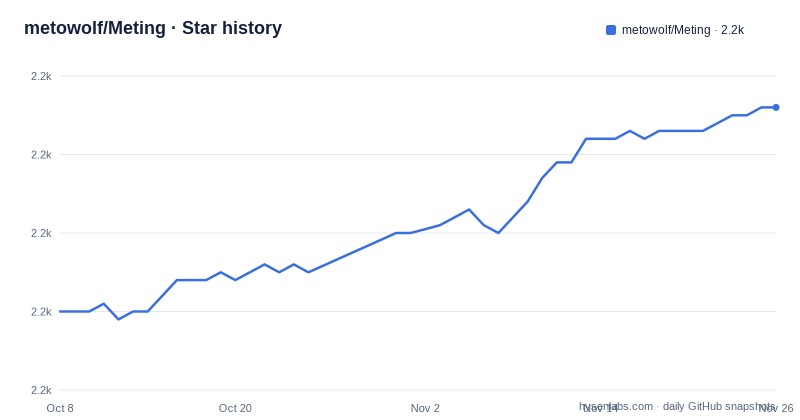
- metowolf/Meting2,226 ★ · +26
| Repository | 2026-10-08 | 2026-11-26 |
|---|---|---|
| metowolf/Meting | 2.2k | 2.2k |
26 Stars in the last 49 days, measured from the daily GitHub snapshot. Compare with other projects
Editorial analysis
A single constructor argument picks the platform
Everything starts with `new Meting(server)`, where `server` is one of `netease`, `tencent`, `kugou`, `baidu` or `kuwo`. Switching later is one call, `meting.site(server)`, so a script can start on one service and move to another without rebuilding the object. The same instance carries `meting.cookie(cookie)` for platform-specific cookies and `meting.format(enable)` for output normalisation.
The package is published as `@meting/core`, version 1.6.2 in package.json, with MIT as the license. It is the Node.js version of the original PHP Meting project by the same author, metowolf, and the PHP repository is the first entry under Related Projects.
Results come back as a string you must parse yourself
Every example in the docs wraps the response in `JSON.parse`. Search returns a string, and so do `song`, `url` and `lyric`, so the promise resolves to text and your code turns it into objects. Forgetting that step is the first mistake a new user makes, because the value looks like data when logged.
The quick-start pattern is short enough to quote in full:
import Meting from '@meting/core';

// Initialize with a music platform
const meting = new Meting('netease'); // 'netease', 'tencent', 'kugou', 'baidu', 'kuwo'

// Enable data formatting for consistent output
meting.format(true);
Calling `meting.format(true)` is what makes the five platforms look alike. Without it you get whatever shape each service returns natively, which defeats the point of using a unifying wrapper.
What format(true) normalises and what it leaves out
With formatting enabled, each track comes back with the same fields: `id`, `name`, `artist` (an array), `album`, `pic_id`, `url_id`, `lyric_id` and `source`. The sample in the docs is the Adele track Hello on NetEase, with id `35847388`.
That shape has a consequence. A song is a bundle of identifiers, not a playable object. To play it you take `url_id` into `meting.url(id, bitrate)`, `lyric_id` into `meting.lyric(id)` and `pic_id` into `meting.pic(id, size)`. Three more requests per track is the price of the uniform record, and a playlist of fifty songs fans out into a lot of calls, which matters given the rate-limit advice later in the docs.
Search options mean different things per provider
Search takes a keyword and an options object with `type`, `page` and `limit`. Page starts at 1 and defaults to 1, and limit defaults to 30. The `type` option is described as a category for providers that support it, and the only mapping given is NetEase: `1` for songs (the default), `10` for albums, `100` for artists, with more codes implied by the "etc." in the docs.
There is no table of type codes for Tencent, KuGou, Baidu or Kuwo. If you want album or artist search on those four, you read the source under `src/` to find the numbers. The support table marks every method as available on every platform, so the gap is in documentation, not in the claimed feature set.
Zero dependencies, but the Node.js floor and the module setup disagree
The README states Node.js >= 12.0.0 and no external dependencies, meaning it is built on Node's native modules. package.json lists only four devDependencies, all Rollup packages: `rollup`, `@rollup/plugin-babel`, `@rollup/plugin-node-resolve` and `@rollup/plugin-terser`. Nothing in `dependencies` means installing it adds nothing to your tree.
The package is marked `"type": "module"` and its `exports` map offers both `./lib/meting.esm.js` for import and `./lib/meting.js` for require. Both files live in `lib/`, which is the only directory in the `files` list besides LICENSE, so a git clone has no runnable code until `npm run build` has produced them. Installing from npm avoids that step:
npm install @meting/coreYarn users run `yarn add @meting/core`. No `engines` field appears in package.json, so nothing enforces the stated Node 12 minimum at install time.
The test suite builds first and talks to live platforms
In package.json, `npm test` expands to `npm run build && node test/test.js`. The docs describe it as running tests for all platforms, so by design it exercises the real services rather than recorded fixtures. A failure can mean a regression in Meting or a platform changing its API, and the output alone does not separate the two.
The other scripts follow the same build-first rule. `npm start` and `npm run example` both run `npm run build && node test/example.js`, and `npm run dev` runs `rollup -c --watch` for development. The repository also carries `ARCHITECTURE.md`, `CHANGELOG.md` and `CLAUDE.md` at the top level. The contributors field in package.json lists Claude Code next to the author, which tells you an AI assistant has worked in this codebase.
No error contract, only a try-catch and a fallback platform
Error handling is one pattern: wrap calls in try-catch and, if one platform fails, call `meting.site('tencent')` and repeat the search. There is no documented error class, no status code, no retry option and no way to tell a blocked request from a missing song.
Rate limiting is left to you as well. The advice is to add delays between consecutive requests, avoid bursts and consider request queuing for heavy use, with a two-second `setTimeout` as the example. The library itself throttles nothing. The Important Notes section adds that platform APIs may change without notice, that some features may be restricted by geographic location, and that each platform has its own limits. Respecting copyright and platform terms of service is listed as the user's job.
The repository has no GitHub releases, so the only version markers are the 1.6.2 in package.json and whatever CHANGELOG.md records. The last push was on 2026-10-10. The README's comprehensive example is also cut off at the step labelled "Get streaming URL", so the full song-to-stream flow has to be pieced together from the method list.
Editorial conclusion
Adopt Meting if you build a player, a bot or a metadata tool in Node.js and want a single call shape across five Chinese music services. Skip it if you need a hosted REST endpoint, a documented error contract or a pinned release history, because none of those ship here. Before committing, run npm test against the platform you care about, since every platform behind it is an unofficial integration that can change without notice.
Frequently asked questions
What is the meaning of Meting in this project?
Meting is the name of metowolf's music API framework. The Node.js version is published as @meting/core and gives one interface to NetEase, Tencent, KuGou, Baidu and Kuwo.
Is it Meting or meeting for the music library?
It is spelled Meting with no second e. The package name is @meting/core and the repository is metowolf/Meting.
How do you pronounce Meting, the music API library?
The repository gives no pronunciation guide. What it does state is the name, Meting, and that the project is a Node.js port of the original PHP Meting by metowolf.
Official sources
Add this badge to your README
If you maintain this project, the badge below links readers to this analysis and shows its maintenance status from the daily GitHub snapshot. Paste the markdown into your README; add ?metric=license or ?metric=stars to the image URL for a different field.

[](https://hysenlabs.com/projects/metowolf-meting)Star history chart for your README
[](https://hysenlabs.com/projects/metowolf-meting)Was this useful?