MODX Revolution 3.x: A PHP CMS with Application Framework Scope
MODX Revolution - Content Management Framework
At a glance
- What is it?
- MODX Revolution is a PHP content management system intended for sites, blogs, multilingual domains, and mobile APIs. Its documented strength is control over markup and design, while technical evaluation requires following its linked 3.x documentation beyond the repository overview.
- Who is it for?
- MODX Revolution fits teams that want a PHP CMS with control over generated markup and possible API use. It is less suitable for evaluators who require a documented runtime architecture, formal GitHub releases, or clear migration guarantees before adoption.
- Can I use it commercially?
- Yes, with conditions. GPL-2.0 is a copyleft licence: if you distribute software that includes it, you must release that software's source code under the same licence. Running it internally without distributing it does not trigger that obligation.
- Is it still maintained?
- Yes. The repository received new commits within the last day.
- What is it written in?
- Mainly PHP, according to GitHub's language statistics.
Answers come from the project's GitHub data, last synced on October 23, 2026, and from our analysis. They are not legal advice.
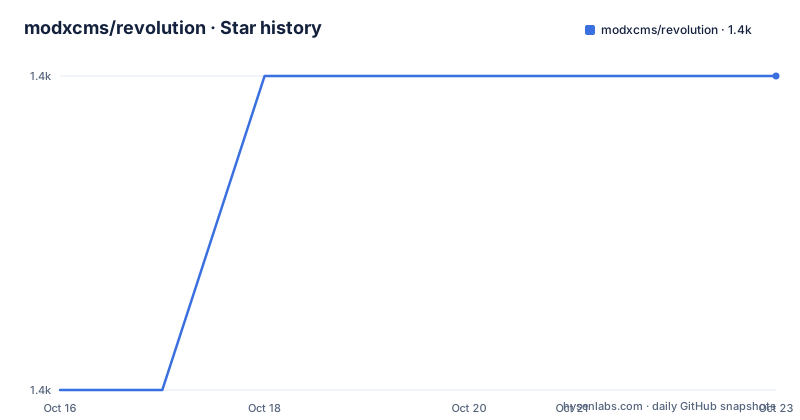
Star history
- modxcms/revolution1,413 ★ · +1
| Repository | 2026-10-16 | 2026-10-23 |
|---|---|---|
| modxcms/revolution | 1.4k | 1.4k |
1 Stars in the last 7 days, measured from the daily GitHub snapshot. Compare with other projects
Editorial analysis
The Content and Application Scope of MODX Revolution
MODX Revolution addresses the need to publish and manage website content while preserving control over the resulting markup. Its README names corporate sites, personal blogs, multilingual and multi-domain properties, and mobile APIs as use cases. That range is broader than a conventional page editor, so the project describes itself as both a content management system and an application framework.
The intended users are developers, designers, and organizations that do not want a fixed presentation layer imposed by the CMS. The documentation says users can control markup and design without having to code, which suggests a separation between content management and front-end implementation. It also says the modular and extensible core can accommodate custom requirements and traffic levels. Those are project claims, but the README does not identify the relevant extension interfaces, request lifecycle, cache policy, or capacity boundaries.
This distinction matters during evaluation. MODX Revolution may fit a project requiring editable content and a separately designed front end. The README is not enough to establish whether it is a better fit than a simpler CMS for a small brochure site, or whether its framework capabilities justify a larger deployment for a complex application.
What the MODX 3.x Repository Reveals About Its Architecture
The default branch is `3.x`. Its repository contains several distinct areas: `core/`, `manager/`, `connectors/`, `setup/`, and `_build/`. `index.php` sits at the repository root, while the JavaScript lint configuration covers `manager/assets` and `setup/assets`. These names indicate a CMS with an administrative interface, setup code, connectors, and build tooling. They do not, by themselves, document how requests or content are processed.
The README gives no database schema, template syntax, route map, cache architecture, component API, or connector protocol. It also does not explain where generated page markup is assembled. Accordingly, a more specific claim about MODX Revolution's runtime data flow would go beyond the documentation. In particular, the README does not establish whether content updates invalidate caches synchronously, whether API responses share the CMS rendering path, or how custom code is isolated.
For an engineer, that missing detail is a real evaluation constraint. Repository contents reveal broad responsibilities, but directory names such as `connectors/` and `_build/` are not substitutes for documented contracts. The 3.x documentation linked by the README is therefore part of the product assessment rather than optional background.
Following MODX Revolution's Official Installation Path
The README does not provide a self-contained command sequence, installer command, environment-variable list, or copy-and-run configuration example. It directs users to download MODX Revolution through `https://modx.com/download` and consult the linked 3.x server-requirements and installation guides. Because the README and listed repository configuration do not contain an exact installation command, this review does not invent one.
A first real use therefore begins outside the repository with the official download and the documented installation procedure. Before downloading, compare the target hosting environment with the linked 3.x server-requirements page. During installation, follow that guide without substituting commands from another CMS. After installation, the first useful verification should be publishing one minimal resource through the manager and requesting its public URL, although the README does not name the precise manager menu or resource type used for that check.
This is a limited tutorial because the repository overview does not expose the complete setup sequence. It identifies the correct first documents and a concrete verification, but it cannot claim particular success messages, database credentials, web-server directives, or filesystem permissions. Those details must come from the linked MODX installation guide.
For developers working from source, the README offers a separate "Install MODX via git" guide. It does not reproduce that guide's commands in the repository README, so the exact branch, Composer invocation, and web-server setup should be taken from `https://docs.modx.com/3.x/en/getting-started/installation/git` rather than guessed.
MODX Revolution Version Signals and Upgrade Exposure
`package.json` identifies the JavaScript package as `revolution` with version `3.0.0`. The README links to repository tags for version information and directs readers to `core/docs/changelog.txt` for changes. These references make the `3.x` branch and the in-repository changelog more concrete than the GitHub releases page, which has no releases.
The absence of GitHub releases does not mean there are no versions or updates. It means the repository does not publish its release history through GitHub Releases. An adopter who expects downloadable GitHub release artifacts, formal GitHub release notes, or a sequence of GitHub releases will not find them there. The README instead points to the MODX download page, repository tags, documentation, and the changelog file.
The repository also includes a dedicated guide for upgrading from 2.x to 3.0. This confirms that migration between major generations is an expected concern. It does not state which templates, extras, connectors, database changes, or configuration files require modification. The README does not document rollback, a compatibility matrix, or automated database migration steps.
For a new installation, migration history is secondary. For an existing MODX site, it is central. Before choosing a production version, identify the intended 3.x download or tag, compare it with `core/docs/changelog.txt`, and inventory custom templates, extras, connectors, and integration code. Then use the official 2.x to 3.0 guide to identify the changes that apply to that inventory.
Where MODX Revolution Is the Wrong Tool
MODX Revolution is a poor fit when a buyer requires the complete runtime contract to be documented in the project README. The repository overview does not explain template processing, cache invalidation, connector behavior, database requirements, or API request handling. If those interfaces must be understood before approval, the linked 3.x documentation needs to provide them before the CMS enters the evaluation.
It is also a questionable choice for a team whose primary requirement is a fixed, conventional publishing workflow. The README emphasizes markup control, design freedom, extensibility, and application use, none of which directly describes a tightly bounded editorial interface. The repository overview does not confirm whether configurable workflow roles, approval stages, or scheduled publishing provide a better fit than those systems.
The missing GitHub Releases history creates a related constraint. Teams that require formal release artifacts and release notes within GitHub will not find them in this repository. The tags, download page, and `core/docs/changelog.txt` remain relevant, but the README does not explain how those sources form a complete release process.
None of these points proves that MODX Revolution cannot serve the project. They define where the repository overview cannot support a confident adoption decision. Installation behavior, extension contracts, and version policy have to be checked in the linked MODX documentation before committing to it.
MODX Revolution, Conventional CMSs, and Separate PHP Frameworks
A real alternative is to combine a conventional CMS with a separate PHP application framework. That approach separates content administration from application routing and runtime behavior, whereas MODX presents itself as one project intended to cover both CMS and application needs. The difference is architectural scope, not a performance claim. The README does not provide comparative measurements that could support one.
Another alternative is a CMS designed around a fixed theme or template workflow. The MODX README specifically emphasizes control over markup and design, making that distinction relevant for projects that need to own front-end output. A fixed-template system may impose fewer presentation choices, but this repository does not identify a specific alternative product or document its behavior. A direct product comparison would therefore require evidence outside this review.
MODX Revolution is a weaker choice when the deciding requirement is a clearly documented extension contract or a release artifact on GitHub. It is a stronger candidate when editable content and control over generated markup must belong to the same platform. The deciding evidence should come from the linked 3.x documentation, not the README's broad claims about speed, security, flexibility, or traffic.
MODX Revolution Licensing, Maintenance, and Adoption Cost
MODX Revolution is distributed under the GNU General Public License, version 2 or, at the recipient's option, any later version. `package.json` uses `GPL-2.0+`, while the README names both GPL version 2 and the option of a later version. The repository contains top-level `LICENSE` and `COPYRIGHT` files. It also includes `SECURITY.md` for security reporting details.
The documented permissions include redistribution and modification under the license terms. That makes source availability and modification part of the project's stated licensing model. This review does not interpret how those permissions apply to a particular deployment or commercial arrangement. Projects built on MODX should inspect `LICENSE`, `COPYRIGHT`, and the licensing terms of every additional component separately.
The repository is not archived, and its last push was on 2026-09-03. That supports a finding of current development activity, but the GitHub Releases page contains no releases and the README points to tags and `core/docs/changelog.txt` for version history. Maintenance review should therefore account for both repository changes and the deployment version's migration requirements.
The clearest supported upgrade cost is evaluation work for 2.x installations. Custom templates, extras, connectors, and integrations must be compared with the 2.x to 3.0 guide and changelog. The GPL terms do not resolve operational questions about hosting, notices, or third-party components; those terms must be checked in the repository files and dependency licenses.
Editorial conclusion
MODX Revolution fits teams that want a PHP CMS with control over generated markup and possible API use. It is less suitable for evaluators who require a documented runtime architecture, formal GitHub releases, or clear migration guarantees before adoption. Review the 3.x server requirements and installation guide first, then confirm that the 2.x to 3.0 upgrade path covers any existing site, custom code, or integrations.
Frequently asked questions
What is MODX Revolution used for?
The README describes it as a PHP CMS and application framework for corporate sites, personal blogs, multilingual and multi-domain properties, and mobile APIs.
How do I install MODX Revolution?
The README links to the official MODX download page, the 3.x server requirements, and the 3.x installation guide. It also provides a separate guide for installing through Git.
Can MODX Revolution be upgraded from version 2.x to 3.0?
The README includes a guide titled "How to upgrade from 2.x to 3.0" and separately links the complete changelog at `core/docs/changelog.txt`. It does not summarize the individual migration steps.
Official sources
Add this badge to your README
If you maintain this project, the badge below links readers to this analysis and shows its maintenance status from the daily GitHub snapshot. Paste the markdown into your README; add ?metric=license or ?metric=stars to the image URL for a different field.

[](https://hysenlabs.com/projects/modxcms-revolution)Star history chart for your README
[](https://hysenlabs.com/projects/modxcms-revolution)Was this useful?