msgpack-java: Binary Serialization for Java Applications
MessagePack serializer implementation for Java / msgpack.org[Java]
At a glance
- What is it?
- msgpack-java provides a Java MessagePack implementation with a dependency-free core and a Jackson integration module. It suits JVM services that need compact binary encoding, but its documentation leaves the API usage path dependent on external examples.
- Who is it for?
- Adopt msgpack-java when a JVM system already uses MessagePack or specifically needs its binary encoding and extension format support. Do not choose it merely because the README contrasts it with JSON, since it does not provide comparative measurements or a self-contained object-mapping example.
- Can I use it commercially?
- Yes. Apache-2.0 is a permissive licence: you can use, modify and sell software built on it, as long as you keep its copyright and licence notices.
- Is it still maintained?
- Yes. The repository last received commits 10 days ago.
- What is it written in?
- Mainly Java, according to GitHub's language statistics.
Answers come from the project's GitHub data, last synced on November 7, 2026, and from our analysis. They are not legal advice.
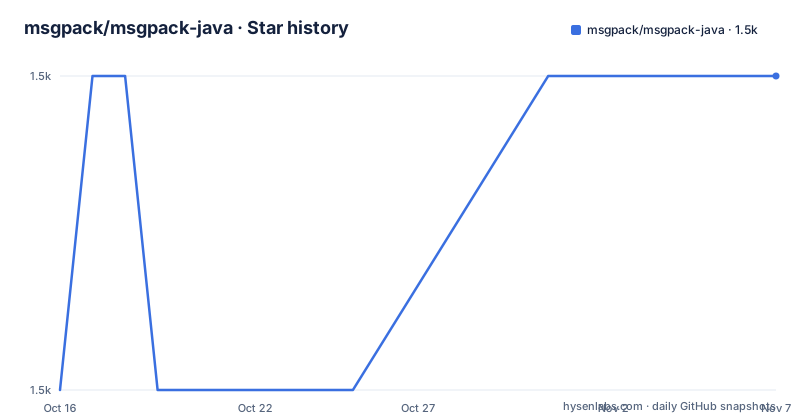
Star history
- msgpack/msgpack-java1,479 ★ · +1
| Repository | 2026-10-16 | 2026-11-07 |
|---|---|---|
| msgpack/msgpack-java | 1.5k | 1.5k |
1 Stars in the last 22 days, measured from the daily GitHub snapshot. Compare with other projects
Editorial analysis
Why msgpack-java Targets JVM Serialization
MessagePack is a binary serialization format, and msgpack-java implements it for JVM applications. The README positions the format as a compact alternative to JSON, giving two concrete encoding examples: a small integer can occupy one byte, while a short string adds only a one-byte prefix to its original byte array. Those examples describe wire efficiency rather than application performance. The repository does not publish benchmark results, so it does not establish how much faster or smaller a particular Java workload will become.
The intended users are Java developers who need MessagePack-compatible storage or network communication. Cross-language compatibility is part of the format's purpose because the README says implementations exist for various languages and calls MessagePack a universal data format. That makes the library relevant to services exchanging data with non-Java components, provided those components also implement MessagePack.
The current v7 implementation supports all MessagePack types, including the extension format. This is broader than a serializer limited to common maps, lists, and scalar values. The repository also retains a Jackson integration, but states that the template-based serialization mechanism used in v06 is deprecated. New adoption should therefore target the Jackson ObjectMapper path rather than treating the older template mechanism as a recommended design.
Inside msgpack-core and msgpack-jackson
The repository is divided into two modules with a clear dependency boundary. `msgpack-core` contains the Packer and Unpacker implementation and, according to the project structure, does not use third-party libraries. `msgpack-jackson` contains a Jackson data-format implementation. This separation lets a project decide whether it needs only the binary MessagePack layer or Java object mapping through `jackson-databind`.
The README describes serialization and deserialization of Java objects through `jackson-databind`. It does not explain the internal record layout, class mapping rules, annotation support, polymorphism behavior, or exact handling of unknown fields. Those details belong to the separate `msgpack-jackson/README.md`, which the main README links but does not reproduce. Consequently, the repository documentation establishes the integration path without providing enough information here to make claims about object-model configuration.
For Java 17, direct access to off-heap memory through `DirectByteBuffer` requires module-opening options. The relevant methods are specifically associated with direct buffers, not every ordinary MessagePack operation. This is an operational detail that can otherwise surface as an access error when applications combine msgpack-java with direct memory in a modular Java runtime.
Maven, sbt, and Gradle Setup
The README lists dependency declarations for Maven, sbt, and Gradle. It uses `(version)` as a placeholder, so choosing that value is an explicit step rather than a copy-ready installation command. For a Maven application, add the following dependency and replace `(version)` with the release selected for the project. The artifact is `org.msgpack:msgpack-core`, and the published JavaDoc link is for the same artifact.
<dependency>
   <groupId>org.msgpack</groupId>
   <artifactId>msgpack-core</artifactId>
   <version>(version)</version>
</dependency>
An sbt build uses the same group, artifact, and version values:
libraryDependencies += "org.msgpack" % "msgpack-core" % "(version)"A Gradle build first declares Maven Central as a repository and then adds the dependency:
repositories {
    mavenCentral()
}

dependencies {
    compile 'org.msgpack:msgpack-core:(version)'
}
The README does not provide a complete first serialization program in the quoted text. Its first concrete usage reference is `MessagePackExample.java` under `msgpack-core/src/test/java/org/msgpack/core/example/`. A new user should consult that linked file for current Packer and Unpacker calls rather than infer an API from the dependency declaration. If Java objects are required, the next documented reference is `msgpack-jackson/README.md`.
Running the First Repository Build
The repository uses sbt, and the README provides a usable development-console command. This first workflow compiles and tests the project itself rather than an application that consumes the library. Run the bundled sbt launcher from the repository root; entering the command starts the sbt console documented by the project.
$ ./sbtInside that console, `compile` builds source code, while `"Test / compile"` includes both production and test code. Running `test` after a source change can provide feedback from the project's test suite. The commands shown in the README use a leading prompt marker, but the actual text to enter is the command after `>`.
> ~compile
> ~"Test / compile"
> ~test
For focused work, `project msgpack-core` selects the dependency-free module and `package` creates a JAR in each project's target directory. The repository also documents `jcheckStyle` for style checks and `scalafmtAll` for Scala and sbt formatting. These are documented build operations, not claims about whether a particular checkout passes them. The README also links to the Java usage example, which is the appropriate starting point after the library is added to an application because the main page does not reproduce its API calls.
Java 17 Direct Buffer Constraints
The documented Java 17 requirement is narrow but operationally significant. The README says that using `DirectByteBuffer` through off-heap memory access methods requires two `--add-opens` options. Applications that need those methods must pass both options to the JVM.
--add-opens=java.base/java.nio=ALL-UNNAMED
--add-opens=java.base/sun.nio.ch=ALL-UNNAMED
This requirement should not be treated as a universal launch setting without checking the application's direct-buffer usage. The README associates it with off-heap access, so heap-backed paths are outside the specific requirement it documents. On the other hand, a service that enables direct memory for another library could encounter the constraint when it adopts msgpack-java's off-heap methods.
The project does not document which runtime versions older than Java 17 are supported, nor does the quoted text state the minimum Java version for `msgpack-core`. It also gives no guidance for containers, service managers, or application servers that may require different JVM option placement. Those deployment-specific details must come from the host system. For a first evaluation, use a Java 17 process configuration where the two options can be applied explicitly and confirm whether the selected API path actually accesses direct buffers.
Maintenance, Releases, and Upgrade Boundaries
The repository is not archived, and its last push was on 2026-10-02. Recent releases include `v0.9.12` on 2026-05-03, `v0.9.11` on 2026-01-02, and `v0.9.10` on 2025-07-19. These dates show recent repository and release activity, but the repository does not publish a support commitment for a particular Java version or an upgrade-compatibility policy in the quoted text.
The project is licensed under Apache-2.0. The repository includes `LICENSE.txt`, `NOTICE`, and a build file named `LICENCE.sbt-extras.txt`. A consumer should account for the Apache License obligations applicable to redistribution and third-party distribution, but this review does not provide legal advice. The presence of `NOTICE` also makes it relevant to packaging decisions.
Upgrade cost depends on which module is used. A consumer of `msgpack-core` works with MessagePack Packer and Unpacker APIs, while a consumer of `msgpack-jackson` also depends on the behavior of `jackson-databind`. The README does not provide a migration matrix for releases. It points to `RELEASE_NOTES.md`, which is the documented place to check changes before changing the dependency version.
Choosing Between msgpack-java and JSON Tooling
The closest documented alternative in the README is JSON-based Java serialization, but the repository does not name or compare a specific JSON library. JSON tooling represents text data with a self-describing textual syntax and commonly integrates with web-oriented libraries. msgpack-java uses MessagePack's binary types and includes support for the extension format. The practical choice is therefore about compatibility and representation, not an assumed speed advantage.
A team should prefer msgpack-java when peers already consume MessagePack, when protocol design specifically calls for MessagePack, or when extension-type support is required. It is the wrong choice when another participant requires JSON, when human inspection of stored payloads is a primary requirement, or when the team needs a fully documented ObjectMapper recipe without following separate documentation. The README gives no data on schema evolution, canonical encoding, streaming limits, maximum nesting, or protection against hostile input.
The project is also not an all-purpose replacement for HTTP framing or schema management. It encodes values according to MessagePack, but the repository does not claim to define service contracts, authentication, compression, or cross-version migration. Those concerns remain outside this library. Based on the repository layout, an application that only needs MessagePack's core representation can depend on `msgpack-core`; adding object mapping introduces the separate `msgpack-jackson` module and its Jackson dependency.
Editorial conclusion
Adopt msgpack-java when a JVM system already uses MessagePack or specifically needs its binary encoding and extension format support. Do not choose it merely because the README contrasts it with JSON, since it does not provide comparative measurements or a self-contained object-mapping example. Before adoption, verify the exact msgpack-core version, inspect the linked MessagePackExample.java for current API calls, and test Java 17 off-heap access requirements against the deployment configuration.
Frequently asked questions
Which msgpack-java artifact should a Maven project use?
The README lists `org.msgpack:msgpack-core` as the core artifact. It also documents `msgpack-jackson` for Java object serialization and deserialization through `jackson-databind`.
Does msgpack-java require special options on Java 17?
The README requires two `--add-opens` options when using `DirectByteBuffer` through off-heap memory access methods. It does not present this as a requirement for every msgpack-java operation.
Where can I find a msgpack-java serialization example?
The README links to `MessagePackExample.java` in `msgpack-core/src/test/java/org/msgpack/core/example/`. For Jackson object mapping, it directs users to `msgpack-jackson/README.md`.
Is msgpack-java archived?
The repository is not archived. Its last push was on 2026-10-02, and recent releases include `v0.9.12`, `v0.9.11`, and `v0.9.10`.
Official sources
Add this badge to your README
If you maintain this project, the badge below links readers to this analysis and shows its maintenance status from the daily GitHub snapshot. Paste the markdown into your README; add ?metric=license or ?metric=stars to the image URL for a different field.

[](https://hysenlabs.com/projects/msgpack-msgpack-java)Star history chart for your README
[](https://hysenlabs.com/projects/msgpack-msgpack-java)Was this useful?