php-spider, a PHP crawler built from swappable components
A configurable and extensible PHP web spider
At a glance
- What is it?
- php-spider is a configurable and extensible web crawler for PHP, and its design is a set of replaceable parts, discoverers that find URIs, prefetch and postfetch filters that decide what to keep, request handlers, persistence handlers and dispatched events. It does not run JavaScript, which is both its clearest limit and the reason it stays small.
- Who is it for?
- php-spider fits a PHP team that needs a crawler for a server-rendered site, whether that is a link checker, an archive job or a feed of pages to index, because the component boundaries let you replace the request handler or the persistence layer without rewriting the traversal. It does not fit a crawler of a modern single page application, since the project states plainly that it does not support JavaScript, and it does not fit a project that wants a distributed crawler.
- Can I use it commercially?
- Yes. MIT is a permissive licence: you can use, modify and sell software built on it, as long as you keep its copyright and licence notices.
- Is it still maintained?
- Yes. The repository last received commits 6 days ago.
- What is it written in?
- Mainly PHP, according to GitHub's language statistics.
Answers come from the project's GitHub data, last synced on November 6, 2026, and from our analysis. They are not legal advice.
Star history
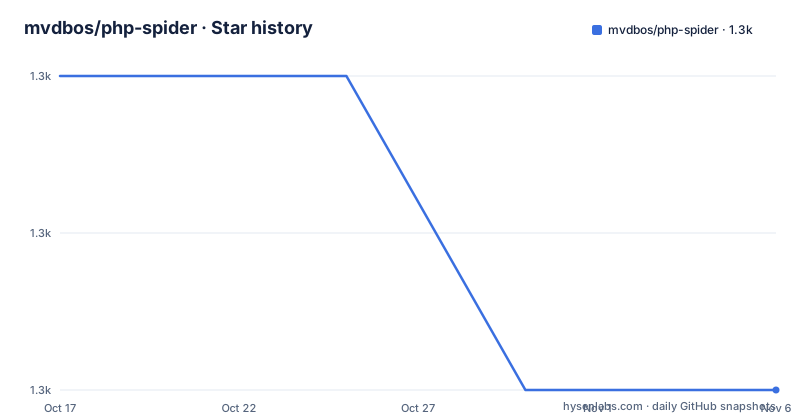
- mvdbos/php-spider1,340 ★ · -2
| Repository | 2026-10-17 | 2026-11-06 |
|---|---|---|
| mvdbos/php-spider | 1.3k | 1.3k |
-2 Stars in the last 20 days, measured from the daily GitHub snapshot. Compare with other projects
Editorial analysis
The parts are the design
php-spider is a configurable and extensible PHP web spider, and the feature list reads as a list of components rather than a list of features. Traversal is one component with two algorithms, breadth-first and depth-first, and the limits are separate controls, so a crawl depth limit, a queue size limit and a maximum download limit are independent. URI discovery is another, and it accepts custom discovery logic based on XPath, CSS selectors or plain PHP. Filtering is split in two, prefetch filters that look at the URI and postfetch filters that look at the resource content, and the built-in set includes robots.txt handling and domain limiting, with custom filters supported in both positions. Requests are handled by their own component, persistence by another, with memory and file handlers provided and custom ones allowed, and the crawl dispatches events so a developer can add behaviour without subclassing the spider. Statistics collection for reporting is built in, and there is a politeness policy. The audience is a PHP developer who wants to assemble these parts rather than write a crawler from scratch.
The spider does not run JavaScript
One line in the README settles the scope of the whole project, and it is worth reading before anything else. This Spider does not support Javascript. That is a hard boundary, and it decides which sites the library is for. A crawler built this way fetches HTML and reads the links out of it, with XPath and CSS selectors as the discovery mechanism, so it handles server-rendered pages and anything whose links are present in the markup. It will not execute a page's JavaScript, will not wait for a client-side router to populate the DOM, and will not see links that only exist after hydration. For a large share of the web, including most documentation sites, blogs, forums and any server-rendered application, that is entirely workable, and the same limitation is what keeps the library small enough to read in an afternoon. It also means the discovery layer has to be written against the markup you actually receive, which is where the XPath and CSS discoverer options earn their place.
A first crawl in five steps
The simple example in the README is short and shows the whole flow. You create the spider with a starting URL, and then you must add a discoverer, because without one the spider does nothing.
$spider = new Spider('http://www.dmoz.org');
$spider->addDiscoverer(new XPathExpressionDiscoverer("//div[@id='catalogs']//a"));
$spider->setMaxDepth(1);
$spider->setMaxQueueSize(10);
Then you attach a listener to the queue manager and to the spider, so that the same handler sees both the queue events and the crawl events, and you run the crawl.
$statsHandler = new StatsHandler();
$spider->getQueueManager()->getDispatcher()->addSubscriber($statsHandler);
$spider->getDispatcher()->addSubscriber($statsHandler);

$spider->crawl();
Afterwards the statistics handler reports what happened, with counts of enqueued, skipped, failed and persisted items, and the downloaded resources are reachable through the downloader's persistence handler, where the example reads the title of each one with an XPath filter.
Fluent configuration for the common settings
For the settings most crawls need, the README shows a fluent style that keeps the configuration in one place, and the method names map directly onto the components.
$spider
    ->setDownloadLimit(50)
    ->setTraversalAlgorithm(QueueManagerInterface::ALGORITHM_BREADTH_FIRST)
    ->setMaxDepth(2)
    ->setMaxQueueSize(500)
    ->setPersistenceHandler(new FileSerializedResourcePersistenceHandler(__DIR__.'/results'))
    ->addDiscoverer(new XPathExpressionDiscoverer('//a'))
    ->addFilter(new AllowedHostsFilter(['example.com']));

$spider->enablePolitenessPolicy(100);
The politeness policy takes a delay between requests to the same domain, and it is optional. The filter used here, AllowedHostsFilter, is a prefetch filter that keeps the crawl inside a set of hosts, which is the guard rail a crawler needs before it walks off into the rest of the internet. The traversal algorithm is chosen by constant rather than by string, which is a small sign of the care taken with the public API.
Caching makes a crawl incremental
The cache support is the feature that turns a one-off crawl into a repeatable job, and it is implemented as a filter plus the file persistence handler. The idea is to keep what was already downloaded and skip it next time, using a fixed spider identifier so that the cache is shared across runs.
$spiderId = 'my-spider-cache';
$spider = new Spider('http://example.com', null, null, null, $spiderId);

$resultsPath = __DIR__ . '/cache';
$spider->getDownloader()->setPersistenceHandler(
    new FileSerializedResourcePersistenceHandler($resultsPath)
);

$maxAgeSeconds = 3600;
$cacheFilter = new CachedResourceFilter($resultsPath, $spiderId, $maxAgeSeconds);
$spider->getDiscovererSet()->addFilter($cacheFilter);
The maximum age is the knob that decides how stale a cached resource may be, with a comment in the example noting that setting it to zero always uses the cache. The filter is added to the discoverer set rather than to the spider directly, which is a detail worth noticing if you write your own filters, since the two positions filter different things.
The default stops the crawl on the first broken response
There is a default in the library that will surprise anyone who points it at a real site, and the README calls it out with a note. By default, the spider stops processing when it encounters a 4XX or 5XX error response. For a link checker that is arguably the right behaviour, since a broken link is the finding, but for a crawler that is meant to keep going it means one missing page ends the run. The documented remedy is a custom request handler, and the link checker example shows it configuring the default Guzzle request handler so it does not fail on 4XX and 5XX responses. That is worth understanding as a design point rather than a workaround, because the failure mode of a crawler that dies on an error response is a crawl that silently covers a fraction of the site, and the fix is a request handler rather than a configuration flag.
The package, the standards and the examples
Installation is a single composer command, and the package is on Packagist under the vendor prefix vdb.
$ composer require vdb/php-spiderThe repository is a conventional PHP library layout, with src/ for the code, tests/ and a phpunit.xml.dist, docs/ with the per filter documentation, bin/, and an example/ directory that is more useful than the README's own snippet. The examples cover the simple crawl, a complex one with logging, caching and filters, basic authentication, a link checker, a health check, persistent request parameters and a complex bootstrap, plus a lib/ directory and a cache/ folder. The contribution rules are explicit, since a pull request is expected to follow the PSR-0, PSR-1 and PSR-2 coding standards, and the tooling in the tree enforces that, with a .php-cs-fixer configuration, phpmd.xml and phpmd-tests.xml for mess detection, a .phan/ directory for static analysis and .run/ for IDE run configurations. The licence is MIT, the repository is not archived, the last push was on 2026-08-04, and the project publishes no GitHub releases, so a consumer pins a Packagist version rather than a tag.
Editorial conclusion
php-spider fits a PHP team that needs a crawler for a server-rendered site, whether that is a link checker, an archive job or a feed of pages to index, because the component boundaries let you replace the request handler or the persistence layer without rewriting the traversal. It does not fit a crawler of a modern single page application, since the project states plainly that it does not support JavaScript, and it does not fit a project that wants a distributed crawler. Verify three things before you build on it: that the default behaviour of stopping on 4XX and 5XX responses matches what you want, because a crawler that stops at the first broken link is not a crawler unless you change the request handler, which the link checker example shows how to do, that the sites you target serve their links in the HTML, and that the politeness policy delay is set to something the target site will tolerate.
Frequently asked questions
What is php-spider?
It is a configurable and extensible PHP web spider. It supports breadth-first and depth-first traversal, crawl depth, queue size and download limits, custom URI discovery with XPath, CSS selectors or plain PHP, prefetch and postfetch filters, caching with a configurable max age, custom request handling, Basic, Digest and NTLM authentication, memory and file persistence handlers, crawl statistics, dispatched events and a politeness policy.
Does php-spider handle pages that need JavaScript?
No. The README states plainly that this Spider does not support Javascript, so it works on server-rendered HTML and cannot see links that only exist after client-side execution. Discovery is done with XPath expressions, CSS selectors or plain PHP against the markup that was fetched.
Why does my crawl stop at the first error?
By default the spider stops processing when it encounters a 4XX or 5XX error response. The link checker example shows the fix, a custom request handler that configures the default Guzzle request handler not to fail on those responses.
How do I install php-spider and cache pages between runs?
Install it with composer require vdb/php-spider, then add a CachedResourceFilter with a fixed spider id and a maximum age to the discoverer set, and a FileSerializedResourcePersistenceHandler on the downloader, so resources downloaded recently are reused rather than fetched again.
Official sources
Add this badge to your README
If you maintain this project, the badge below links readers to this analysis and shows its maintenance status from the daily GitHub snapshot. Paste the markdown into your README; add ?metric=license or ?metric=stars to the image URL for a different field.

[](https://hysenlabs.com/projects/mvdbos-php-spider)Star history chart for your README
[](https://hysenlabs.com/projects/mvdbos-php-spider)Was this useful?