JPL Open Source Rover: the hardware repository for a build-it-yourself six-wheel Mars rover replica
A build-it-yourself, 6-wheel rover based on the rovers on Mars!
At a glance
- What is it?
- nasa-jpl/open-source-rover holds the mechanical, electrical and parts documentation for a scaled-down six-wheel rover built from off-the-shelf parts. The rover code lives in a separate repository, the cost is about $1600, and the community support is volunteer-run.
- Who is it for?
- The JPL Open Source Rover is a sound choice for a school, club or hobbyist who wants a rugged six-wheel platform and is willing to spend around $1600 and learn Linux, ROS and Python along the way. It is the wrong choice for anyone expecting official NASA support, a quick build, or software included in this repository.
- Can I use it commercially?
- Yes. Apache-2.0 is a permissive licence: you can use, modify and sell software built on it, as long as you keep its copyright and licence notices.
- Is it still maintained?
- Yes. The repository last received commits 8 days ago.
- What is it written in?
- Mainly HTML, according to GitHub's language statistics.
Answers come from the project's GitHub data, last synced on November 14, 2026, and from our analysis. They are not legal advice.
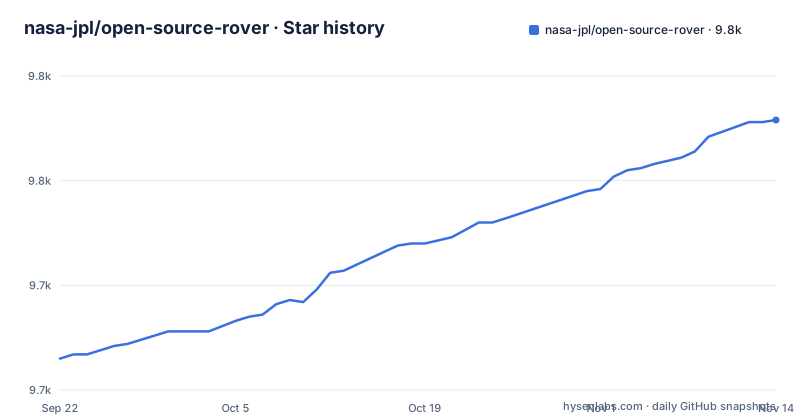
Star history
- nasa-jpl/open-source-rover9,779 ★ · +114
| Repository | 2026-09-22 | 2026-11-14 |
|---|---|---|
| nasa-jpl/open-source-rover | 9.7k | 9.8k |
114 Stars in the last 53 days, measured from the daily GitHub snapshot. Compare with other projects
Editorial analysis
A scaled-down copy of the Mars suspension, built only from off-the-shelf parts
The JPL Open Source Rover is an open source, build-it-yourself, scaled-down version of the six-wheel rover design that JPL uses to explore the surface of Mars. Everything is made from consumer off-the-shelf parts, and the stated purpose is teaching and learning in mechanical engineering, software, electronics and robotics, with a second use as a research platform for rugged terrain.
Three driving mechanics are borrowed from the real vehicles. The rocker-bogie suspension keeps all six wheels in contact with the ground while climbing obstacles. The differential pivot mechanically offloads weight from one side of the rover to the other. Six-wheel Ackermann steering governs where each wheel points and how fast it turns. The project has existed since 2017 and has been through many iterations.
The motivation is outreach. JPL says it releases the plans to inspire the next generation of scientists, engineers and roboticists, and to give budding enthusiasts a fun robotics project that gets them involved sooner and at lower cost. That framing explains why the documentation is aimed at beginners, and also why it is not a maintained commercial product with guarantees.
The spec table has a speed figure with an open condition
The at-a-glance table gives four values: top speed of about 1.6 m/s, 10 motors, aluminum structure and a total cost of about $1600, linked to the parts list and compared with the cost of a TurtleBot 3 Waffle. The speed entry is qualified in the table itself as slow running, subject to motor selection, so it is not a guaranteed number for every build.
Most of the mechanical parts come from GoBilda, and the README points to GoBilda's international shipping options. If you live outside the vendor's main market, shipping and import cost are your problem and are not part of the headline $1600. The README also says cheaper open-source alternatives exist but are slower, less strong and more fragile, so the price is the cost of that extra strength. The aluminum frame and ten motors also mean the build is a substantial piece of hardware, not a desktop kit.
Battery life is measured on one 7.2Ah pack and ends in a hard cutoff
With a 7.2Ah battery and some driving on rough terrain, the project says to expect at least 3 hours of drive time. A chart recorded on rocky terrain plots voltage, current draw and commanded velocity over time. When the voltage falls below 13 to 14 V, the rover powers down.
Two consequences follow. The 3 hour figure belongs to that battery and that kind of driving, so a heavier load or a smaller pack will give less. You can extend runtime with a bigger battery, or by carrying a second one to swap out. The README also warns that discharging a LiPo battery too far drastically shortens its life and can make it hard or impossible to recharge, so the power-down threshold is a protection you should not try to bypass.
The rover's brain is a Raspberry Pi, and its code is in another repository
A Raspberry Pi is the brain of the rover, chosen for versatility, accessibility and simplicity. Any method you can use to communicate with a Raspberry Pi, including Bluetooth, WiFi and USB devices, can be wired into the control system.
This repository is the hardware side. Its top level holds electrical, mechanical, parts_list, expansion and examples directories, plus the documentation configuration. All code is in a separate repository called osr-rover-code, which also carries the step-by-step setup instructions. Anyone cloning only this repository to get a running robot will find no firmware. Plan to work across both, and make sure the code release you pick matches the hardware design you build.
Where machining is optional and where skills are not
The project claims that no prior skills or knowledge are required. The Skills Necessary section is less absolute: it says you need some experience in fabrication, electronics and software. No metal machining should be needed for the base version of the rover, because all parts are off the shelf. Optional expansions may call for metal cutting with a band saw or dremel, drilling, filing and sanding.
Electronics work such as soldering, electrical debugging and wiring is not strictly required, but the README says having access to someone who can help will save a lot of time. For software, basic familiarity with Linux, ROS, Git and Python is described as helpful. In practice, treat soldering and Linux as real prerequisites unless you have a mentor. A head display and robot arm were considered in the design, so expansions are anticipated.
The README adds that most of these skills can be picked up fairly quickly from videos and research. Take that as encouragement, not as a schedule: nothing in it estimates how many hours a first build takes.
Tag numbers do not match the design generation
The release names are easy to misread. Tag v4.0.0, dated 2023-09-14, is titled v2 design. Tag v3.1.0, dated 2023-09-01, is the legacy v1 hardware, described as the last update before the switch to v2. Tag v3.0.0, dated 2021-07-02, was the first stable hardware release.
So version 4 of the repository holds version 2 of the rover. A note at the top of the README directs readers who want the previous major version to the v3.1.0 tree. The practical risk is mixing parts lists or instructions from the two generations. Before you buy anything, check which generation your guide, your parts list and your code repository refer to. The last push to the repository was on 2026-10-22, but the latest tagged release is still the 2023 one.
Support comes from volunteers, and the documentation builds with MkDocs
The recommended place for questions is a Slack group run by members of the general public. The README states that JPL and Caltech have no official affiliation with it. Builders post modifications and add-ons there, and the maintenance note tells you to check issues, pull requests and the Slack forum for upcoming changes. The project carries Open-Source Hardware certification.
The documentation is published on Read the Docs at open-source-rover.readthedocs.io and built with MkDocs. The requirements file pins mkdocs 1.6.1 along with Jinja2 3.1.6 and Markdown 3.10.2, among others. A browser-viewable 3D model of the latest version is hosted on OnShape, and a gallery of community builds, including older versions, sits in the examples directory. Do not expect an official help desk: if your build fails, the answer will come from other builders.
Editorial conclusion
The JPL Open Source Rover is a sound choice for a school, club or hobbyist who wants a rugged six-wheel platform and is willing to spend around $1600 and learn Linux, ROS and Python along the way. It is the wrong choice for anyone expecting official NASA support, a quick build, or software included in this repository. Before ordering parts, confirm that you are working from the v4.0.0 design and the matching code repository.
Frequently asked questions
Is the Curiosity rover still running?
This repository does not report on NASA's Curiosity. It documents a scaled-down, build-it-yourself rover based on the six-wheel design JPL uses to explore Mars.
Does NASA use ROS?
The repository does not say what NASA's flight rovers run. For the open source rover, basic familiarity with Linux, ROS, Git and Python is described as helpful, and the code is in the osr-rover-code repository.
How much does one Mars Rover cost?
The cost of NASA's missions is not given here. The scaled-down open source rover has a total cost of about $1600, according to its parts list, roughly the price of a TurtleBot 3 Waffle.
Is rover still active?
The repository was last pushed to on 2026-10-22, while the newest tagged release, v4.0.0, is from 2023-09-14. The maintainers point readers to issues, pull requests and the Slack forum for upcoming changes.
Official sources
Add this badge to your README
If you maintain this project, the badge below links readers to this analysis and shows its maintenance status from the daily GitHub snapshot. Paste the markdown into your README; add ?metric=license or ?metric=stars to the image URL for a different field.

[](https://hysenlabs.com/projects/nasa-jpl-open-source-rover)Star history chart for your README
[](https://hysenlabs.com/projects/nasa-jpl-open-source-rover)Was this useful?