nayafia/microgrants: A Directory for Small Project Funding
A list of microgrant programs for your good ideas
At a glance
- What is it?
- nayafia/microgrants is a curated directory of microgrant programs for students, creators, researchers, open source developers, and early-stage builders. Its breadth is useful, but the repository does not verify current application status or provide a common application workflow.
- Who is it for?
- Use nayafia/microgrants as a starting point if you need to identify several small funding programs and can independently check their current eligibility, deadlines, and application requirements. Do not treat it as a complete grant database or a source of authoritative award status.
- Can I use it commercially?
- Yes. CC0-1.0 is a permissive licence: you can use, modify and sell software built on it, as long as you keep its copyright and licence notices.
- Is it still maintained?
- Yes. The repository last received commits 151 days ago.
- What is it written in?
- GitHub does not report a main language for this repository.
Answers come from the project's GitHub data, last synced on November 6, 2026, and from our analysis. They are not legal advice.
Star history
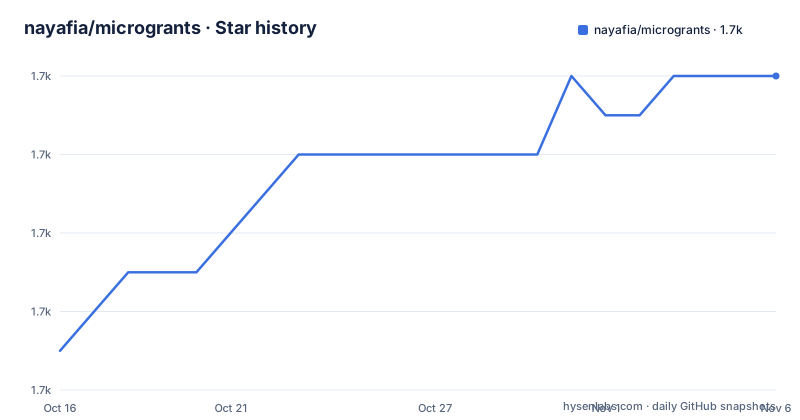
- nayafia/microgrants1,728 ★ · +7
| Repository | 2026-10-16 | 2026-11-06 |
|---|---|---|
| nayafia/microgrants | 1.7k | 1.7k |
7 Stars in the last 21 days, measured from the daily GitHub snapshot. Compare with other projects
Editorial analysis
What nayafia/microgrants Actually Contains
nayafia/microgrants solves a discovery problem rather than a payment or application problem. It gathers microgrant and fellowship opportunities in one README, with short descriptions that let readers compare award size, eligible audience, project area, and terms. The listings cover student projects, scientific and engineering work, arts, community activity, research, entrepreneurship, games, and open source software.
The catalog is not uniform. Some entries are unrestricted or low-paperwork grants. Others are fellowships, contests, community-voted events, investment opportunities, or grants tied to a particular region or mission. Atomic Fellowship, for example, lists a $5,000 no-strings-attached grant for students and mentions a possible additional $40k investment from gradCapital. Da Vinci Fellowship is described as an equity-free €150,000 grant, which places it at a different scale from the small awards that dominate the directory.
This variety makes the repository useful for early exploration. It also makes direct comparison necessary. The README states that amounts are in USD unless otherwise specified, but entries also use INR, euros, and percentages. A reader should preserve those distinctions rather than convert every listing into one simplistic category.
The directory originated from the author's experience running Helium Grants, which offered $1K no-strings-attached grants and is now on hiatus. The repository also includes templates for people interested in starting their own microgrant program. Its visible top-level structure consists of `README.md`, `LICENSE.md`, and `templates/`.
How the Funding Directory Is Structured
The data flow is editorial and human-readable. Each entry is placed in `README.md` as a heading, followed by the program's external URL and an italic summary. There is no database query, API, eligibility filter, account system, or standardized application schema. The reader searches the Markdown file, identifies relevant headings, then follows a link to the external program.
That format makes the project light to publish and easy to scan, but it imposes the work of normalization on the reader. Some descriptions state exact amounts, such as Cactus Capital's $50 to $100 range and Fortitude Fund's $1,000 initial grant with a possible $2,500 Next Level Grant. Others describe a process instead, such as 5x5 Night, where selected creators present a $5,000 next step and meet potential collaborators.
Eligibility is similarly inconsistent by design. Bellare Grants is limited to Indian initiatives in named fields, Bed-Stuy Create & Connect Fund focuses on Bedford-Stuyvesant, and Clarity Health Fund concerns psychedelics and drug policy. NLNet Foundation applies open licensing and open standards requirements to eligible projects. Readers cannot reliably filter the README for those constraints.
The repository layout also has a visible boundary. The README ends at the heading for Patch Grant without a corresponding description or URL in the visible text. Based on the repository layout, the `templates/` directory adds another use case, but the README does not document its individual files.
Finding and Using a Relevant microgrant
There are no installation steps because nayafia/microgrants is not an application package or service that must be built. The README directs readers to the directory and to the external links beside each listing. A first useful pass is therefore to open `README.md`, search for terms related to the project, and compare the few entries that match both audience and subject.
For a student planning a science or engineering project, the relevant comparison points include Atomic Fellowship, listed at $5,000 for students and backed by gradCapital, and Feather Grants, listed at INR 15,000 for students. For an open source developer, NLNet Foundation is a more specific entry. It offers $5K to $50K and requires releases under open licenses plus open standards where possible.
For a crypto-related creator, cache money grants lists $5K grants paid in BTC, ETH, or SOL. That payment method is a material difference from a bank-based grant and should be considered before assuming the listing is suitable. Mitzvoters is described as funding $500 grants through $50 per month in collective giving, which makes it structurally different from a one-time institutional award.
After selecting a listing, open its linked website and look for current eligibility, deadlines, review dates, application forms, award conditions, and payment details. The README does not provide those details, and it does not document a way to validate whether a linked program remains open. The first real use is research followed by external verification, not an application submitted through this repository.
Examples Across Creators, Researchers, and Communities
The directory's breadth is its strongest editorial feature. Echoing Green offers a two-year full-time fellowship with $80,000 for individuals and $90,000 for partnerships, plus a flexible benefit stipend. That is a substantial commitment rather than a small project grant. It belongs in the repository because the README mixes fellowship and grant opportunities, but an applicant should not classify it as ordinary seed funding.
Other entries are tied closely to place or identity. The Bed-Stuy Create & Connect Fund provides $1,000 grants to artists, cultural practitioners, community builders, organizers, and makers in Bedford-Stuyvesant. The Native Cultures Fund lists $1,000 to $10,000 for projects supporting California native culture, arts, knowledge systems, and lifeways. Such entries can be highly relevant for a local applicant and unsuitable for everyone else.
The list also includes projects with an event or community-review mechanism. At a 5x5 Night event, the community votes on ideas, and selected creators explain a $5,000 step intended to move an idea forward. Awesome Foundation chapters are described as supporting projects through $1,000 microgrants, usually monthly. These models differ in how money is awarded and what evidence an applicant needs.
The result is not a ranked recommendation system. The headings have no visible priority labels, update dates, application deadlines, or success-rate data. The reader must interpret the descriptions. Phrases such as "runs irregularly," "usually given out monthly," and "new fellowship and grant program" signal different schedules without defining a dependable application calendar.
Why Funding Terms Need Independent Verification
A linked URL is not proof that a program is currently accepting applications. Programs can change award amounts, geographic restrictions, review cycles, and paperwork requirements after a directory description is written. The README does not include per-entry verification dates, so it cannot tell a reader which details were checked most recently.
Some restrictions are explicit. Cactus Capital targets student builders at any stage in a program run by two northern Virginia high schoolers. Fortitude Fund focuses on northeast Indiana. Bellare Grants is for Indian initiatives. These details prevent an entry from functioning as a general-purpose funding option.
There are also different forms of financial support. The possible investment mentioned with Atomic Fellowship should not be treated as equivalent to a grant. Gumroad's Creators Fund is described through an annual allocation with individual grants between $500 and $5,000, while the overall allocation is described as more than $50,000. Failure to distinguish pool size from individual award size can create a wrong expectation.
The repository is most reliable as a launch point. It identifies names and links, allowing an applicant to discover options that would not share a single search query. The external program page remains the source that must confirm terms. The README does not state when each entry was last checked, whether every URL works, or whether a listed grant will recur.
Maintenance, Licensing, and the Cost of Keeping Entries Accurate
The repository is not archived. Its last push was on 2026-06-10, and it has no GitHub releases. There is no release history against which changes to individual listings can be assessed. Maintenance activity must be judged from repository updates rather than inferred from the age of every external grant program.
The repository uses the CC0-1.0 license. That designation applies to the curated material and templates in this repository, not automatically to the websites, applications, or funds operated by the listed organizations. Reusing an entry does not grant access to a program's funds, remove its eligibility rules, or replace the need to check its terms. This is a repository licensing point, not advice about a particular grant agreement.
There is no stated release process or documented policy for correcting stale URLs. That leaves an ongoing editorial cost on the maintainer or contributors: programs must be removed or revised when their schedules change, and visitors need to recognize that the directory can outlive the facts attached to a specific award. The repository does not claim automated verification, and its Markdown structure does not indicate one.
For users, the practical maintenance cost is checking several external pages each time a funding search matters. For an organization considering reuse, the absence of structured metadata means it must parse headings, links, amounts, currencies, and constraints itself. The CC0-1.0 license removes a stated restriction on reuse, but it does not solve data normalization or source verification.
Editorial conclusion
Use nayafia/microgrants as a starting point if you need to identify several small funding programs and can independently check their current eligibility, deadlines, and application requirements. Do not treat it as a complete grant database or a source of authoritative award status. Before applying, open the linked program page, confirm that the opportunity still accepts applications, and compare its amount, restrictions, reporting requirements, and payment method with your project.
Frequently asked questions
How do I install or use nayafia/microgrants?
There is no installation step because the repository is a Markdown directory, not a software package. Open `README.md`, find a relevant program, and follow its external URL.
Does nayafia/microgrants cover grants for open source developers?
Yes. NLNet Foundation is listed with $5K to $50K for open source projects by independent researchers and developers, with open licensing and open standards requirements where possible.
Does nayafia/microgrants show which applications are currently open?
No. The README does not provide application deadlines, current availability checks, or per-entry update dates. Each linked program must be checked directly.
Can I use the nayafia/microgrants list under a permissive license?
The repository lists CC0-1.0 as its license. That license covers repository content, while individual grant programs retain their own eligibility and funding terms.
Official sources
Add this badge to your README
If you maintain this project, the badge below links readers to this analysis and shows its maintenance status from the daily GitHub snapshot. Paste the markdown into your README; add ?metric=license or ?metric=stars to the image URL for a different field.

[](https://hysenlabs.com/projects/nayafia-microgrants)Star history chart for your README
[](https://hysenlabs.com/projects/nayafia-microgrants)Was this useful?