nivu/ai_all_resources: A Link Index for Self-Taught Machine Learning
A curated list of Best Artificial Intelligence Resources
At a glance
- What is it?
- The repository is a curated list of courses, YouTube playlists and blog authors, not a library or a framework. Its value depends entirely on whether the maintainer keeps the links alive, and the README gives no stated criteria for inclusion.
- Who is it for?
- Adopt this if you are assembling a self-study path and want a pre-filtered starting point for university lecture series and long-form tutorial channels; the Stanford, CMU, MIT and UCL playlists listed in the README are the part that is hardest to find by searching. Do not adopt it if you need versioned, tested code, because the repository ships links rather than software.
- Can I use it commercially?
- The repository metadata does not identify a licence. Check the project’s published terms and any component-specific licences before reuse.
- Is it still maintained?
- Yes. The repository last received commits 67 days ago.
- What is it written in?
- Mainly Jupyter Notebook, according to GitHub's language statistics.
Answers come from the project's GitHub data, last synced on November 25, 2026, and from our analysis. They are not legal advice.
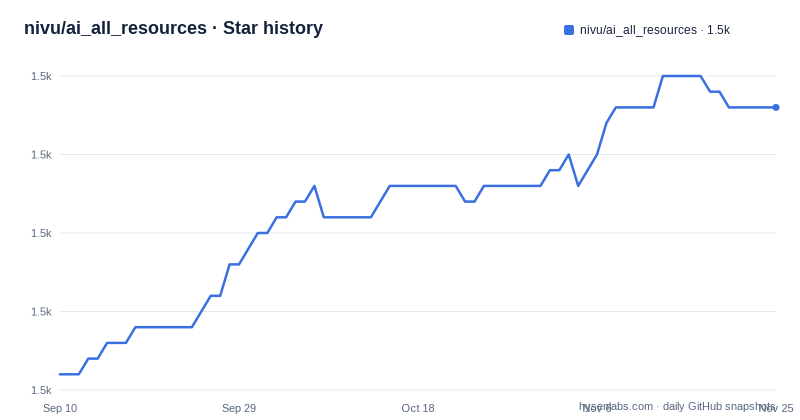
Star history
- nivu/ai_all_resources1,543 ★ · +17
| Repository | 2026-09-10 | 2026-11-25 |
|---|---|---|
| nivu/ai_all_resources | 1.5k | 1.5k |
17 Stars in the last 76 days, measured from the daily GitHub snapshot. Compare with other projects
Editorial analysis
What This Repository Actually Contains
The README describes the project as an "Ultimate Compilation of AI Resources for Mathematics, Machine Learning and Deep Learning." That phrasing is accurate about the ambition and slightly misleading about the format. There is no installable artifact here. The repository is a Markdown index. Its entries point outward to Coursera, Udacity, YouTube, fast.ai, Distill, and personal blogs. The primary language field says Jupyter Notebook. Treat the notebook label as a repository classification rather than a claim that you will be running the maintainer's code.
The audience is the self-directed learner. The README's own framing, "Knowledge Not Shared is wasted," and the section titled "Why Data Science and how to get started?" point at someone deciding where to begin rather than someone debugging a training loop. If you already know which paper to read next, this list will not help you. If you are staring at twenty tabs of half-finished tutorials, the structure is the point: it separates introductory material, MOOCs, university lecture series, and individual explainers into distinct blocks.
The Named Authors Are the Real Curation
The opening block lists contributors whose material the collection draws on: Andrej Karpathy, Brandon Rohrer, Andrew Trask, Jay Alammar, Sebastian Ruder, Distill, StatQuest with Josh Starmer, sentdex, Lex Fridman, 3Blue1Brown, Alexander Amini, The Coding Train, and Christopher Olah. This is the most defensible part of the repository. Each name corresponds to a body of work with a recognizable style, and the list avoids the common failure of mixing peer-reviewed lectures with SEO-driven blog spam.
What the README does not give is a rationale per entry. There is no annotation explaining why Karpathy's blog is listed alongside Alammar's visual explainers, or what a reader should go to each for. A curated list without per-item notes is closer to a bookmark export than to editorial judgement. The maintainer's voice appears once, in the Communities to Follow section, which promotes AI Coimbatore and the TensorFlow User Group Coimbatore with Telegram, Facebook and Meetup links. That local community focus is fine, but it tells you the list grew out of a specific regional scene rather than a systematic survey of the field.
How the README Is Organised and How to Read It
The structure runs from orientation to depth. It opens with career and getting-started links, then a short Intro to ML block, then a section called Anyone can do Machine Learning that points at Google's Teachable Machine for training a model on your own images, sounds and poses without code. From there it moves to MOOCs (Andrew Ng's Stanford course on Coursera, Udacity's Intro to Machine Learning and Intro to TensorFlow, fast.ai's Practical Deep Learning for Coders v3), then to Courses from Top Universities, then to YouTube ML Playlists.
The university block is the densest and the most useful. Under Stanford it lists CS221, CS229, CS230, CS231n, CS224n, CS234, CS330 and CS25, each with an instructor name and a YouTube playlist link. Carnegie Mellon entries cover advanced NLP, neural networks for NLP, multilingual NLP, multimodal machine learning, introduction to deep learning, and a low-resource NLP bootcamp, all attributed to Graham Neubig or Louis-Philippe Morency or Bhiksha Raj and Rita Singh. MIT contributes 6.S191, 6.S094 and 6.S192. UCL contributes David Silver's reinforcement learning course. Because the entries are playlists rather than single videos, the list functions as a set of semester-length commitments, and a reader should treat it that way rather than as a queue to clear.
Getting Started With the List Itself
There is nothing to install. The repository has no releases, no package manifest, and no documented build step. The practical workflow is to clone or read the README and follow the outbound links. A shallow clone keeps the index local:
git clone --depth 1 https://github.com/nivu/ai_all_resources.git
After that, the only file that matters is README.md at the repository root on the master branch.
The Topics field gives a sense of intended coverage: convolutional-neural-networks, decision-trees, gan, kmeans, knn, random-forest, regression, reinforcement-learning, rnn, support-vector-machine, tensorflow, statistics, mathematics. Note the mismatch between that breadth and the README's visible content. The topic tags promise classical algorithms and statistics; the sections that appear in the README lean heavily toward deep learning courses and video explainers. If you came for decision trees or k-means specifically, verify the corresponding section exists before assuming it does.
Where the List Breaks Down
Link rot is the structural risk. Every entry is an external URL, and the README includes deep links to specific YouTube playlists, Coursera course pages, and Udacity classroom URLs. Udacity's classroom links in particular are the kind of path that changes when a course is retired. The last push timestamp is the only signal of activity, and it says nothing about whether the links inside still resolve.
The second limitation is the absence of a licence. The repository metadata does not state one. For a list of links that is a smaller problem than for code, because you are not redistributing the maintainer's implementation, but it does mean the terms under which you may copy the compilation are unclear. If you plan to fork the list into an internal onboarding document, that is the question to settle first, and it is a question for whoever handles licensing at your organisation rather than something this article can answer.
The third limitation is staleness by omission. Fast-moving areas of the field are represented by whatever was current when the entry was added. There is no date column, no "last verified" marker, and no deprecation note. A reader cannot tell from the README whether a given playlist reflects the state of the art or the state of the art three years ago.
How It Compares With Structured Alternatives
The closest comparison is fast.ai, which the README itself links. The difference in approach is fundamental. fast.ai publishes its own course with its own notebooks, its own library, and a defined sequence through the material. The repository here publishes pointers to other people's material and imposes an ordering by section heading. With fast.ai you get a prescribed path and runnable code; with this list you get a menu and you supply the discipline.
A second comparison is a maintained syllabus such as a university course page for CS229 or CS231n. Those pages pair each lecture with readings, assignments and deadlines. The repository's entries strip that scaffolding down to a playlist URL. That is a deliberate trade: less structure, more freedom to pick and mix. It also means the list cannot tell you when you are ready to move from the Intro to ML block to the Stanford lecture series. Nothing in the README defines prerequisites between sections, so the ordering is presentational rather than pedagogical.
Maintenance Cost and What to Check Before Adopting
If you use this as a personal reference, the cost is near zero and the risk is a dead link. If you fork it for a team, the cost is the ongoing work of verifying outbound URLs, which is manual here because no tooling is described. The repository has no releases, so there is no upgrade cadence to track and no changelog to read. You pull the README and you get whatever state it is in.
Before you commit to it, check three things in the repository itself. First, open the commit history on master and look at how recent commits relate to link changes versus new entries; that tells you whether maintenance is happening. Second, confirm whether a licence file exists at the root, because the metadata does not name one. Third, read the full README beyond the truncated view and confirm that the sections you need (statistics, classical algorithms, mathematics) are actually populated rather than only present in the topic tags. The repository is a reasonable starting shelf. It is not a substitute for a syllabus, and it will not tell you what to skip.
Editorial conclusion
Adopt this if you are assembling a self-study path and want a pre-filtered starting point for university lecture series and long-form tutorial channels; the Stanford, CMU, MIT and UCL playlists listed in the README are the part that is hardest to find by searching. Do not adopt it if you need versioned, tested code, because the repository ships links rather than software. Before relying on it, open the repository and check the commit history on the default branch to see whether link rot is being repaired, and confirm the licence file, since the repository metadata does not state one.
Frequently asked questions
What does nivu/ai_all_resources actually contain?
A README of links plus sixteen root entries: directories for autonomous_car, computer_vision, data_engineering, gans, generative_ai, reinforcement_learning, robotics, stat_prob, talks, webinars and new_resources, and standalone files ai_job_concepts.md and tinyml.md. There is no LICENSE file at the root.
Who maintains nivu/ai_all_resources and who is it for?
The README credits Navaneeth Malingan and links to an Instagram profile and a LinkedIn profile. The communities section points at AI Coimbatore and TensorFlow User Group Coimbatore, both with Meetup, Telegram and Facebook links.
Which university courses does nivu/ai_all_resources list?
Stanford CS221, CS229, CS230, CS231n, CS224n, CS234, CS330 and CS25; Carnegie Mellon LTI 11-711, 11-747, 11-737, 11-777 and 11-785 plus a low resource NLP bootcamp; MIT 6.S191, 6.S094 and 6.S192; and UCL COMP M050. All are YouTube playlists or channel pages.
Can I fork or reuse nivu/ai_all_resources?
No license is stated in the metadata and no LICENSE file exists at the root, so the terms are unstated rather than permissive. The linked courses belong to their own authors under their own terms, and the file does not address that either.
Official sources
Add this badge to your README
If you maintain this project, the badge below links readers to this analysis and shows its maintenance status from the daily GitHub snapshot. Paste the markdown into your README; add ?metric=license or ?metric=stars to the image URL for a different field.

[](https://hysenlabs.com/projects/nivu-ai-all-resources)Star history chart for your README
[](https://hysenlabs.com/projects/nivu-ai-all-resources)Was this useful?