Novu: One API for Product Notifications and Agent Conversations
The open-source communication infrastructure for agents and products
At a glance
- What is it?
- Novu is an open-source communication layer that unifies product notifications and agent messaging across channels. This review covers its architecture, setup, limitations, and when to choose it.
- Who is it for?
- Adopt Novu if you are building a product that needs multi-channel notifications or an agent that must converse on Slack, Teams, Telegram, or email, and you want one API instead of per-channel webhooks. Avoid it if you need deep control over every provider's native features or if your agent logic must be tightly coupled to a specific platform's message format.
- Can I use it commercially?
- Check first. The repository uses a licence we do not classify automatically, so read its LICENSE file before any commercial use.
- Is it still maintained?
- Yes. The repository received new commits within the last day.
- What is it written in?
- Mainly TypeScript, according to GitHub's language statistics.
Answers come from the project's GitHub data, last synced on November 15, 2026, and from our analysis. They are not legal advice.
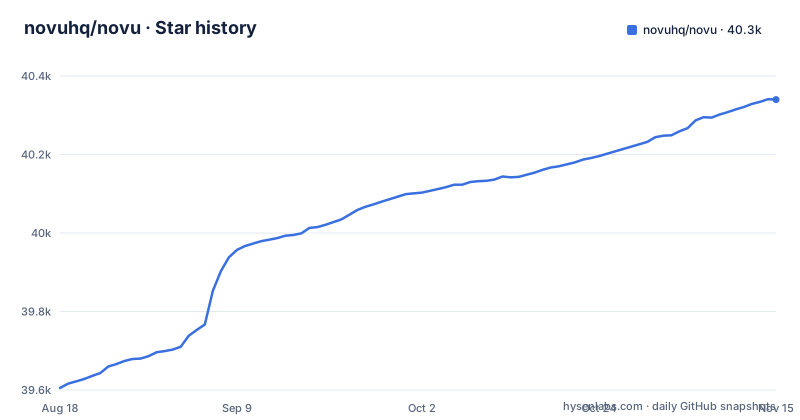
Star history
- novuhq/novu40,340 ★ · +735
| Repository | 2026-08-18 | 2026-11-15 |
|---|---|---|
| novuhq/novu | 39.6k | 40.3k |
735 Stars in the last 89 days, measured from the daily GitHub snapshot. Compare with other projects
Editorial analysis
The Problem Novu Targets
Software is shifting from one-way notifications to conversational interactions. Users want to reply to a notification, ask a follow-up question, or continue a thread. Building that from scratch means integrating with every channel your users live on: Inbox, Email, SMS, Push, Chat, Slack, Microsoft Teams, Telegram, and more. Each channel has its own API, webhook format, and quirks. Novu exists to be that layer, so you do not rebuild Inbox feeds, provider integrations, and channel webhooks every time. The README frames this as a shift from broadcast to meaningful dialog. The target audience is twofold: product teams that need multi-channel notification workflows, and companies building agents that need a voice on real communication channels.
Two Products, One Foundation
Novu offers two ways to build, but they share a single API and a unified conversation model. The first is communication infrastructure for products: send notifications across Inbox/In-App, Email, SMS, Push, and Chat through one API, with workflows, digests, and an embeddable Inbox component. The second is Agent Communication Infrastructure (ACI), which connects any agent you have already built to Slack, Microsoft Teams, Telegram, WhatsApp, email, and an In-App Inbox. The key phrase in the README is 'You build the agent. Novu gives it a voice.' Novu is not the agent itself. It receives inbound messages from each channel, normalizes them into one consistent shape, routes them to your agent, and sends responses back out. This bidirectional messaging is the core of ACI, and it is a different problem from sending a one-way notification.
How the Unified Conversation Model Works
The mechanism is a normalization layer. Each channel has its own message format and webhook quirks. Novu abstracts those away behind a single conversation model. When a user sends a message on Slack, Novu receives it, converts it to that unified shape, and forwards it to your agent. Your agent replies, and Novu converts the response back to the channel's expected format. The README lists best practices built in: conversation threading, reactions, channel-aware formatting, and actions. The trade-off is that you lose direct access to channel-specific features unless Novu exposes them.
Getting Started: Commands and Components
The README directs you to create a free account on the dashboard and follow the instructions there. That is the primary onboarding path. For ACI, there is a quick start: run 'npx novu@latest connect' to try Novu Connect, which integrates an existing Claude Managed Agent as a teammate in Slack, Telegram, or Email in under two minutes. For the Inbox component, you can use the React version via the React quickstart in the Novu docs, or build your own using the API and SDK. The README notes that React Native, Vue, and Angular support are coming soon. So the documented setup path is account-based.
Limitations and Wrong Tool Cases
The README is honest that Novu does not constrain your agent logic, but that also means you must handle agent reasoning yourself. If you are looking for a framework that builds the agent, Novu is not it. Another limitation is the channel list: WhatsApp is mentioned in the ACI section, but the main product list does not include it, so verify which channels are actually supported for which product. The embeddable components are not complete across frameworks. Vue and Angular are coming soon, so if you are on those stacks, you will need to build your own UI against the API. Also, the license is listed as NOASSERTION, which is a red flag for adoption without legal review.
Alternatives and the Difference in Approach
The main alternative is building your own integration layer. You would write a webhook handler per channel, normalize messages yourself, and maintain that as each platform changes its API. That is exactly what Novu claims to replace. For agent communication, you could use a platform-specific SDK, say the Slack Bolt framework, and build your agent directly inside Slack's ecosystem. That gives you native access to Slack features but locks you to one channel. Novu's approach is channel-agnostic: integrate once and route to many. The difference is in the abstraction level. Novu abstracts the channel plumbing, while a direct SDK gives you more control but more work per channel.
Maintenance and Upgrade Cost
The repository is actively maintained, with recent releases including @novu/framework v2.14.0 on 2026-09-28 and @novu/nextjs v3.19.2 on 2026-09-07. That suggests a steady release cadence. The cost of maintenance is on the consumer side: you depend on Novu's API and SDKs, so when they release breaking changes, you must upgrade.
Editorial conclusion
Adopt Novu if you are building a product that needs multi-channel notifications or an agent that must converse on Slack, Teams, Telegram, or email, and you want one API instead of per-channel webhooks. Avoid it if you need deep control over every provider's native features or if your agent logic must be tightly coupled to a specific platform's message format. Before committing, verify the exact channel list and the state of the embeddable components for your framework, since the README notes React Native, Vue, and Angular support as coming soon. Also check the license, which the repository lists as NOASSERTION, meaning you need to inspect the actual license file before using it commercially.
Frequently asked questions
What does Novu stand for?
The README does not expand the name. It describes the project as open-source communication infrastructure for agents and products, built around one API and one unified conversation model covering Inbox, Email, SMS, Push, Chat, Slack, Microsoft Teams, and Telegram.
What are the benefits of using Novu?
For products, one API across Inbox and In-App, email, SMS, push, and chat instead of a separate provider integration per channel, plus a workflow engine with branching, a digest engine, and embeddable Inbox and preferences components. For agents, ACI normalizes inbound channel messages into one shape and sends replies back out, so you integrate once rather than per platform.
Is Novu free to use?
The repository ships `LICENSE-MIT` next to `LICENSE-ENTERPRISE` and a separate `EE-PACKAGES-LICENSE`, with an `enterprise/` directory, which is why the project does not resolve to a single license identifier. The documented getting-started path is a free account on the hosted dashboard rather than a self-hosted install.
Official sources
Add this badge to your README
If you maintain this project, the badge below links readers to this analysis and shows its maintenance status from the daily GitHub snapshot. Paste the markdown into your README; add ?metric=license or ?metric=stars to the image URL for a different field.

[](https://hysenlabs.com/projects/novuhq-novu)Star history chart for your README
[](https://hysenlabs.com/projects/novuhq-novu)Was this useful?