nati.ve has no stable channel, an unsigned Windows build and a macOS app that cannot sign in
Adaptive native Nextcloud client for mobile and desktop, with dynamic support for the wider Nextcloud app ecosystem.
At a glance
- What is it?
- An unofficial Kotlin and Compose client for Nextcloud that renders installed server apps as native interfaces instead of embedded web pages, using a typed runtime that infers what it can and refuses to invent the rest. It is alpha software distributed as dated nightly builds, and the packaging state is uneven across five platforms.
- Who is it for?
- nati.ve suits someone willing to test a Nextcloud client on a secondary device, who reads release notes before installing and who wants server apps rendered as native surfaces rather than web views in 2026. It does not suit a production deployment, since prereleases are explicitly not a replacement for every production workflow or the only copy of important data, and the platform gaps are uneven: macOS cannot sign in yet, Windows is unsigned, and macOS covers Intel only.
- Can I use it commercially?
- Yes, with strict conditions. AGPL-3.0 is a network copyleft licence: if people use a modified version over a network, for example as a hosted service, you must offer them its source code under the same licence.
- Is it still maintained?
- Yes. The repository last received commits 5 days ago.
- What is it written in?
- Mainly Kotlin, according to GitHub's language statistics.
Answers come from the project's GitHub data, last synced on November 20, 2026, and from our analysis. They are not legal advice.
Star history
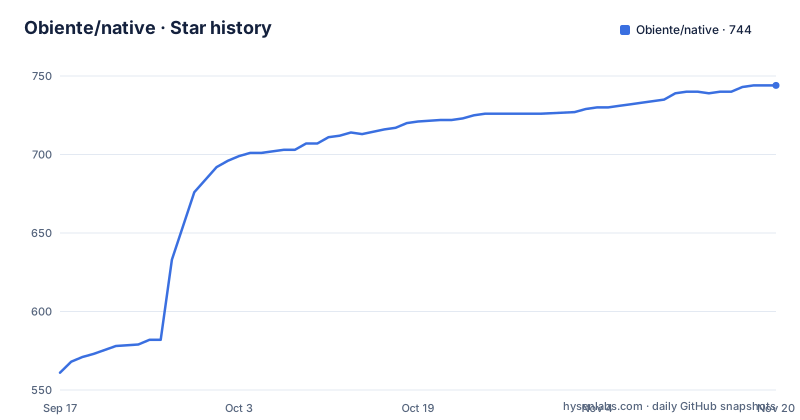
- Obiente/native744 ★ · +183
| Repository | 2026-09-17 | 2026-11-20 |
|---|---|---|
| Obiente/native | 561 | 744 |
183 Stars in the last 64 days, measured from the daily GitHub snapshot. Compare with other projects
Editorial analysis
Nightly is the only update track inside the app
The download table offers a latest build and an explicit nightly for each platform, but the note above it settles what that means. At the review date, Nightly was the default and the only selectable in-app update track for direct installations. The tags themselves give the same answer from the other side, since the three most recent releases are dated nightlies carrying a timestamp, a run counter and a short commit hash, such as a build from late September labelled with run 2285. There is no stable or release channel in that list, so an installed client has one path to update and no way to ask for a quieter one from inside the app. The project labels itself alpha and says the prereleases are for testing and contribution rather than as a replacement for a production workflow.
macOS cannot sign in and Windows is not signed
Two packaging limitations are stated plainly and both matter before download. The macOS package is described as a packaging preview that cannot sign in yet, which makes it useful for judging the interface and nothing else. Windows builds are not Authenticode-signed, so a Windows install carries an unverified publisher. Checksums exist, and there is a Windows provenance verification step, but both live in the current release notes rather than in the download table itself, so the table is not self-sufficient for a security-conscious install. The macOS row is also narrower than the others: it is labelled an Intel preview, which leaves Apple Silicon unlisted while Android, both Linux package formats and Windows x86-64 all have rows.
Five download rows for a product still being shaped
The quick download table covers five targets. Android 8.0 and later gets an APK. Debian and Ubuntu get a DEB, Fedora and RHEL get an RPM, and Windows x86-64 gets an MSI. macOS gets a DMG, labelled as an Intel preview. Every row has both a latest build and an explicit nightly link behind short redirect paths rather than direct release URLs, which means the file you receive is whatever the redirect resolves to at the moment you click. Nothing in the table describes a store listing, so distribution is entirely through those redirects and the releases page. The platform spread is genuinely wide for an alpha client, and the release notes are where the per-platform caveats live.
Discovery is deterministic before it is heuristic
The runtime's contract is the most interesting sentence in the project. It can infer field roles, relationships, component families, labels and useful entry points from what a server app exposes, and it does that before reaching for anything clever. What it may not do is invent an endpoint, a payload, a permission, a resource ID or a retry guarantee. That is a trust boundary written as a prohibition rather than as a feature list, and it is what separates this approach from wrapping every Nextcloud app in a generic screen. Three documents at the repository root hold the details, `DYNAMIC_APP_DESCRIPTOR.md`, `NATIVE_SCHEMA.md` and `ADAPTER_ARCHITECTURE.md`, covering the trust and execution boundaries the runtime operates inside.
An adapter must extend the runtime, not fork a second app
Hand-written code is allowed, but only under a narrow condition and with a structural requirement attached. Small verified adapters are welcome when they supply meaningful behaviour that cannot be inferred safely, which is the escape hatch for the cases the deterministic pass deliberately refuses to guess. The structural part is stricter: an adapter enhances the same typed runtime rather than creating an isolated second app. That rules out the common escape route of special-casing one app into its own private screen with its own navigation and its own idea of permissions, which is exactly the fragmentation the project set out to remove. The distinction is the whole argument in one clause, and it is why the adapter architecture gets its own document alongside the schema and descriptor specifications.
The shared layer does plumbing, components do workflow
The division of labour is explicit. A common layer supplies identity, permissions, caching, actions, search, settings, navigation and platform behaviour, and those are the things that should look and behave identically everywhere. Semantic components supply the workflow, and the requirement there is that each app keeps its own character: a table should behave like a table, a deck like a board, a mailbox like mail, a recipe like something a person can cook from, and an expense project like a financial workspace. The stated goal is larger than putting many apps behind one icon, with Nextcloud intended to feel like a single operating-system service covering files, media, Talk, calendars, contacts, tasks, mail, notes, music, recipes, boards, tables and budgets. Administration surfaces appear only where permissions and authentication make them safe.
A 0.1.0 Rust crate with four dependencies sits under a Kotlin app
The repository is Kotlin-first, with an Android application module, a Gradle wrapper, a `.java-version` file and a Compose-flavoured asset pipeline, but the top level also carries a Cargo manifest and lockfile. That crate is `nextcloud-native-runtime`, version 0.1.0, edition 2024, licensed AGPL-3.0-or-later and described as a typed semantic compiler for adaptive native clients. Its dependency list is four crates, `serde` with derive, `serde_json`, `thiserror` and `url`, plus `pretty_assertions` for tests. There is no HTTP client and no async runtime in that list, which confirms the crate compiles descriptions rather than talking to a server. The one platform-specific block is Windows-only and pulls the `windows` crate features for storage providers, storage streams, storage search and cryptography, which is how native file integration is done on that platform.
Three review dates, and each points somewhere different
Freshness is handled by dating things, and the dates do not agree. A status snapshot says it was last reviewed on 2026-08-20 and warns that implementation, compatibility, packaging and release availability may have changed since, pointing at the GitHub Releases page as the source of truth for published builds and their known limitations. A separate heading over the implemented alpha surfaces says last reviewed 2026-09-01, adds that a listed surface can still carry platform, version, action or lifecycle limitations, and names the default branch as the source of truth for current code. The screenshots are honest in the same spirit, coming from the real Compose application but driven by deterministic synthetic fixtures, and existing in light and dark variants per viewport under the website's public screenshots directory. Neither claim is a stability promise.
Editorial conclusion
nati.ve suits someone willing to test a Nextcloud client on a secondary device, who reads release notes before installing and who wants server apps rendered as native surfaces rather than web views in 2026. It does not suit a production deployment, since prereleases are explicitly not a replacement for every production workflow or the only copy of important data, and the platform gaps are uneven: macOS cannot sign in yet, Windows is unsigned, and macOS covers Intel only. Before installing, read the release notes for checksums and platform limitations, treat the GitHub Releases page rather than the README table as the source of truth, and keep your own backup. The most recent tags are dated nightlies and the last push is 2026-10-02.
Frequently asked questions
Is there a stable release channel for nati.ve?
Not in the app. At the review date Nightly was the default and the only selectable in-app update track for direct installations, and the recent release tags are all dated nightlies carrying a run number and commit hash.
Can I use the nati.ve macOS build?
Not yet. The macOS package is described as a packaging preview that cannot sign in, and its download row is labelled an Intel preview, so Apple Silicon is not listed.
Are nati.ve Windows builds signed?
No, they are not Authenticode-signed. Checksums and a Windows provenance verification step exist, but they are described in the current release notes rather than in the download table.
What is the nati.ve runtime allowed to infer on its own?
Field roles, relationships, component families, labels and useful entry points, and it does that deterministically before anything heuristic. It may not invent an endpoint, payload, permission, resource ID or retry guarantee.
Is nati.ve affiliated with Nextcloud GmbH?
No. It is described as an independent Obiente project, unofficial and not affiliated with, sponsored by or endorsed by Nextcloud GmbH.
Official sources
Add this badge to your README
If you maintain this project, the badge below links readers to this analysis and shows its maintenance status from the daily GitHub snapshot. Paste the markdown into your README; add ?metric=license or ?metric=stars to the image URL for a different field.

[](https://hysenlabs.com/projects/obiente-native)Star history chart for your README
[](https://hysenlabs.com/projects/obiente-native)Was this useful?