try-omarchy lists four of its own nine highlights as not yet verified
Run Omarchy on MacOS without any setup.
At a glance
- What is it?
- A macOS app that runs another project's Linux desktop inside a virtual machine, with the emulator, the graphics stack and the guest image all rebuilt for Apple Silicon. The readme is the interesting part: it publishes idle CPU measurements, decomposes them, flags which measurement came from which session, and keeps an explicit list of the shipped features nobody has exercised.
- Who is it for?
- try-omarchy is the rare port whose readme is more useful than its feature list, and the reason is that it tells you which parts of the feature list have not been exercised. Read that section first: window resizing across a display density change, switching Mac output devices mid-session, the shared folder and clipboard sharing are all listed as highlights and all listed as unverified.
- Can I use it commercially?
- Yes. MIT is a permissive licence: you can use, modify and sell software built on it, as long as you keep its copyright and licence notices.
- Is it still maintained?
- Yes. The repository last received commits 2 days ago.
- What is it written in?
- Mainly Swift, according to GitHub's language statistics.
Answers come from the project's GitHub data, last synced on November 15, 2026, and from our analysis. They are not legal advice.
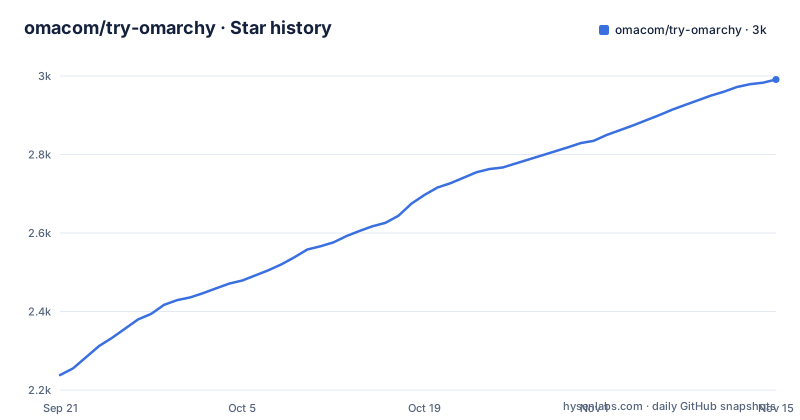
Star history
- omacom/try-omarchy2,991 ★ · +753
| Repository | 2026-09-21 | 2026-11-15 |
|---|---|---|
| omacom/try-omarchy | 2.2k | 3k |
753 Stars in the last 55 days, measured from the daily GitHub snapshot. Compare with other projects
Editorial analysis
Four of the nine highlights appear again in a section called not yet verified
The readme has a highlights list of nine items, and a separate short section near the end of the visible document with four lines in it.
That section says four things have not been exercised since the port: window resize across a display density boundary, Mac output-device switching in the middle of a session, the shared folder, and clipboard sharing.
Now put the two lists side by side. The highlights include a resizable native window with automatic guest resolution and display-density scale updates. They include Mac audio input and output selection inside the guest. They include an optional shared Mac folder that appears inside the guest under the same name. And they include two-way clipboard sharing for text and images.
So four of the nine things the readme leads with are four of the four things it says are untested. The document does not hide this, which is why it is worth reading in this order: the highlights tell you what the project intends to be, and the short section tells you how much of that it currently is.
For a user, the practical list is: the video and audio paths and the virtualisation are exercised, the graphics stack is exercised, and the windowing and clipboard edges are not.
The idle CPU number is measured, decomposed, and then partially disowned
This port publishes its measurements, which is rare, and it does something rarer: it explains why one of them is less trustworthy than the others.
The table is three rows. The emulator's share of a core at idle goes from about sixty-five percent to about fifteen. The host audio daemon's share, attributed to the virtual machine, goes from six point four percent to zero point three. The total goes from about seventy-one percent to about fifteen.
Then the paragraph that makes the table honest. The emulator figure moved twice: the interrupt work took it to about twenty-two percent, and clearing a graphics flag took it to about fifteen. The second measurement was taken on a freshly booted desktop rather than in the same session, so the split between the two improvements should be treated as approximate.
That is a contributor stating that their own decomposition came from two different runs, in a document where nobody asked them to. It is the single most credible sentence in the readme.
The mechanism behind the first improvement is equally specific. The emulator emulated the interrupt controller in userspace under a global lock, so every guest interrupt cost roughly four lock acquisitions and every inter-processor interrupt roughly five across two threads, and the cost grew with the number of virtual processors regardless of what the guest was doing. Moving that path out of the lock is where the twenty-two percent came from.
The emulator upgrade was forced, and the patch it replaced stopped being maintained
The component table gives exact revisions and dates for everything that changed, which is the opposite of an upgrade note that says we bumped a dependency.
The emulator goes from a revision dated January 2026 to one dated August 2026, and the stated reason is that the new release is the first to carry a particular interrupt-controller source file. The interrupt controller itself moves from a version emulated in the emulator's userspace to one provided by Apple's hypervisor framework, with the reason given as removing the interrupt path from the global lock.
And then the reason the upgrade was not a choice appears further down: under Apple's hypervisor, the new emulator rejects the old interrupt controller version outright. So the readme says this is now the only supported configuration rather than an optimisation. Two constraints forced the move, and both are named.
The graphics patch is a second story of the same kind. A patch set from another project, originally twenty-nine files, has been vendored and trimmed to eighteen and forward-ported, because that source has been unmaintained since a date in January 2026 and the emulator's display interface has since moved. The original archive is no longer fetched at all; the patch lives in the repository.
There is a third row worth reading for what it says about Python: the build dependencies are pinned to three specific wheels, because the new emulator builds one module from source and Python 3.12 dropped the packaging library from the standard installation.
A host audio device was opened to negotiate a format and never closed
The audio section describes a resource leak with a very specific shape, and it is the most satisfying bug in this repository.
Pausing an audio device turned out not to stop it, because the emulator links a compatibility layer over a newer audio library, and in that combination pausing a logical device leaves the physical one running. That alone would be a background cost. The worse part is which device was being held: not one opened for playback, but one opened at startup purely to negotiate a sample format, which nothing ever released.
So a physical audio device on the host stayed open for the entire life of the virtual machine, resampling silence, and the cost showed up in the idle measurement rather than as anything a user would notice. The readme's own table attributes part of the before figure to the host audio daemon.
Microphone capture was handled separately and more carefully, with the trade-off stated rather than hidden. Its initial device open is deferred until a guest application actually records, and the device is closed again when the capture stream stops. The consequence is that the first recording takes one device open longer to begin. And simply launching the application does not open the Mac microphone at all, which is a property worth having and worth checking.
A tracing guard left a dirty flag latched for the life of the machine
The graphics bug is a scoping bug, and the readme describes it in three sentences.
A vendored patch that adjusts guest display resolution cleared a dirty flag inside a conditional that only runs when graphics tracing is enabled. In a normal build, tracing is off, so the flag was never cleared. It latched true on the first damage event, and from then on the refresh function blitted the scanout on every tick for the life of the machine, whether or not anything had changed.
So a diagnostic-only guard turned a feature into a permanent redraw. That is the kind of bug that survives into a release because it does not look like a bug, and the readme's framing is accurate: the fix was to move the clear to function scope, which is where the statement's own comment said it belonged.
Two things make this section more useful than a bug list. The author says which patch the bug came from, so you can reason about whether other lines in it are suspect. And they note that clearing this flag is what took the emulator's idle share from about twenty-two percent down to about fifteen, which ties a graphics bug to a headline performance number.
Both halves are stated, and the readme is careful to say the split between the two improvements is approximate.
Two hypotheses were tried, and both were ruled out
The audio dropouts section is a short investigation report, and the negative results are the point.
The symptom is continuous underruns reported by the guest audio server, on a ring buffer 682 milliseconds deep, with the guest driver using 17 microseconds against a 42 millisecond deadline. The mechanism is that the emulator advances its emulated audio device position from a 100 Hz timer, so the counter jumps in coarse steps and the guest's audio library concludes it has missed.
The fix was to raise the guest's buffer quantum, which gives the emulated counter fewer and larger checks to satisfy.
Then the two things that did not work. Making the host-side buffer deeper made the problem worse, which rules out buffer depth as the cause. Raising the emulator's main loop to a higher scheduling priority changed nothing, which rules out priority inversion.
Read together those are two eliminations, and the second one matters more than the fix: a scheduling-priority hypothesis is the obvious first guess for audio glitches, and this author spent the experiment to disprove it rather than shipping the obvious answer.
It is also the only section in the readme where a component is measured in microseconds and milliseconds rather than in percent of a core, and it is the section that tells you the audio path is the least understood part of this port.
The graphics chain is drawn as a diagram, with two bundled drivers deliberately not in the path
The graphics section is the one place in this document with a complete diagram, and it is worth reading because it names what is not used.
The guest sees a virtual graphics device and needs no Apple-specific driver. Linux graphics commands go through a virtual device, cross the machine boundary, and are replayed as desktop OpenGL on the host, backed by the Apple Silicon GPU. Multisample support is preserved, using mutable multisample textures where the host lacks immutable multisample storage, which is what lets browsers create the contexts they need for default acceleration without browser-specific flags. Native Apple drivers pick integer vertex attributes automatically, with alpha and channel-order conversions done once.
Then the exclusions. Hardware video decoding and Vulkan remain unavailable. And two libraries are bundled but explicitly not on the display path: a translation layer whose Metal backend is not the default, and Mesa's Vulkan-to-Metal driver, which the readme notes is not part of this path. They are there because the upstream compatibility code imports them, not because the port uses them.
That last point is the one to carry into a dependency review: two graphics translation stacks are shipped inside the runtime so that upstream code will link, and neither is on the path your frames travel.
The one-line limitation above the highlights section is the practical summary of all of this: video decoding is CPU-only, so playback can be slow at high resolution, and an improved video path is in development.
The build file names a person and signs releases with their identity by default
The last thing worth reading is the build file, because it describes both the test surface and the release identity in the same twenty lines.
Nine shell test targets are enumerated by name, and they are contract tests against a running machine rather than unit tests: a network helper, the networking layer, port forwarding, and contracts for SSH, memory, power actions, USB passthrough, monitor readiness and persistent storage. For a virtualization port that is the correct test surface, because the things that break are the interfaces, not the functions.
The file also declares the default target as help, so running make with no arguments prints a command list rather than doing something. Build inputs are tracked, so the default build only rebuilds what changed and a forced flag rebuilds everything, and the test job count is a variable with a documented way to set it to one for debugging.
Then this: the release signing identity defaults to a named individual's Developer ID Application certificate, with the team identifier in the same line, and the notary profile defaults to a named profile. Those are the values a maintainer has to override to sign with their own certificate, and there is a variable for it. The development signing identity defaults to the word auto, and the help text says that path selects a stable development certificate for you.
The last configuration item is a build cache implemented as a Python script and a build state directory, so incremental builds have somewhere to record what they have already done.
Editorial conclusion
try-omarchy is the rare port whose readme is more useful than its feature list, and the reason is that it tells you which parts of the feature list have not been exercised. Read that section first: window resizing across a display density change, switching Mac output devices mid-session, the shared folder and clipboard sharing are all listed as highlights and all listed as unverified. The engineering is real, the measurements are published with their methodology caveats intact, and the emulator upgrade was forced rather than chosen, so the configuration is now the only one that works. Two things to check before you rely on it. Video decoding is CPU-only, so playback at high resolution will be slow. And the kernel source is being fetched from a mirror that the readme says should be reverted once the primary returns.
Frequently asked questions
What is try-omarchy?
A macOS application that runs the upstream Omarchy Linux desktop on an Apple Silicon Mac without installing Linux. It packages a project-built ARM64 Arch Linux image configured with the Omarchy setup, an emulator runtime using Apple's hypervisor framework, and a small Swift launcher into one app, with the guest image built from pinned packages and a pinned upstream revision.
What works in try-omarchy and what does not?
The readme keeps a section listing what has not been exercised since the port: window resizing across a display density boundary, Mac output-device switching mid-session, the shared folder, and clipboard sharing. All four also appear among the project's nine advertised highlights, so treat those four as intended rather than tested.
Does try-omarchy support hardware video decoding?
No. The readme states that video decoding is CPU-only, so playback can be slow at high resolution, and that an improved video path is in development. Vulkan is also unavailable, and the graphics path replays Linux graphics commands as desktop OpenGL on the host GPU.
How much CPU does the try-omarchy virtual machine use when idle?
The readme measures about sixty-five percent of a core before the fork's changes and about fifteen percent after, with the host audio daemon's share attributable to the machine falling from six point four percent to zero point three. The author notes the second measurement came from a freshly booted session, so the split between the two improvements is approximate.
Why did try-omarchy have to upgrade its emulator?
Because the newer emulator rejects the interrupt controller version it previously emulated in userspace, so the hypervisor-provided version is now the only supported configuration rather than an optimisation. The readme names the exact upstream revision and date that first carried the required support, and explains that the graphics patch it replaced stopped being maintained.
Is the try-omarchy kernel source fetched from somewhere unofficial?
The readme notes that a device-tree mirror should be reverted once the primary kernel source host returns, which means the build is currently reading that from a mirror rather than upstream. That line sits in the same short section as the unverified features.
Official sources
Add this badge to your README
If you maintain this project, the badge below links readers to this analysis and shows its maintenance status from the daily GitHub snapshot. Paste the markdown into your README; add ?metric=license or ?metric=stars to the image URL for a different field.

[](https://hysenlabs.com/projects/omacom-try-omarchy)Star history chart for your README
[](https://hysenlabs.com/projects/omacom-try-omarchy)Was this useful?