OpenSIPS SIP Server Configuration and Operations
OpenSIPS is a GPL implementation of a multi-functionality SIP Server that targets to deliver a high-level technical solution (performance, security and quality) to be used in professional SIP server platforms.
At a glance
- What is it?
- OpenSIPS is a C-based SIP server implementation intended for professional platforms. Its module-oriented repository supports varied server functions, but installation, deployment, and licensing decisions require checking the included documentation and license files.
- Who is it for?
- Adopt OpenSIPS when an engineering team specifically needs a configurable SIP server and can support its source-build and configuration model. Do not assume it is a lightweight SIP application or rely on GitHub releases for upgrades.
- Can I use it commercially?
- Check first. The repository uses a licence we do not classify automatically, so read its LICENSE file before any commercial use.
- Is it still maintained?
- Yes. The repository last received commits 1 day ago.
- What is it written in?
- Mainly C, according to GitHub's language statistics.
Answers come from the project's GitHub data, last synced on November 7, 2026, and from our analysis. They are not legal advice.
Star history
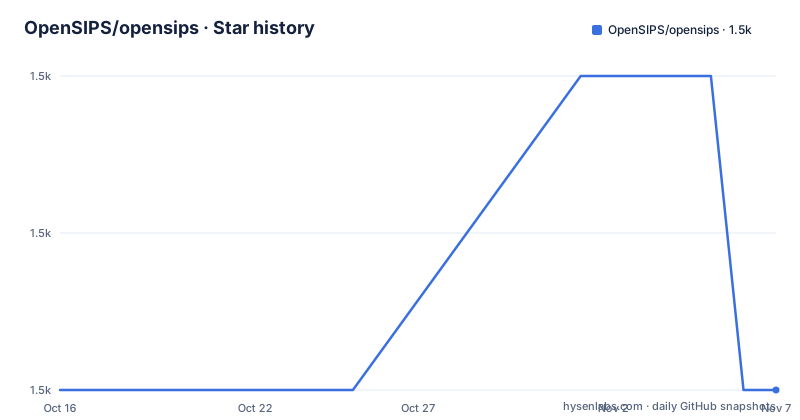
- OpenSIPS/opensips1,543 ★ · +0
| Repository | 2026-10-16 | 2026-11-07 |
|---|---|---|
| OpenSIPS/opensips | 1.5k | 1.5k |
0 Stars in the last 22 days, measured from the daily GitHub snapshot. Compare with other projects
Editorial analysis
OpenSIPS Targets Professional SIP Infrastructure
OpenSIPS addresses the need for a configurable SIP server implementation within professional server platforms. SIP is the signaling layer used to establish and manage sessions, and OpenSIPS places routing and related server behavior into a C codebase with a module structure. The intended audience is therefore not a developer who merely wants to send an occasional SIP request. It is an operator, telecom engineer, or platform integrator who needs to assemble a server around a particular signaling workflow.
The project originated as a fork of the Fokus Fraunhofer SIP Express Router, known in the README as SER. OpenSIPS states that the fork was intended to create a more open project in both licensing and project management, while shortening the path from a new feature to a release. That history matters during technical evaluation because it explains the relationship to an established SIP server design, but the README does not provide a feature-by-feature comparison with SER.
OpenSIPS is not presented as a hosted communications service or a closed appliance. The repository contains server source, build files, documentation directories, databases, module directories, and example configurations. This makes it suitable for teams that want direct access to the implementation and configuration, provided they are prepared for the operational complexity associated with a full SIP server.
OpenSIPS Routes Work Through a Modular C Architecture
Based on the repository layout, OpenSIPS separates its core server from functions organized into modules. The top level includes core C files such as `action.c`, `async.c`, `cmds.c`, and `context.c`. It also contains directories including `aaa/`, `cachedb/`, and `db/`, which indicate that accounting, cache database integration, and database support are separate areas of the codebase.
The repository also exposes configuration machinery through `cfg.lex`, `cfg.y`, `cfg_pp.c`, and `cfg_reload.c`. These filenames support a configuration processing and reload architecture, although the truncated repository listing does not document the grammar or the exact runtime reload procedure. It would therefore be unsafe to claim which directives trigger a reload or how running workers receive a changed configuration.
Module-based organization gives an integrator control over compiled functionality. The project provides a module listing and online documentation outside the root README, while each module directory is said to contain its own `README` file. This arrangement is useful when the required behavior maps cleanly to a documented module. It also creates selection work: the repository includes many functional areas, and the README does not identify a minimal recommended module set for a new installation.
Several operational concerns are visibly separate from the core. `bin_interface.c` suggests a management interface mechanism, `core_stats.c` covers statistics functionality, and `daemonize.c` relates to daemon behavior. `SECURITY.md` is also present at repository root. Their existence confirms that the code covers more than SIP request routing, but the README does not describe their configuration or security guarantees in enough detail to assess them as adoption criteria.
Building OpenSIPS Requires GNU Make and System Preparation
The README directs users to the repository's `INSTALL` file for installation instructions. No contents from that file are included here, so this review cannot provide a verified dependency list, compiler command, install prefix, or service initialization procedure. Adding commands such as `make`, `gmake`, or installation flags would risk presenting assumptions as supported instructions.
One build constraint is explicit in `Makefile`: GNU Make is required. The same file lists Linux, FreeBSD, SunOS, OpenBSD, and NetBSD among supported architectures. This is a broad compatibility statement in the build file, not evidence that every module or external integration builds on each platform. A candidate production host still needs validation against the selected configuration.
The examples directory offers several starting points for configuration work, including `examples/opensips-redirect-server-BRANCH.cfg`, `examples/opensips-redirect-server-BRANCH_2.cfg`, and `examples/opensips-redirect-server-CT.cfg`. The README also points to `examples/samples.md` and a templates directory. These files are more useful for a first review than an installation tutorial because the project documentation does not connect them to a verified sequence of build and startup commands.
For a first real use, begin by reading the relevant example and the documentation for every module it loads. Then check its module paths, database requirements, listening behavior, and routing assumptions against the intended deployment. That is a concrete review sequence, but the actual compile, install, and launch procedure must come from `INSTALL` and the module-specific documentation.
OpenSIPS Example Configurations Need Deployment-Specific Review
The redirect-server examples show that OpenSIPS can be evaluated through concrete configuration files rather than through a fixed application wizard. However, filenames alone do not establish the behavior of their directives, required modules, transport settings, or expected signaling results. The project documentation does not provide a walkthrough for these files in the README.
This is a real adoption constraint. A team must already understand enough SIP signaling to judge whether a route, transaction, branch, or contact transformation matches its intended topology. The documentation points to module `README` files and external resources for details, but it does not promise that copying one example will produce a production-ready service.
The examples should therefore be treated as reference configurations. Before using one, identify every included module, trace its references, and confirm that its assumptions match the target environment. The README does not document rollback behavior for configuration reloads, nor does it explain what happens if a worker fails during a reload. Those cases require direct testing against the selected build.
OpenSIPS also is the wrong choice when the requirement is a narrow client-side SIP utility, a ready-managed service, or a deployment that avoids source compilation and explicit module configuration. Its repository shape points toward a server platform assembled by an operator rather than a library imported into a small application.
OpenSIPS Differs from a Minimal SIP Application
A useful alternative is the SER lineage from which OpenSIPS was forked. That comparison has a concrete architectural basis: the README identifies OpenSIPS as a fork of the Fokus Fraunhofer SIP Express Router project. It does not, however, provide a current feature matrix, compatibility statement, or migration guide between OpenSIPS and SER.
The alternative approach in this case is an existing SER-derived deployment. Such a deployment may be more appropriate when its configuration, module set, and operating procedures have already been validated and OpenSIPS would introduce a separate platform without documented migration assurances. Choosing it on the basis of shared history alone would be inadequate because the README says little about present compatibility.
A packaged SIP appliance or managed SIP platform is another alternative, but only at the level of operating model. OpenSIPS exposes source code, build configuration, modules, and examples to the adopting organization. That visibility can support customization, while it also transfers responsibility for compilation, configuration, testing, security review, and operations. The relevant choice is therefore direct control versus operational simplicity, not a claim that one implementation has better SIP behavior.
OpenSIPS Licensing and Upgrade Signals Need Direct Inspection
The repository metadata classifies the license as a custom license that GitHub cannot classify and directs readers to the `LICENSE` file. The README instead calls OpenSIPS GPL licensed and points to `COPYING` for complete license information. Those statements make the license files the controlling source for an engineering and compliance review. This article does not interpret the license or provide legal advice.
For maintenance, the repository is not archived, and the last push was on 2026-10-16. That is recent activity, but it does not establish the stability of a particular configuration or module. The repository also has no GitHub releases. Operators therefore cannot infer an upgrade cadence from a listed sequence of GitHub release artifacts in the repository information.
The README names `[email protected]` for usage questions, `[email protected]` for contributions and bug reports, and `[email protected]` for alerts and updates. This provides concrete channels for asking about deployment behavior and update notices. The README does not state a support response time, compatibility policy for `master`, or procedure for upgrading an existing configuration.
Upgrade cost should therefore include more than replacement of binaries. Configuration review, module compatibility checks, testing of signaling behavior, and reconciliation of the `LICENSE` and `COPYING` terms remain project-specific work. The repository's workflow files include build, unit test, fuzzing, cross-platform, RTP.io, and Coverity jobs, but the README does not claim that any one module or deployment has passed those checks for a given change.
Editorial conclusion
Adopt OpenSIPS when an engineering team specifically needs a configurable SIP server and can support its source-build and configuration model. Do not assume it is a lightweight SIP application or rely on GitHub releases for upgrades. Before adoption, inspect the INSTALL file, select the required modules, review a relevant example configuration, and resolve the GPL licensing statements against the repository's COPYING file.
Frequently asked questions
What operating systems does OpenSIPS support?
The top-level `Makefile` lists Linux, FreeBSD, SunOS, OpenBSD, and NetBSD. The README does not state that every module and external dependency is supported on every listed system.
How do I install OpenSIPS?
The README directs users to the repository's `INSTALL` file. Its contents are not included in the project overview here, so verified installation commands cannot be supplied.
Where can I find documentation for an OpenSIPS module?
The README says each module directory contains a `README` file. It also points to the online module documentation and tutorials at `https://opensips.org/Resources/Documentation` and `https://opensips.org/Resources/DocsTutorials`.
Official sources
Add this badge to your README
If you maintain this project, the badge below links readers to this analysis and shows its maintenance status from the daily GitHub snapshot. Paste the markdown into your README; add ?metric=license or ?metric=stars to the image URL for a different field.

[](https://hysenlabs.com/projects/opensips-opensips)Star history chart for your README
[](https://hysenlabs.com/projects/opensips-opensips)Was this useful?