OpenTK's news stops in 2022 and its previews keep coming
The Open Toolkit library is a fast, low-level C# wrapper for OpenGL, OpenAL & OpenCL. It also includes windowing, mouse, keyboard and joystick input and a robust and fast math library, giving you everything you need to write your own renderer or game engine. OpenTK can be used standalone or inside a GUI on Windows, Linux, Mac.
At a glance
- What is it?
- A C# binding layer for OpenGL, OpenGL ES, OpenAL and OpenCL, where the news section's most recent entry is from 2022 while 5.0 preview releases keep shipping, the Linux build badge points at a retired domain, a strong-name key file sits in the root, and the requirements still list mobile platforms the body says were dropped.
- Who is it for?
- OpenTK is the right choice when you are writing C# and want OpenGL without maintaining a native binding yourself, since the metapackage pulls a modular package set and the GLFW based windowing and input work is already done. Two things to know before committing to it.
- Can I use it commercially?
- Check first. The repository uses a licence we do not classify automatically, so read its LICENSE file before any commercial use.
- Is it still maintained?
- Yes. The repository last received commits 31 days ago.
- What is it written in?
- Mainly C#, according to GitHub's language statistics.
Answers come from the project's GitHub data, last synced on November 15, 2026, and from our analysis. They are not legal advice.
Star history
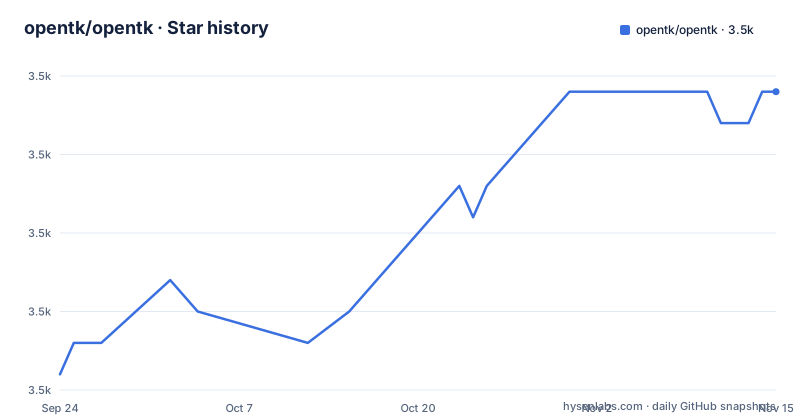
- opentk/opentk3,547 ★ · +9
| Repository | 2026-09-24 | 2026-11-15 |
|---|---|---|
| opentk/opentk | 3.5k | 3.5k |
9 Stars in the last 52 days, measured from the daily GitHub snapshot. Compare with other projects
Editorial analysis
The news section stops in 2022 while previews keep shipping
The most recent entry under News is dated 2022-09-24 and says OpenTK 5.0.0 is still under active development and usage, with preview releases running non-trivial applications successfully on .Net 6 across all platforms. That is the last word on the page, and everything older is a 4.x or 3.x announcement. The tags tell a different story. There are three recent releases, 5.0-pre.16 from 2026-05-17, 5.0-pre.15 from 2025-08-24 and 5.0-pre.14 from 2025-07-11, so the preview line has run to sixteen and still has no final 5.0, on intervals that range from a month to nine. The last commit to master is dated 2026-09-30, four months after the newest tag, so the branch is still moving without producing a new preview.
The build status row points at a retired domain and a personal account
The Build Status table has two rows. Windows points at `ci.appveyor.com/project/varon/opentk`, so the AppVeyor project lives under a personal account called varon rather than under the opentk organisation. Mono/Linux points at `travis-ci.org/opentk/opentk`, and travis-ci.org is the domain the service retired when it moved to travis-ci.com, so that badge is pointed at an address the company no longer serves. The tree backs up only half of the row: `appveyor.yml` is present at the root and there is no Travis configuration file among the top level entries. So one badge refers to a personal CI project, the other to a decommissioned host, and only one of the two has its configuration in the repository.
A signing key and three license files sit in the root
The root of the tree carries `OpenTK.snk`, which is a strong-name key file, alongside `LICENSE.md` and `THIRD_PARTIES.md`. A signing key checked into a public repository is the kind of artifact that is normally excluded from source control, and nothing on the page explains what it signs or whether it is meant to be shared. The licensing story needs the same reading. The repository's license field reports no recognised value, while a news entry from 2020 states that OpenTK 4.0.0 is entirely MIT licensed, and there are three separate files at the root to sort out: the license itself, a third party file for bundled dependencies, and the key. Read them rather than trusting the metadata.
The requirements list mobile platforms the body says were dropped
The Requirements section opens with Windows 7, 8 and 10, Linux, macOS, BSD, SteamOS, Android or iOS. Three sections earlier the page says something different about the last two: an old, unsupported version of OpenTK 1.0 may be included in the Xamarin Android and iOS distribution, and the Xamarin fork is not supported or maintained by this project. Adding support for mobile again is called a future goal, described as somewhat frustrated by Apple's deprecation of OpenGL, with contributions welcomed. So the same page lists Android and iOS as target platforms in one section while explaining in another that they were removed and are not coming back soon. The list also ends with an empty bullet, and it still names Windows 7.
The build instructions name build.cmd and build.sh, the root has build.ps1
There are two documented routes and neither matches the root of the tree exactly. The first is to clone and open the solution.
git clone https://github.com/opentk/opentk   # Download source code from git
cd opentk                                    # Enter the source directory
# open OpenTK.sln
That path needs Visual Studio 2019 or later. The alternative is a build script, described as `build.cmd` on Windows and `build.sh` elsewhere, which require .net 6, with a target selected by `./build.cmd -t <Target>`. What is actually at the top level is `build.ps1`, a PowerShell script, plus a `build/` directory, and neither `build.cmd` nor `build.sh` appears among the entries. So the scripts a contributor is told to run are not the scripts sitting next to the clone.
Four style configurations and a Paket lockfile
Style and analysis are configured four separate ways. `stylecop.json` and `stylecop.ruleset` are both present, which is two configuration formats for one analyser. `OpenTK.sln.DotSettings` carries the IDE side, and `.editorconfig` covers the general whitespace and editor rules, with a `.config/` directory for the tool manifest. Dependency management runs through Paket, with `paket.dependencies` and `paket.lock` at the root, while the contributing steps tell you to install the .Net Core SDK and the build script asks for .net 6. So three different statements about the toolchain appear within one page, and a contributor working from the contributing section alone will not know which of them is current.
Regenerating the bindings takes two Windows batch files
The root carries `update-bindings.bat` and `update-specifications.bat`, and those two names explain how the library stays current. The binding layer is generated from specifications rather than hand written, so an OpenGL or OpenAL revision lands by regenerating, not by editing a thousand declarations. The regeneration path is a pair of Windows batch files with no shell equivalent offered, which means updating the bindings on Linux or macOS is not something the repository documents. One more root script belongs to the same family: `install-opengl.ps1`, which sits next to the requirement that you have OpenGL drivers or a suitable emulator such as ANGLE. A binding library that ships a driver installer is telling you something about how often that step goes wrong.
One package became a metapackage of many
The 4.0.0 announcement explains the shape of the distribution: a total restructure of all packages into a modular system with a number of packages, where the OpenTK NuGet package is now a metapackage that will automatically download all of these for you. The same entry lists full support for .Net Core 3.1, a brand new GLFW based windowing system and a brand new GLFW based input system, and the removal of all platform specific backends. Earlier entries show the 3.x line splitting a second package out, with separate NuGet links for `OpenTK.GLControl` at 3.0.0, 3.0.1 and 3.1.0. One small oddity in the same list: two entries carry the date 2020-04-06, one announcing a 4.0.0 preview and the next announcing 3.2.0.
Editorial conclusion
OpenTK is the right choice when you are writing C# and want OpenGL without maintaining a native binding yourself, since the metapackage pulls a modular package set and the GLFW based windowing and input work is already done. Two things to know before committing to it. There is no 5.0 final: every recent tag is a pre-release, the last news entry on the page is from 2022, and the documented toolchain has moved on from the one those notes describe. And the licensing needs reading rather than trusting, because the repository metadata reports no recognised license, three license related files sit at the root, and one of them is a signing key.
Frequently asked questions
what is opentk
OpenTK is the Open Toolkit library, a fast, low-level C# binding for OpenGL, OpenGL ES, OpenAL and OpenCL, plus windowing, input and a linear algebra library. The page says it runs on all major platforms and powers hundreds of apps, games and scientific research, and can be used standalone or inside a GUI.
how to install opentk
As a NuGet Package. From OpenTK 4.8 the Visual C++ Redistributable 2015 is no longer required to run OpenTK 4 on Windows; earlier OpenTK 4 versions need OpenTK.redist.glfw >= 3.3.8.35 to remove that requirement. Building from source means cloning the repository and opening OpenTK.sln in Visual Studio 2019 or later.
Is OpenTK still being worked on?
The branch is moving: the last commit to master is dated 2026-09-30. What has not happened is a 5.0 release. The three newest tags are 5.0-pre.16, 5.0-pre.15 and 5.0-pre.14, and the most recent entry under News is dated 2022-09-24, saying 5.0.0 is still under active development.
Does OpenTK support Android and iOS?
Not currently, despite the requirements list naming them. The page says an old, unsupported OpenTK 1.0 may be included in the Xamarin Android and iOS distribution and that the Xamarin fork is not supported or maintained, and that adding mobile support again is a future goal, somewhat frustrated by Apple's deprecation of OpenGL.
What does OpenTK need to build?
Either Visual Studio 2019 or later to open OpenTK.sln, or the build script, described as build.cmd on Windows and build.sh elsewhere, which require .net 6 and accept a -t <Target> argument. The root of the repository carries build.ps1 and a build directory instead of those two names.
What are the alternatives to OpenTK?
The repository does not compare itself to anything. It names the four APIs it binds, OpenGL, OpenGL ES, OpenAL and OpenCL, claims OpenGL 4.6 and OpenGL ES 3.2 support, and lists the platforms it runs on: Windows, Linux, macOS, BSD and SteamOS, usable standalone or inside Windows.Forms, WPF, GTK+, Qt or VTK.
Official sources
Add this badge to your README
If you maintain this project, the badge below links readers to this analysis and shows its maintenance status from the daily GitHub snapshot. Paste the markdown into your README; add ?metric=license or ?metric=stars to the image URL for a different field.

[](https://hysenlabs.com/projects/opentk-opentk)Star history chart for your README
[](https://hysenlabs.com/projects/opentk-opentk)Was this useful?