OpenVidu's conferencing app lives in another repository, and the Platform claims LiveKit compatibility
OpenVidu Platform: self-hosted real-time video and audio for your apps, built on LiveKit and mediasoup
At a glance
- What is it?
- OpenVidu is a self-hosted WebRTC stack that ships two products from an ecosystem of four repositories. The conferencing app's own source is not here, four of the eight directories in this tree exist for testing, and the programmable half declares itself API-compatible with LiveKit, which raises the fair question of what the layer adds. The commercial edition is a paid deployment rather than a hosted tier.
- Who is it for?
- OpenVidu is a sound choice for an organisation that has decided it cannot send its conferencing traffic to a vendor, and the two products let you buy in stages: run the app first, and only reach for the SDKs when the app stops being enough. Three things to check before you commit.
- Can I use it commercially?
- Yes. Apache-2.0 is a permissive licence: you can use, modify and sell software built on it, as long as you keep its copyright and licence notices.
- Is it still maintained?
- Yes. The repository last received commits 2 days ago.
- What is it written in?
- Mainly TypeScript, according to GitHub's language statistics.
Answers come from the project's GitHub data, last synced on November 22, 2026, and from our analysis. They are not legal advice.
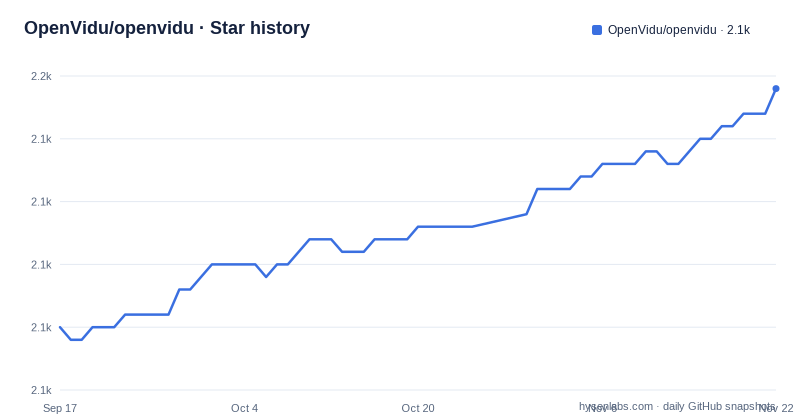
Star history
- OpenVidu/openvidu2,149 ★ · +19
| Repository | 2026-09-17 | 2026-11-22 |
|---|---|---|
| OpenVidu/openvidu | 2.1k | 2.1k |
19 Stars in the last 66 days, measured from the daily GitHub snapshot. Compare with other projects
Editorial analysis
The app you deploy is built from somewhere else
The repository tree explains what this project is and is not. There are eight directories: a documentation directory, an Angular web components package, a deployment bundle, a directory named for LiveKit, and four that exist for testing, covering browsers, end to end runs, integration and a test application. There is also a submodules file, a licence, a notice file and a contributing guide. The conferencing application that most people picture when they hear the name is not in this tree. The page links its source to a separate repository, and the deployment bundle here is the piece that assembles a running instance. So a team starting from this repository is starting from the integration layer and the tests, and the user-facing application arrives through a dependency rather than a directory.
Half the directories are test harnesses
Four of the eight directories in the tree are test related, and they are named for the layer they exercise: one for browser testing, one for end to end tests, one for integration tests, and one test application that the others drive. That is a high proportion for a stack whose page describes it as two products, and it says something specific about where the difficulty lies. Real-time media is easy to demo and hard to keep working, because a change in a signalling path or a codec negotiation breaks in ways no unit test sees. The product directory list in the page, by contrast, is short: recording, streaming egress through RTMP, AI agents for transcription and translation, and virtual backgrounds. A repository shaped around four test harnesses and one components package is a repository whose hard part is keeping a distributed system honest.
API-compatible with LiveKit, which asks what the layer adds
The most consequential sentence on the page is that the Platform is API-compatible with LiveKit, and that any LiveKit client or server SDK works unchanged. Read as a portability promise it is a strong claim: a team already holding a LiveKit integration is not describing itself as needing a rewrite. Read as a design statement it invites the harder question, because the page also names mediasoup as a foundation alongside LiveKit, so two separate real-time media projects are under the hood. Nothing on the page says which parts of the surface are OpenVidu's own rather than LiveKit's, and it gives no compatibility matrix, no version pairing between the OpenVidu release and the LiveKit release it tracks, and no migration note. For an evaluation, that gap is the thing to fill in with a test rather than with marketing copy.
The paid edition is a deployment, not a service
The commercial model is stated in one sentence and it is unusual. Both products are self-hosted only, on infrastructure you run yourself across four named cloud providers or on premises, and there is no hosted or software as a service tier. OpenVidu PRO is a paid self-hosted edition, and the team offers support and consultancy separately. So the paid product does not take the operational load off you, it sells you a supported build plus someone's time. That is a coherent position for a project whose users are organisations that cannot use a hosted tier anyway, and it is also the reason the page leans on a forum, a documentation site and an OpenCollective backers link rather than on a status page for someone else's infrastructure. The funding mix on the page matches: a European public grant named with its own project identifier, plus private sponsorship slots.
Releases every two or three months, branch three days ahead
The three most recent tags are v3.7.0 in May 2026, v3.8.0 in July and v3.9.0 at the end of September, so roughly sixty five and then eighty two days between minor releases. The default branch was last pushed on 2026-10-02, three days after the newest tag, which means the tree is barely ahead of what has shipped. That is the healthier end of the range for a WebRTC stack: a fast-moving dependency ecosystem underneath you makes a long gap between releases more dangerous than a short one, and this project is shipping on a two to three month minor cadence with a patch level that increments on every release rather than only on fixes. The page carries no stability statement, no support matrix per version, and no list of which LiveKit release each minor targets, so the version number alone does not tell you what you are running.
A grant with a different project name
The acknowledgements name a public funding source in unusual detail, down to a project identifier, a funder acronym, a DOI and a specific European programme. The project name inside that identifier is not the product name, which is common for European grants and worth knowing if you go looking for the deliverable documents. The money is acknowledged as support rather than authorship, and the sentence makes no claim about what the grant paid for beyond the platform itself. Alongside it the page carries an OpenCollective backers link, a sponsors link, and ten sponsor slots whose image anchors are all empty, so a reader sees the mechanism without the logos. What is absent is any statement of governance: no maintainer list, no decision process, no code of conduct file in the tree, only a contributing guide.
Two products, four repositories, two integration styles
Counting the repositories the page names gives four for the free side: this one, the conferencing application, a local deployment bundle, and a tutorials repository. The two products then split along integration style. The app requires no code at all: you deploy it and rooms, recordings, chat, screen sharing and moderation are there, with branding through your own name, logo and colours and per-participant feature control. It embeds by iframe or by a web component and is driven from your backend over a REST API with webhooks. The other product is the opposite: SDKs for building a custom application with low-level control over media, which is where the LiveKit compatibility and the choice of foundation actually matter. Choosing between them is the first decision, and it is a decision about who owns the user interface.
Editorial conclusion
OpenVidu is a sound choice for an organisation that has decided it cannot send its conferencing traffic to a vendor, and the two products let you buy in stages: run the app first, and only reach for the SDKs when the app stops being enough. Three things to check before you commit. Where your code will actually live, because the app you deploy is built from a different repository than the one most people clone, and the deployment bundle and the test harnesses here are the parts you inherit first. What the LiveKit compatibility claim means for your roadmap, since any LiveKit SDK working unchanged is either a strong portability story or a thin layer, depending on what you need. And what the paid edition actually is, because PRO is a self-hosted deployment with support attached rather than a managed service, so the operational burden stays with you either way.
Frequently asked questions
openvidu vs jitsi
The page positions OpenVidu Meet as an open-source alternative to Jitsi Meet, along with Zoom and Google Meet, and offers no feature comparison. Its own pitch is a self-hosted app needing no code, with branding and per-participant features configurable.
What is the difference between OpenVidu Meet and OpenVidu Platform?
Meet is a ready-to-use conferencing application that needs no code and can be embedded by iframe or web component. Platform is the client and server SDKs for building custom applications, built on LiveKit and mediasoup and API-compatible with LiveKit.
Does OpenVidu offer a hosted or SaaS version?
No. Both products are self-hosted only, on your own infrastructure. OpenVidu PRO is a paid self-hosted edition, and the team separately offers support and consultancy.
Where does the OpenVidu Meet source code live?
In a separate repository. This repository holds documentation, an Angular web components package, a deployment bundle, and four test related directories rather than the conferencing application itself.
Which advanced media features does OpenVidu support?
Recording, RTMP and streaming egress, AI agents for transcription and translation, and virtual backgrounds, according to the feature list shared by both products.
Official sources
Add this badge to your README
If you maintain this project, the badge below links readers to this analysis and shows its maintenance status from the daily GitHub snapshot. Paste the markdown into your README; add ?metric=license or ?metric=stars to the image URL for a different field.

[](https://hysenlabs.com/projects/openvidu-openvidu)Star history chart for your README
[](https://hysenlabs.com/projects/openvidu-openvidu)Was this useful?