LLM4AD automates algorithm design, and its setup.py grants research use with a mandatory citation
LLM4AD: A Platform for Algorithm Design with Large Language Model
At a glance
- What is it?
- LLM4AD is a Python platform that runs large language models against optimisation tasks, published on PyPI as llm4ad and BSD-2-Clause per its license field. The parts worth reading are the research-only notice in setup.py, the two dependency lists that do not match each other, and a git dependency with no version pin.
- Who is it for?
- LLM4AD fits a research group reproducing a paper or building a new search method on top of an existing harness, where the module layout of task, method, and tools.llm does most of the work for you. Three things to settle before you build on it.
- Can I use it commercially?
- Yes. BSD-2-Clause is a permissive licence: you can use, modify and sell software built on it, as long as you keep its copyright and licence notices.
- Is it still maintained?
- Yes. The repository last received commits 12 days ago.
- What is it written in?
- Mainly Python, according to GitHub's language statistics.
Answers come from the project's GitHub data, last synced on November 15, 2026, and from our analysis. They are not legal advice.
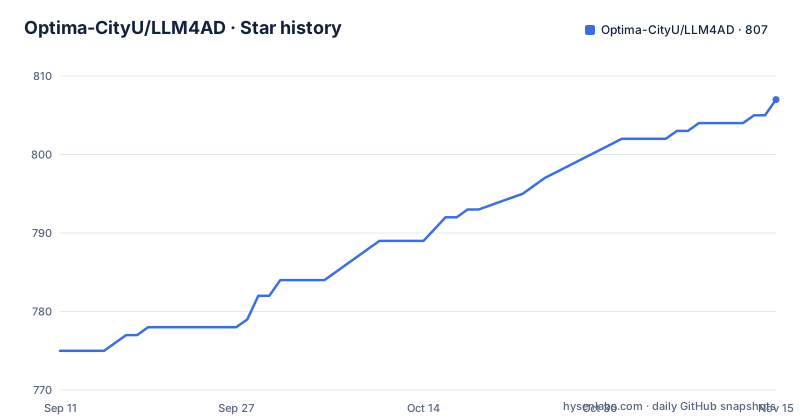
Star history
- Optima-CityU/LLM4AD807 ★ · +32
| Repository | 2026-09-11 | 2026-11-15 |
|---|---|---|
| Optima-CityU/LLM4AD | 775 | 807 |
32 Stars in the last 65 days, measured from the daily GitHub snapshot. Compare with other projects
Editorial analysis
BSD-2-Clause in the license field, research use in the setup.py header
There is a LICENSE file at the repository root and the project's license field reads BSD-2-Clause. The notice at the top of `setup.py` says something narrower. Permission is granted to use the platform for research purposes, and any publication, software, or other work that uses the platform or any part of its codebase must acknowledge the use of LLM4AD and cite a specific reference: the arXiv preprint 2412.17287, credited to nine authors from the Optima group. The same header adds a line about inquiries regarding commercial use or licensing, and points at `llm4ad.com/contact.html`.
Two different permission stories therefore sit in one repository, and the narrower one is the one you meet first if you read the build file before the license. Nothing here picks between them, and a commercial deployment should not rely on the SPDX identifier alone.
The same header is dated. It carries a last revision line of 2025/2/16, while the version string inside the same file is `1.0` and the only GitHub release is v1.0.0 from 2025-03-20.
Two dependency lists that install different environments
The package can be installed from a clone or from the index, and each path points at a different list of what gets pulled in:
$ cd LLM4AD
$ pip install .$ pip install llm4adA conda environment is suggested for both, and an `environment.yaml` sits at the root for that purpose. But the list in `install_requires` inside `setup.py` and the list in `requirements.txt` are not the same set.
`setup.py` requires numpy below 2, torch, tensorboardX, wandb, scipy, tqdm, numba, requests, openai, pytz, matplotlib, python-docx, ttkbootstrap, and the git URL for llamea. `requirements.txt` instead has numpy below 2.0.0, scipy, numba, requests, openai, tensorboard, wandb, pytz, pandas, pymoo, matplotlib, ttkbootstrap, codebleu, tree-sitter-python pinned at 0.23, gym, gymnasium, datasets, huggingface_hub, networkx, and llamea, with a commented-out langchain_ollama line.
So torch, tensorboardX, tqdm, and python-docx arrive with the package install and not with the requirements file, while pymoo, codebleu, tree-sitter-python, gym, gymnasium, datasets, huggingface_hub, networkx, and pandas arrive with the requirements file and not with the package install. The page also asks for everything in `requirements.txt` if you intend to use the GUI, which is the one place the two lists are meant to be combined.
One install requirement is a git URL on another repository's main branch
The last entry in `install_requires` is `llamea`, spelled as a direct reference to `git+https://github.com/XAI-liacs/LLaMEA.git@main`. `requirements.txt` carries the same repository twice: once as the bare package name `llamea` and once as the git URL with a trailing comment calling it a new method.
There is no version, tag, or commit in either reference, and `main` is a branch. That means the content your installation resolves is whatever the head of that branch was when pip read it, which makes an installed environment a function of a date rather than of a release. It also means the two installations of the same package can differ, since one comes from a clone at a moment you chose and the other from the index at a moment pip chose.
The rest of the dependency set is conventional by comparison: numpy is capped below 2, tree-sitter-python is pinned exactly at 0.23, and the optional pieces are named in prose rather than declared as extras, so a feature dependency can be missing from an environment that installed cleanly.
A platform for algorithm design that supports one programming language
The feature table is a two column list, and the second column is the useful part. Marked as supported are unified interfaces across methods, tasks, and LLMs, multiprocessing evaluation as an acceleration path, secure evaluation through main process protection and timeout interruption, local logs with wandb and Tensorboard support, a GUI covering method selection, task selection, convergence, and the best algorithm found, and resume for interrupted runs.
Three rows are marked as coming soon: support for other programming languages, more search methods, and more task examples. The first of those is the one to read carefully, because a platform whose purpose is generating algorithms is currently scoped to generating Python. The dependency list backs that up: codebleu as a code metric and tree-sitter-python as a Python parser.
The remaining rows say more search methods are planned, which means the method layer is meant to be extensible while shipping with a narrow set, and the example directory at the root is arranged the same way, with `llms`, `methods`, `others`, and `tasks` as separate folders.
The records belong to a method that ships inside the platform
The achievements in the news section are attached to the project, but the mechanism behind one of them is a specific method you import by name. The circle packing result is credited to EoH, which set a world record with a score of 2.63594 for 26 circles in 2025.6, and the more recent entry from 2026.02 reports a win in the CVRPLib best known solutions competition with 51 new best known solutions on large-scale vehicle routing benchmarks.
In code, EoH arrives as `from llm4ad.method.eoh import EoH, EoHProfiler`, and the profiler is constructed with a log directory and a log style, for example `EoHProfiler(log_dir='logs/eoh', log_style='simple')`. So the shape of the library is a method that proposes candidates, a profiler that measures them, and a task that supplies the problem and the evaluation.
That distinction is the one to keep in mind when reading a result. The platform is the harness that ran the search, and the record is a property of the method inside it, which is also why the coming-soon row for more search methods matters more than the number of tasks.
The news list stops in February 2026 and the tree moved in June
The dated entries run from 2024.10 through 2026.02: the survey online, v1.0 released, the paper released, tutorial appearances at EMO 2025 and CEC 2025, the circle packing record, the survey accepted by ACM Computing Surveys, and the best known solutions win. Nothing after 2026.02 is recorded there.
The tree kept moving after that. The last commit on the default branch is dated 2026-06-30, four months after the final news entry, and the release history holds a single tag, v1.0.0 from 2025-03-20. The version string in `setup.py` is `1.0`, hardcoded in the call to setup rather than read from the package, and the header comment in the same file is dated 2025/2/16.
So the public record is a single release, a build file that has not been touched since early 2025, and a changelog-shaped section that has not been updated since the start of 2026. The project has 784 stars, 103 forks, and 24 open issues, which is activity that the version history does not reflect.
The extras are named in prose, and one of them is known to conflict
The Python constraint is stated twice and is a real one: at least 3.9 and below 3.13, with the page using capital letters for emphasis, and `python_requires` reading `>=3.9,<3.13`. Anything on 3.13 or newer is outside the supported window.
What you add on top is a matter of which features you want, and each is named separately rather than declared as an extra: numba if you want the Numba acceleration path, tensorboard for the Tensorboard logger, wandb for the wandb logger, gym for the GUI and for machine learning tasks, pandas for science discovery tasks, and the full contents of `requirements.txt` if you want the GUI at all.
The gym line comes with a warning attached: the version may conflict with your own Python environment, and you are pointed at the gym documentation to pick an appropriate one. That is the honest framing for a platform that supports both an optimisation suite and a machine learning task suite in one package, and it is the piece of installation advice that costs the most time when it goes wrong.
The namespace is task, method, tools.llm, and the API is set in code
A run is assembled from three import paths. The problem comes from `llm4ad.task.optimization.online_bin_packing`, which supplies an `OBPEvaluation` object. The model comes from `llm4ad.tools.llm.llm_api_https`, which supplies `HttpsApi`. The search method comes from `llm4ad.method.eoh`, which supplies `EoH` and `EoHProfiler`.
The model is configured in code rather than through a config file or environment variable. `HttpsApi` takes a host, a key, a model, and a timeout, and the example sets the timeout to 20. The instructions before the snippet ask you to set the host to something like `api.deepseek.com`, the key to your own, and the model to something like `deepseek-chat` before running the script.
The task and method names both encode the algorithm family, which is why the example directory is split into `tasks`, `methods`, `llms`, and `others`, and why the documentation points at a Colab notebook for the online bin packing tutorial. Adding a task means matching what `OBPEvaluation` does, since evaluation acceleration, timeouts, and main process protection are all wired through that object.
Editorial conclusion
LLM4AD fits a research group reproducing a paper or building a new search method on top of an existing harness, where the module layout of task, method, and tools.llm does most of the work for you. Three things to settle before you build on it. The licensing, because the SPDX field and the LICENSE file at the root say BSD-2-Clause while the notice in setup.py grants research use, requires an acknowledgement and a citation to arXiv 2412.17287, and routes commercial questions to a contact page. Which dependency list you actually install from, since `pip install .` and `pip install -r requirements.txt` do not produce the same environment. And that one install requirement is a git URL on the main branch of another repository, so a `pip install llm4ad` today and the same command next month are not guaranteed to fetch the same code.
Frequently asked questions
What license is LLM4AD released under?
The license field reads BSD-2-Clause and a LICENSE file sits at the root, while the notice at the top of setup.py grants use for research purposes, requires publications to acknowledge LLM4AD and cite arXiv 2412.17287, and routes commercial inquiries to a contact page.
Which Python versions does LLM4AD support?
At least 3.9 and below 3.13, stated on the page and enforced by python_requires reading >=3.9,<3.13 in setup.py. A conda environment is suggested for both install paths, and an environment.yaml is present at the repository root.
What extra packages does the LLM4AD GUI need?
gym for the GUI and for machine learning tasks, pandas for science discovery tasks, numba for the Numba acceleration path, tensorboard for the Tensorboard logger, and wandb for the wandb logger. The page also warns that the gym version may conflict with your own Python environment.
How is the LLM configured in an LLM4AD run?
In code, through the HttpsApi constructor from llm4ad.tools.llm.llm_api_https, which takes a host, a key, a model, and a timeout, with timeout set to 20 in the example. The notes ask you to set a host such as api.deepseek.com and a model such as deepseek-chat before running.
Can LLM4AD be installed from PyPI?
Yes, pip install llm4ad, and pip install . works from a clone. One install_requires entry is a git reference to the main branch of another repository with no version pinned, so what the index install fetches depends on when you run it.
What results has LLM4AD reported?
The news section records a 2026.02 win in the CVRPLib best known solutions competition with 51 new solutions on large-scale vehicle routing benchmarks, and a 2025.6 world record in circle packing with a score of 2.63594 for 26 circles, credited to the EoH method.
Official sources
Add this badge to your README
If you maintain this project, the badge below links readers to this analysis and shows its maintenance status from the daily GitHub snapshot. Paste the markdown into your README; add ?metric=license or ?metric=stars to the image URL for a different field.

[](https://hysenlabs.com/projects/optima-cityu-llm4ad)Star history chart for your README
[](https://hysenlabs.com/projects/optima-cityu-llm4ad)Was this useful?