A curated 502-topic ML book whose contribution link still points at master
The AI Compendium, previously called the ML Compendium, curates resources and explanations of machine learning (ML) and deep learning, from a business problem through data, AI, engineering, and product.
At a glance
- What is it?
- orico/www.mlcompendium.com is an open GitBook of 502 machine learning and product topics kept as Markdown files, not a package you install. Its GitBook layout, its two parallel names and a stale branch link show how a private study document became a public site without losing the scaffolding of its first form.
- Who is it for?
- Adopt the AI Compendium as a map rather than a course: an engineer who already knows which part of machine learning to follow will find a dated, navigable path through 502 topics, while someone expecting runnable examples or measured results will find none here.
- Can I use it commercially?
- Not without permission. GitHub finds no licence file in the repository, and without a licence all rights are reserved by default: you may read the code but not reuse it. Check the README, or ask the authors, before using it.
- Is it still maintained?
- Yes. The repository last received commits 20 days ago.
- What is it written in?
- GitHub does not report a main language for this repository.
Answers come from the project's GitHub data, last synced on October 21, 2026, and from our analysis. They are not legal advice.
Star history
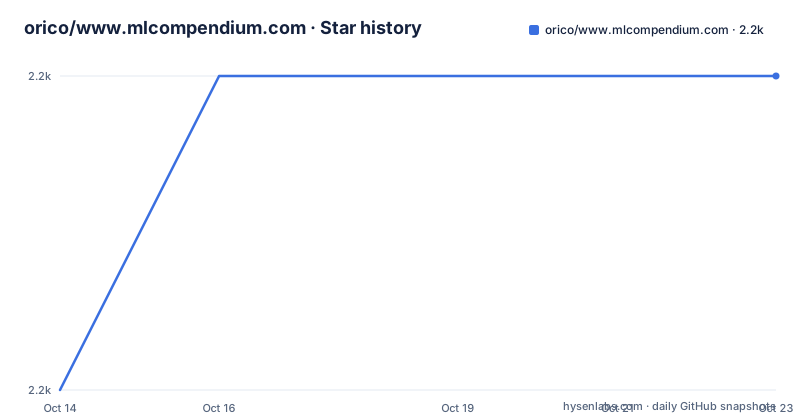
- orico/www.mlcompendium.com2,200 ★ · +1
| Repository | 2026-10-14 | 2026-10-21 |
|---|---|---|
| orico/www.mlcompendium.com | 2.2k | 2.2k |
1 Stars in the last 7 days, measured from the daily GitHub snapshot. Compare with other projects
Editorial analysis
No package to install, only Markdown files to read
There is no package manager entry and no command to run here. orico/www.mlcompendium.com is a book kept as Markdown files, images and a GitBook layout, so the README is a cover page rather than a setup guide. Stated scope runs to 502 topics, from modern machine learning algorithms and deep learning techniques through NLP, audio processing, classic and deep computer vision, time series analysis, anomaly detection and graph methods, then outward to data science management, team building, product management, design and technology stacks seen from a data science point of view. Three readers are named outright: an industry data scientist, an academic, and someone who has just started out. What all three receive is a curated path rather than instruction, since the content is summaries, links and articles attributed to the authors it references. That framing decides what the project can and cannot do for you later on.
Two root files hold the navigation spine and the sequence
Order comes from two files rather than from the folder names alone. `SUMMARY.md` sits at the top level as the navigation spine, while `start/introduction.md` holds the sequence itself, and the README defers to that page instead of reproducing it. The eighteen top-level entries divide into subject areas (`business-problems/`, `problem-framing/`, `data/`, `decision-intelligence/`, `predictive-ml/`, `deep-learning/`, `language-ai/`, `generative-ai/`, `evals/`, `responsible-ai/`) and delivery areas (`ops/`, `ai-engineering/`, `ai-product/`), alongside `appendix/` and the `.gitbook/` asset directory. `appendix/makeover.md` records one reorganization that has already happened, so the present ordering is a second version of a sequence that changed once. That history matters for anyone following an older link, because a chapter moved during that makeover now answers to a new path.
GitBook YAML keys switch the site chrome on and off
Presentation is configured by a GitBook YAML front matter block at the top of README.md, and every key in it concerns layout rather than content. Title and description are both set to `visible: false`, so the cover page carries no headline block, while the table of contents, the outline and pagination are switched on. Those three switches produce the sidebar, the nested chapter tree and the previous/next links that make a document this long usable.
---
layout:
  title:
    visible: false
  description:
    visible: false
  tableOfContents:
    visible: true
  outline:
    visible: true
  pagination:
    visible: true
---
No preview or build instruction accompanies the block, which is the practical limit of depending on a hosted renderer for structure.
The contribution link targets master while the branch is main
A stale branch name sits in the one place a new contributor will read. The closing part of README.md invites readers to contribute through a GitHub URL ending in `tree/master`, while the repository's default branch is `main`. Someone who copies that link has to repair the path by hand before opening a fork or a pull request. The same README opens with a plain repository URL carrying no branch segment at all, so two links to one repository disagree about how its tree is addressed.
Naming drifted in the same direction. The project now presents itself as the AI Compendium, and the README notes that it was previously called the Machine & Deep Learning Compendium and the ML Compendium, yet the repository is still orico/www.mlcompendium.com, the homepage is still www.mlcompendium.com, and the topic list still carries `mlcompendium` next to `machine-learning` and `deep-learning`. Older names survive in the plumbing after the cover page changed.
Craft folders and delivery folders answer to different job functions
The division between learning the craft and running the system is deliberate. The README says the book walks from a business problem through data, AI, engineering and product, and that the Ops half covers how you build, ship, govern and run the thing you built. In the tree, `ops/` and `ai-engineering/` stand apart from the algorithm folders and sit next to `ai-product/`, which is why someone chasing one modelling technique can skip half the index without missing anything relevant. `evals/` and `responsible-ai/` have no counterpart under a single algorithm heading either, and both sit closer to production concerns than to theory.
That breadth is also the bill. A reader after one method scrolls past directories written for another job function, and nothing in the tree distinguishes the deep treatments from the passing references, so the signal-to-noise ratio is only discoverable by opening files.
GitBook embed tags and an unstated provenance record
Provenance is thin in the files themselves. Content is a layer of summaries, links and articles built on other people's writing, which makes this an index with commentary rather than primary material; any individual summary has to be checked against its source, and the README names no review process for that check. Licence and version metadata are unstated: the repository carries no licence identifier, its primary language field is empty, and the GitHub release list is empty too. The last push was on 2026-09-26.
The site layer leaks as well. Body text uses GitBook template directives, for example:
{% embed url="https://github.com/orico/www.mlcompendium.com" %}A GitBook renderer expands that into an embedded card, while a reader on plain GitHub sees the template tag itself. Since no local build or preview command appears anywhere in the README, checking your own edit means pushing a branch and trusting someone else's renderer to show it.
Against the private Google document it replaced, and against runnable code
The obvious comparison is the private Google document this project started from, and the difference is structural rather than editorial. A private list is searchable for its author alone and invisible to everyone else, with no navigation spine, no assets directory, no commit history and no path a stranger can open. Moving the same notes into a repository with `SUMMARY.md` at the top and a GitBook layout turns one reader's filing system into addressable files, at the cost of needing merges and a renderer that most contributors do not run locally.
A second contrast is the code-first option: a repository of runnable notebooks or a library of model implementations lets a reader execute the method and inspect the output. This project cannot do that, because it ships text and hyperlinks. Its unit of value is the path between links, which pays off for a reader who already knows which branch of the field to follow, and pays nothing for a reader who needs to see a method run.
Editorial conclusion
Adopt the AI Compendium as a map rather than a course: an engineer who already knows which part of machine learning to follow will find a dated, navigable path through 502 topics, while someone expecting runnable examples or measured results will find none here. Before committing study time, open `start/introduction.md` to see the order, confirm that any repository link you followed resolves on `main` rather than `master`, and read the terms yourself, because the project points to no file that settles reuse.
Frequently asked questions
What does the ML Compendium actually cover?
The stated scope is 502 topics covering machine learning algorithms, deep learning techniques, NLP, audio processing, classic and deep computer vision, time series analysis, anomaly detection and graphs, plus data science management, product management and design. Content is summaries, links and articles attributed to their original authors.
Where do I start reading the AI Compendium in order?
The reading order lives in `start/introduction.md`, and `SUMMARY.md` at the repository root holds the navigation spine. `appendix/makeover.md` records a reorganization that already happened, so a chapter may sit at a different path than in older links.
Can I contribute to orico/www.mlcompendium.com?
The README points contributors at the GitHub repository and at the author's LinkedIn profile. Its GitHub link ends in `tree/master` although the default branch is `main`, so fix the path before opening a pull request.
Is the ML Compendium free and open to reuse?
The README states the project stays not-for-profit and free. The repository itself carries no licence identifier, so reuse terms are not settled by anything recorded there.
Official sources
Add this badge to your README
If you maintain this project, the badge below links readers to this analysis and shows its maintenance status from the daily GitHub snapshot. Paste the markdown into your README; add ?metric=license or ?metric=stars to the image URL for a different field.

[](https://hysenlabs.com/projects/orico-www-mlcompendium-com)Star history chart for your README
[](https://hysenlabs.com/projects/orico-www-mlcompendium-com)