GRASS has four build systems and two container files kept in sync by hand
GRASS - free and open-source geospatial processing engine
At a glance
- What is it?
- GRASS is a geospatial processing engine in C, hosted by a foundation and fiscally sponsored by a non-profit, with a 347 word front page carrying seventeen badges. The interesting parts are in the build files rather than the prose: a configure tree committed in generated form, a container definition pinned by digest, a spell checker skip list that doubles as a to-do list, and a licence stated two different ways.
- Who is it for?
- This is what a long-lived foundation project looks like from the inside, and the unglamorous files are the honest ones. The build tree commits its generated configure output so that a contributor does not need the autotools installed, the container pins its base by digest and tracks each geospatial dependency for automated updates, and the graph software interfaces are counted in Makefile directories rather than feature lists.
- Can I use it commercially?
- Check first. The repository uses a licence we do not classify automatically, so read its LICENSE file before any commercial use.
- Is it still maintained?
- Yes. The repository received new commits within the last day.
- What is it written in?
- Mainly C, according to GitHub's language statistics.
Answers come from the project's GitHub data, last synced on November 15, 2026, and from our analysis. They are not legal advice.
Star history
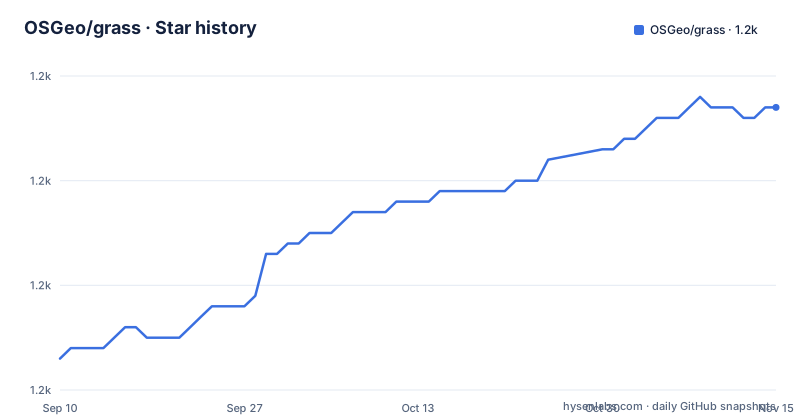
- OSGeo/grass1,187 ★ · +24
| Repository | 2026-09-10 | 2026-11-15 |
|---|---|---|
| OSGeo/grass | 1.2k | 1.2k |
24 Stars in the last 66 days, measured from the daily GitHub snapshot. Compare with other projects
Editorial analysis
Seventeen badges on a 347 word page
The first thing on the page is seventeen links, and then three paragraphs.
Most of those links are not for the person who landed on the page. A source code scanning service, an open source security scorecard viewer, a best practices compliance project, and a registry of research software that meets accessibility and reusability criteria: those four exist so that a funder, an institutional research office or a security auditor can look the project up. A package on a conda channel, a hosted notebook that builds this branch on demand, and a translation platform are for users. A DOI for citing the software, a community forum, a fiscal sponsor, and the host foundation are for everyone else.
Five of them are continuous integration workflows, each queried by the workflow's name: a C and C plus plus standards check, a Python code quality check, a general linting pass, an Ubuntu build and a Windows distribution build. So the badge row doubles as a build matrix, and it is the only place on the page that says the project is built on more than one platform.
What is missing from the row is the thing a user needs most, which is a version. The description section does not carry one either. A reader has to click through to a download page to find out which release they are looking at.
A build tree committed in generated form
The repository ships its build system in at least four shapes, and the oldest one is committed after generation.
There is a configure script, the automake input it came from, a generated macro library, and two generated helper scripts that guess the build platform and substitute values into it. Those last three are outputs a build system normally produces on the developer's machine and normally does not commit. Committing them is a deliberate choice, and the reason is a good one: a contributor can build the project without installing the autotools and without the right version of them.
The price is that the committed copies are only as fresh as the last time somebody regenerated them, and nothing on the front page says when that was.
Alongside that there is a CMake file and a package description template for pkg-config, a Nix flake with a lock file, a Vagrant file, a binder directory for hosted notebooks, and a plain Makefile at the root that does not generate anything and simply walks twenty two module directories in order. The Makefile's own header credits the original authorship as unknown, probably a European research consortium, then four named contributors, and carries a machine-readable licence identifier and a copyright range ending in the current year.
Two container files and an instruction to copy one into the other
The container definition is the most carefully maintained file in the repository and also the one with the most obvious hazard.
It pins its syntax directive and its base image by content digest rather than by tag, which is the right call and rarer than it should be. Then it takes the version of each geospatial dependency as a build argument, one per library: the geometry engine, the coordinate projection library, the raster library, the point cloud library, the bridge between the raster library and this engine, and the Python widget toolkit. Each argument carries a comment naming the update source, so an automated dependency tool knows where to look for new releases.
The hazard is in the third line of the file. It says the file must be kept in sync with a second copy under the docker directory, and that changes must be copied over to the other file.
That means a dependency update lands in one copy, a bot rewrites it, and a human copies it. The two files will diverge the first time somebody forgets, and nothing in the build will fail when they do, because both are valid container definitions that differ only in versions. It is also worth noticing what is a build argument and what is not: the graphical interface is a switch that defaults to off, so the default container is a processing engine with no desktop, and a block of compiler and linker flags is present but commented out, next to a question in the file asking whether those should be arguments at all.
The spell checker skip list is a to-do list
The Python tooling configuration is the most revealing file for how old this codebase is and how carefully it is being maintained.
It configures two tools. A formatter is pinned to an exact release, told to target four Python versions, and told to skip two specific directories, which are described in a comment as generated code. The spell checker gets an ignore list of about twenty words, most of them surnames and abbreviations that appear in author names and option names, and a skip list of about twenty five paths.
Look at what is in that skip list. A compiled object file inside the fonts directory, which is a build artefact that happens to live in the tree. Geodetic data tables. Translation catalogue files. An installer template. A package specification. Two files under the interpolated library that differ from each other by one character in the name, which is the kind of thing that makes a path list untidy. And vector image files, with a comment explaining that they carry embedded base64 data.
Eight of the entries carry a note saying they should be dealt with. In other words the skip list is a to-do list that got written down honestly instead of being quietly emptied. The same file carries an inline comment on the minimum Python version, saying it must be kept in sync with a version defined elsewhere in the source, which it therefore specifies twice.
The licence is stated two ways and recorded in neither
The page says the project is free and open source software available under the GNU General Public License, and links to a section of the licence text rather than to a specific version.
The build header says something more specific. Its machine-readable licence identifier names version 2 or later.
Those are different statements, and they matter to anyone who combines this code with other licensed code. The root of the repository holds a copying notice file and, separately, a file containing the licence text itself, so a reader can find the terms. The repository's own record, though, carries no licence value, which means the metadata a package index or an automated tool would read is silent.
This article does not pick between them, and it is worth being clear about why. A licence file is a grant and an identifier in a build header is a claim by whoever wrote that header, and where the two disagree only one of them has been signed by the copyright holders. Practically, an organisation doing a licence review has to read the text rather than the badge, and that is a five minute job that the front page could have saved everybody.
It is a small blemish on a project whose governance is otherwise unusually well documented, with a governance document at the root, a roadmap, a code of conduct, and a long-standing arrangement with a fiscal sponsor.
Twenty two directories are a better feature list than the page
The root Makefile walks twenty two module directories in a fixed order, and that list is the most complete description of the software anywhere in the repository.
There is a volumetric raster module alongside the ordinary raster one. There is a database interface module. There is a time series module, which is the temporal framework the page mentions in a single clause. There is an imagery module and a post scripting module. There is a general module holding the commands that are not data type specific. There are separate modules for vector and for miscellaneous programs. There is a user interface module, a visualisation module, a documentation module, a manual page module, a locale module, a scripting module for the language that drives all of it, and a Windows installer module sitting in the same build as everything else.
Two things follow. The first is that a multi-platform project is not aspirational here: the Windows installer is a directory in the build tree, and there is a continuous integration workflow named after that distribution.
The second is that the top level also holds a to-do file and a requirements document, both of which are the kind of artefact that outlives the people who maintain them. In a codebase this old, the requirements document is likely to be a better place to look for what is actually needed to build than any one machine's package list.
Translation is offered as a contribution with no coding required
The contributing section has two paths and the second is the interesting one.
The first is ordinary: join the developer discussion space, or open a pull request. The second is translations, through a web translation platform, with the note that no coding skills are required. For a project whose user interface has been translated into a large number of languages by volunteers, that is the mechanism, and calling it out on the front page is the kind of recruitment that actually works.
The build tree supports the claim. There is a locale module, translation catalogue files live in the repository, and the spell checker is explicitly told to skip those catalogues. So translations are tracked in the tree rather than in a separate service, and the tooling is configured around them.
The rest of the help section pairs a community forum with a link to commercial support offered by third parties. That pairing is deliberate rather than contradictory, and it is the standard arrangement for this kind of foundation project: the free route is the forum, the paid route is somebody else's business, and the project takes no part in the transaction.
What the page does not do, having done nearly everything else, is tell you which version you are reading.
Editorial conclusion
This is what a long-lived foundation project looks like from the inside, and the unglamorous files are the honest ones. The build tree commits its generated configure output so that a contributor does not need the autotools installed, the container pins its base by digest and tracks each geospatial dependency for automated updates, and the graph software interfaces are counted in Makefile directories rather than feature lists. Three things to check before you rely on it. Establish the licence version yourself, because the page and the build header say different things and a distributor combining it with other code needs the answer. Read the container sync comment before you bump a dependency, because the update bot touches one copy and a human copies it to the other. And decide from the twenty two module directories whether the engine covers your problem, since that list is a better description of the software than the page is.
Frequently asked questions
What is GRASS GIS?
It is a computational engine for raster, vector and geospatial processing, supporting terrain and ecosystem modelling, hydrology, data management and imagery, with a built-in temporal framework and a Python API. It can be used as a desktop geographical information system or as a processing engine from the command line, from Python or from R.
What licence is GRASS released under?
The page states the GNU General Public License and links to the licence text rather than to a version, while the root Makefile's header carries a machine-readable identifier naming version 2 or later. The repository ships both a copying notice file and a separate licence text file, and the repository's own record carries no licence value.
How do I build GRASS from source?
The repository ships a configure script and its generated build output, so a build does not require the autotools to be installed or regenerated. There is also a CMake file, a package description template, a top-level Makefile that walks 22 module directories, a Nix flake, a Vagrant file, a binder directory and a container definition. A separate requirements document sits at the root.
How is the GRASS container image pinned?
The container definition pins its base image by content digest rather than by tag, and takes the version of each geospatial dependency as a build argument with a comment naming the source an update tool should watch. The graphical interface is a build argument that defaults to off. A comment in the file says it must be kept in sync with a second copy under the docker directory.
What does the GRASS Python interface require?
The packaging configuration states Python 3.11 or newer and configures a formatter pinned to an exact release targeting four Python versions. The container definition sets 3.14 as its build argument, and an inline comment in the packaging configuration notes that the minimum version is duplicated elsewhere in the source and has to be kept in sync.
Official sources
Add this badge to your README
If you maintain this project, the badge below links readers to this analysis and shows its maintenance status from the daily GitHub snapshot. Paste the markdown into your README; add ?metric=license or ?metric=stars to the image URL for a different field.

[](https://hysenlabs.com/projects/osgeo-grass)Star history chart for your README
[](https://hysenlabs.com/projects/osgeo-grass)Was this useful?